Control Operations Including Removal of Damaged Trees to Be Completed by May
Precision Monitoring Also Underway
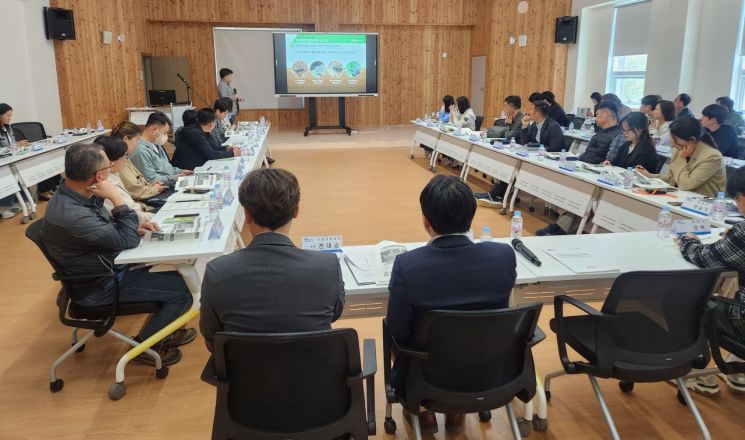 Jeollanam-do held a meeting of related agencies for the control of pine wilt disease on the 25th. Provided by Jeonnam Province
Jeollanam-do held a meeting of related agencies for the control of pine wilt disease on the 25th at the Forest Business Center of the Forest Research Institute, with more than 50 participants including representatives from the Korea Forest Service, Gwangju Metropolitan City, cities and counties within the province, the Korea Forestry Promotion Institute, and the Korea National Park Service.
The meeting included sharing updates on control operations by each agency in the Gwangju and Jeonnam regions, strengthening three-tiered precision monitoring using helicopters, drones, and ground patrols, promoting interregional cooperation for joint control efforts, and providing training on monitoring techniques.
By agency, Jeollanam-do plans to complete the removal of dead and damaged pine trees and conversion to alternative tree species for 90,000 trees, while Gwangju City will do the same for 20,000 trees, with a target completion date by the end of May. As of the 25th, 70% of this work has been completed.
In particular, in areas with severe damage such as Yeosu, Suncheon, and Jangseong, all damaged trees in repeatedly affected and clustered outbreak sites have been felled, and 60 hectares have been converted to forests with tree species better suited to climate change. Suncheon City is currently conducting a consent process with about 4,000 forest owners to implement phased tree species conversion starting in October this year for areas along the Namhae Expressway that have experienced concentrated damage.
To prevent the further spread of pine wilt disease, thorough monitoring after completing control operations by May is critical. Therefore, the Korea Forestry Promotion Institute, the Western Regional Forest Service, and the Korea National Park Service have pledged to designate responsible monitoring zones, ensuring there are no blind spots in monitoring areas such as the boundaries between cities, provinces, and national parks, and to conduct three-tiered precision monitoring using helicopters, drones, and ground patrols.
In addition, the Korea Forestry Promotion Institute provided expert training on the ecological characteristics of pine wilt disease and control methods, monitoring techniques, standard survey methods for outbreak hotspots, and the use of genetic diagnostic kits for pine wilt disease as part of proactive response efforts.
Each agency will complete monitoring of their designated responsibility zones by the end of August, based on the decisions made at the meeting, and will establish a pine wilt disease control strategy based on the results.
Kang Shinhee, head of the Forest Resources Division of Jeollanam-do, stated, "Pine wilt disease is not just a simple forest damage issue, but a forest disaster that threatens the balance of the ecosystem. Experts, related agencies, and the local community will work together to protect clean forests through regular monitoring and systematic control operations."
© The Asia Business Daily(www.asiae.co.kr). All rights reserved.












