Discussion on Strategies for the Preservation and Utilization of Cultural Heritage
Using the Vezere River Case as an Example
Gwangju Jeonnam Future Vision held a forum to discuss the global value of Paleolithic sites along the Boseonggang River, as well as strategies for their preservation and utilization.
Gwangju Jeonnam Future Vision announced on the 25th that, during an expert forum held the previous day, participants explored ways to preserve and utilize Paleolithic sites in the Boseonggang area by referencing the case of the V?z?re River in France.
 Participants of the forum "Paleolithic Culture and Global Value of the Bezeergang and Boseonggang Basins," held on the 24th at the Prima Art Hall in Gwangju Cheomdan, are taking a commemorative photo. Photo by Gwangju Jeonnam Future Vision
The forum highlighted the value of the Boseonggang River basin by comparing it with the V?z?re River valley (192 km) in the Dordogne region of France. The V?z?re River is home to 147 prehistoric sites, including the Lascaux Cave Paintings and Cro-Magnon sites, which preserve 400,000 years of human history and are protected as UNESCO World Heritage Sites.
In comparison, 85 Paleolithic sites distributed along the 120 km-long Boseonggang River?including the Suncheon Wolpyeong Site and the Jangheung Sinbuk Site?were also evaluated as key resources for reconstructing the lives and culture of Paleolithic people on the Korean Peninsula. In particular, the Boseonggang River basin is regarded as a space where the natural environment of the Paleolithic era is well preserved, allowing visitors to vividly experience traces of ancient human life.
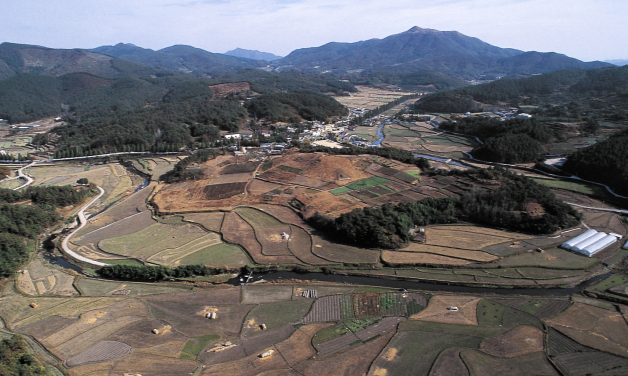 The appearance of Suncheon Wolpyeong Site, National Historic Site No. 458. Provided by Gwangju Jeonnam Future Vision
As a representative example, the Jangheung Bukgyori Sinbuk Site introduced at the forum yielded iron quartz, believed to have been used as red pigment, as well as obsidian tools originating from Mount Baekdu and Kyushu, Japan. These findings are important evidence not only of the aesthetic sensibilities of Paleolithic people but also of prehistoric exchanges between the Korean Peninsula and Japan. They are currently on display at the National Museum of Korea.
© The Asia Business Daily(www.asiae.co.kr). All rights reserved.













