European Commission to Announce 'Energy Decoupling from Russia' Roadmap Next Month
Breaking Away from Dependence on Russian Energy
Laying the Groundwork for Expanding U.S. LNG Imports
The European Union (EU) is pushing forward with plans to gradually reduce imports of fossil fuels from Russia. This move is intended both to lower the EU's dependence on Russian energy and to serve as a bargaining chip in tariff negotiations with the United States, as President Donald Trump has urged the EU to increase imports of American liquefied natural gas (LNG).
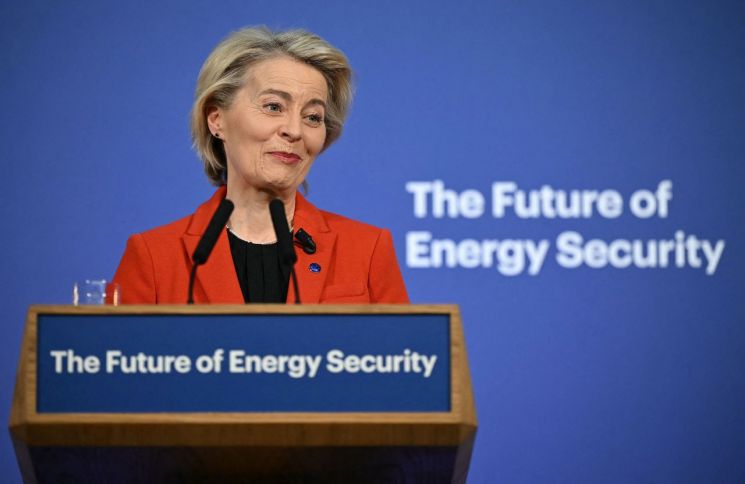
On April 24 (local time), European Commission President Ursula von der Leyen announced at the Future of Energy Security Summit in London that "within two weeks, we will unveil a roadmap containing concrete measures to phase out all imports of Russian fossil fuels." She emphasized that this is "to ensure we no longer depend on hostile countries (Russia) for our energy needs."
This roadmap centers on a complete halt to Russian fossil fuel imports by 2027. Its official release is expected on May 6. After the roadmap is announced, the EU plans to consult with member states and relevant companies to decide whether to pursue legislation. If a bill is introduced, it will require approval from both the European Parliament and the member states.
Just a few years ago, the EU relied on Russia for 45% of its natural gas imports, 50% of its coal, and about one-third of its oil. Currently, the share of Russian natural gas has dropped to 18%, and oil dependence has been reduced to one-tenth of pre-war levels. Von der Leyen also reported that coal imports from Russia have ceased entirely.
This shift occurred after energy supplies, including natural gas, became unstable following the Russia-Ukraine war. The EU responded by implementing the REPowerEU policy to transition to clean energy and diversify its sources. As a result of the war, Russian natural gas supplies to Europe via Ukraine were cut off. Combined with a cold snap, this drove European natural gas prices up to 49.6 euros per megawatt-hour (about 75,000 won) at one point, the highest level since the European energy crisis triggered by the Russia-Ukraine war in 2022.
The United States has capitalized on this gap. The U.S. is now the largest supplier of LNG to Europe. The share of U.S. LNG in EU imports rose from 23% in 2020 to 47% in 2023. For the American natural gas industry, the Ukraine war has guaranteed large volumes and high prices, making it a windfall. Through this process, the U.S. has overtaken Qatar and Australia to become the world's top LNG exporter.
Von der Leyen noted regarding gas supplies that "during the (energy) crisis, the United States immediately provided LNG, and Norway supplied additional gas via pipelines." She also said, "We have not forgotten that countries farther away, such as Japan and South Korea, have closely cooperated to ensure our immediate energy security." She emphasized that "the energy partnership, including imports of U.S. LNG, remains strategically important," a remark interpreted as a nod to the Trump administration's calls for the EU to increase LNG imports from the U.S.
The EU is also engaged in negotiations to resolve trade disputes with the United States and has publicly stated its willingness to discuss expanding imports of U.S. LNG as part of tariff talks. President Trump has continuously pressured Europe, insisting that it must buy more American energy to avoid tariffs.
Some observers question whether the EU's measures to shift energy demand from Russia to the U.S. and other countries will actually work. U.S. political media outlet Politico noted, "There are limits to what the EU can ultimately do," adding, "In the end, it is companies, not governments, that purchase LNG, and some EU countries are already having their domestic companies import as much U.S. LNG as possible." This means that even if the EU presents a roadmap, actual implementation will depend on individual countries and companies.
© The Asia Business Daily(www.asiae.co.kr). All rights reserved.












