Construction of West Coast Energy Expressway by 2030
Expansion to a U-shaped Korean Peninsula Expressway by 2040
No Mention of Funding Sources
If Burden Falls on KEPCO with 205 Trillion Won Debt, Public Will Ultimately Pay
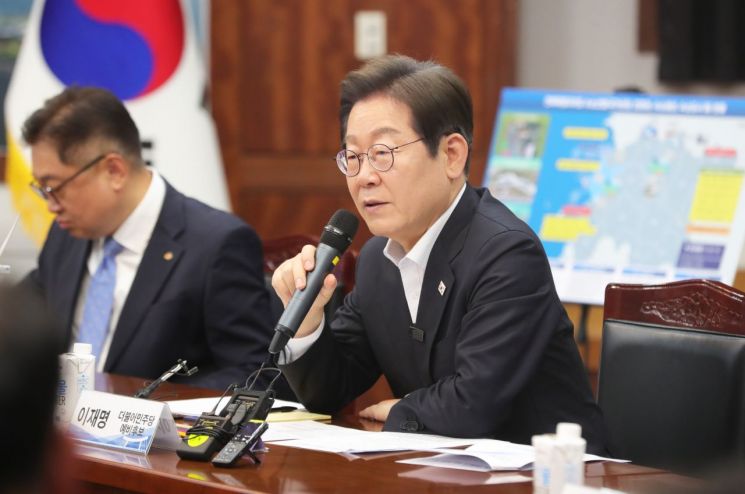 Democratic Party presidential primary candidate Lee Jaemyung is speaking during his visit to the Saemangeum33 Center in Jeonbuk on the morning of April 24, 2024. Photo by Yonhap News
Lee Jaemyung, a leading presidential primary candidate from the Democratic Party, announced his energy policy pledges on April 24. The core of his proposal is to expand renewable energy sources such as solar and wind power, and to build an "energy expressway" connecting the West Sea, South Sea, and East Sea to support this expansion. This pledge is interpreted as an effort to win the support of voters in regions rich in renewable energy resources ahead of the Honam regional primary scheduled for April 26.
Companies supplying power equipment related to the energy expressway pledge have welcomed the announcement. However, there was no specific mention of how the massive funding, expected to reach tens of trillions of won, would be secured. If Korea Electric Power Corporation (KEPCO), which is already burdened with 205 trillion won in debt, shoulders these costs, it will ultimately lead to higher electricity bills for the public.
On this day, Lee stated, "Through the energy expressway, we will achieve a leap forward in the Korean economy and balanced regional development," and added, "To respond to the climate crisis and achieve sustainable growth, we will expand renewable energy and establish a stable energy supply system."
Lee also cited data from the International Energy Agency (IEA, as of December 2024), noting, "Among the 38 OECD member countries, Korea's proportion of renewable energy generation remains at the lowest level." As of 2024, Korea's energy mix consists of nuclear power at 31.7%, coal at 28.1%, liquefied natural gas (LNG) at 28.1%, renewable energy at 9.5%, and new energy at 1%. Lee emphasized, "We must minimize the share of coal, gradually reduce LNG, and rapidly increase the proportion of renewable energy."
On this day, Lee particularly emphasized the energy expressway. He stated, "We will build a West Coast energy expressway by 2030," and added, "We will transmit 20 gigawatts (GW) of offshore wind power from the southern and western coasts to major industrial zones via a marine power grid, and with a target completion date of 2040, we will launch a 'U'-shaped energy expressway around the Korean Peninsula to establish a marine grid across the entire peninsula."
He proposed, "Through this project, we will connect the power grids of Honam and Yeongnam, link offshore wind power from the East Coast, and create a new energy paradigm for Korea."
This plan closely resembles the proposal introduced by the Democratic Research Institute, the Democratic Party's think tank, at the forum "The Role and Support Measures of Offshore Wind Power for Building a Renewable Energy Expressway," co-hosted by the Democratic Party and the Korea Wind Energy Industry Association at the National Assembly on March 17. It appears that Lee's campaign has adopted the Democratic Research Institute's proposal as an official pledge.
At the time, Bae Jiyoung, a research fellow at the Democratic Research Institute, presented the "Concept and Implementation Direction of the Energy Expressway," outlining five key design elements: ▲energy foundation works (grid stabilization facilities), ▲West Coast Expressway (HVDC-based marine grid), ▲energy rest areas (energy storage systems for grid congestion control), ▲inter-regional energy expressway connections (construction of long-distance transmission lines), and ▲local energy security (local production and consumption through distributed energy).
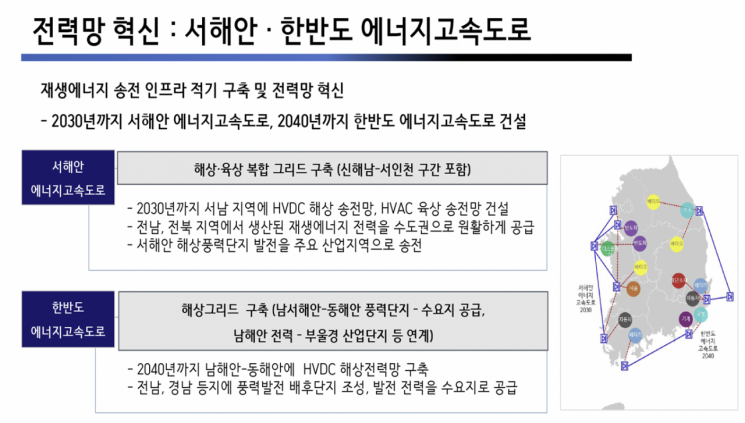 Concept of Energy Expressway proposed by the Democratic Research Institute. Screenshot of presentation materials from the forum "The Role and Support Measures of Offshore Wind Power for Building a Renewable Energy Expressway"
Specifically, the West Coast energy expressway plan calls for the construction of a high-voltage direct current (HVDC) offshore transmission network and a high-voltage alternating current (HVAC) onshore transmission network in the southwest region by 2030. This would enable the smooth supply of renewable energy generated in Jeonnam and Jeonbuk to the Seoul metropolitan area. Additionally, electricity produced at future expanded offshore wind farms along the West Coast would also be transmitted to major industrial complexes in the capital region.
The Korean Peninsula energy expressway envisions establishing an HVDC offshore power grid along the South and East Coasts by 2040. The plan includes creating wind power cluster complexes in areas such as Jeonnam and Gyeongnam and supplying the electricity generated there to demand centers.
On this day, companies supplying power equipment, such as cable manufacturers, expressed support for Lee's energy policy. A representative of the Korea Offshore Grid Industry Association stated, "We expect the related market to expand."
However, given that the construction of the West Coast expressway and the 'U'-shaped Korean Peninsula energy expressway is expected to require enormous funding, questions have been raised regarding the feasibility of the project. On this day, Lee did not provide specific details on how the funding would be secured.
Experts in the energy sector also agreed on the need to expand the power grid, but pointed out that securing funding and addressing the burden of electricity bills on the public remain key challenges.
Yoo Seunghoon, a professor at Seoul National University of Science and Technology's Department of Future Energy Convergence, stated, "Building the core elements of the energy expressway?renewable energy, power grids, energy storage systems (ESS), green hydrogen, and heat pumps?will require astronomical costs," and added, "There appears to be insufficient consideration of how to secure such funding."
The costs of building the power grid will be borne by KEPCO, and ultimately, these costs will be passed on to the public. As of the end of last year, KEPCO was saddled with 205.5 trillion won in debt and an accumulated deficit of 34.7 trillion won. Professor Yoo added, "To ensure feasibility, solutions to address the insolvency of these energy public enterprises must be presented first."
Jung Dongwook, a professor in the Department of Energy Systems Engineering at Chung-Ang University, stated, "Even the 10th Long-term Transmission and Transformation Facility Plan, which was established in connection with the existing 10th Basic Plan for Electricity Supply and Demand, projected power grid investment costs of 56 trillion won," and added, "A funding plan for the energy expressway, which is expected to require even greater costs, must be reviewed first."
© The Asia Business Daily(www.asiae.co.kr). All rights reserved.













