Victor Cha: "Difficult to Conclude South Korea-U.S. Tariff Deal Before Early Presidential Election"
"South Korean Government Faces Tight Deadline Before Tariff Suspension Ends"
"Next Administration to Have Limited Time for Negotiations"
"U.S. Forces Korea May See Expanded Strategic Flexibility"
"South Korea Risks Being Sidelined in Future Denuclearization Talks"
"North Korea's Support from China and Russia Weakens Sanctions' Effectiveness"
Victor Cha, Korea Chair at the Center for Strategic and International Studies (CSIS), said on the 23rd, "It will be difficult to reach a deal on the South Korea-U.S. mutual tariff negotiations before South Korea's early presidential election."
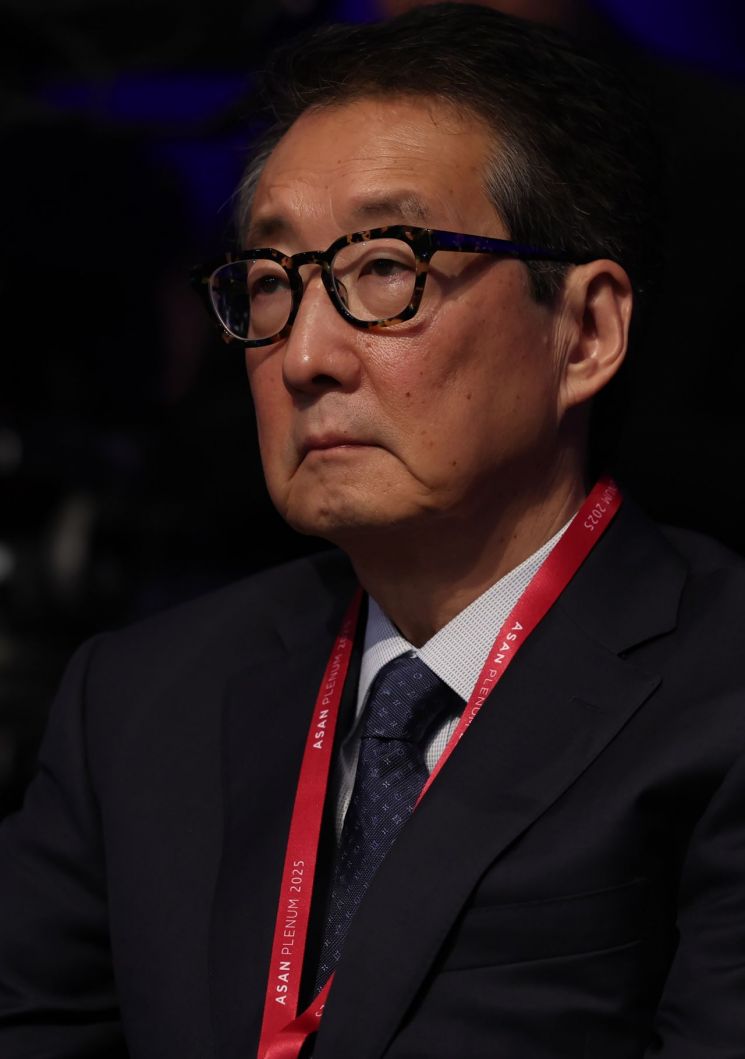 Victor Cha, Korea Chair at the Center for Strategic and International Studies (CSIS), attending 'Asan Plenum 2025' hosted by the Asan Institute for Policy Studies at the Grand Hyatt Seoul in Yongsan-gu, Seoul on the 23rd. Photo by Yonhap News
Cha made these remarks during a press conference at 'Asan Plenum 2025', which was held at the Grand Hyatt Seoul on the theme of '80th Anniversary of Liberation, 60th Anniversary of Korea-Japan Normalization of Diplomatic Relations.' He was responding to questions regarding the South Korea-U.S. tariff negotiations. He added, however, "Since the deal must be concluded before July 9, when the tariff suspension ends, the South Korean government is in a difficult situation."
The next South Korean administration will be inaugurated on June 4, the day after the presidential election. Considering the physical procedures required to form a cabinet, such as confirmation hearings, the new government will not have much time to negotiate the South Korea-U.S. tariff deal.
Cha also commented on possible changes such as a reduction of U.S. Forces Korea, stating, "The next South Korean administration will have to address the issue of strategic flexibility of U.S. Forces Korea again." He continued, "If the Trump administration's goal is to strengthen the deterrence of U.S. Forces Korea against China, then expanding the deployment of U.S. troops to Japan, Australia, the Philippines, Guam, Hawaii, and other locations would be the appropriate approach. The biggest change would occur on the Korean Peninsula." Ultimately, this suggests that the role of U.S. Forces Korea could become more 'flexible,' expanding beyond South Korea to regional conflict zones such as the Taiwan Strait. Cha emphasized, "It is not an exaggeration to say that such discussions between South Korea and the United States will take place soon," adding, "President Trump has previously stated that 'South Korea has sufficient self-defense capabilities.'"
Regarding the possibility that South Korea could be excluded from denuclearization discussions if a future North Korea-U.S. summit resumes, Cha said, "During the first Trump administration, it was only possible to meet Kim Jong Un (Chairman of the State Affairs Commission of North Korea) with the help of South Korea or China, but now the U.S. can speak directly without the help of other countries." He added, "This is a potential risk for South Korea, as it could be passed over."
However, considering that North Korea has received support from China and Russia, which has reduced the effectiveness of sanctions against North Korea, he added, "North Korea may not have a strong willingness to meet with the United States."
© The Asia Business Daily(www.asiae.co.kr). All rights reserved.