Lee Jae Myung Moves Coal Phase-Out Up by 10 Years
No Concrete Plans or Cost Details Provided
Germany Began Coal Phase-Out Before Korea
Up to 150 Trillion Won Needed by 2038
Retirement Pay for Workers and Compensation for Regions Required
"Plans Must Go Beyond Declarations and Become Legally Binding"
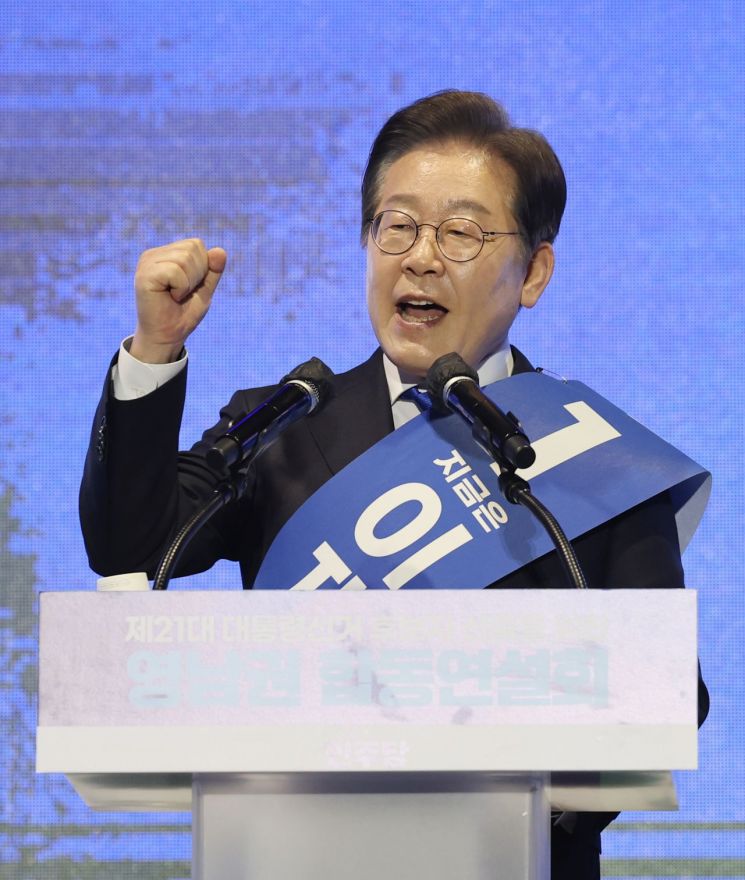
Lee Jae Myung, former leader and presidential primary candidate of the Democratic Party, has announced a plan to eliminate coal power generation by 2040. However, he did not discuss specific methods or how the necessary funds would be secured. The cost of phasing out coal is enormous, as demonstrated by Germany, which began closing coal power plants ahead of Korea and expects costs to reach as much as 150 trillion won. Environmental groups are also calling for more detailed and concrete plans, rather than just a declaration of coal phase-out.
On April 22, in recognition of Earth Day, Lee wrote on his Facebook page, "We will shut down coal power generation by 2040 and drastically reduce fine dust by expanding the supply of electric vehicles." His pledge to achieve coal phase-out by 2040 is ten years earlier than the Korean government's original plan. In 2021, under the Moon Jae In administration, Korea declared at the 26th Conference of the Parties to the United Nations Framework Convention on Climate Change (COP26) in Glasgow, United Kingdom, that it would eliminate all coal power generation by 2050.
The main issue is the cost. Lee did not mention any detailed plans or the required budget for coal phase-out.
German Coal Commission: "Phasing out coal by 2038 will require up to 93 billion euros"
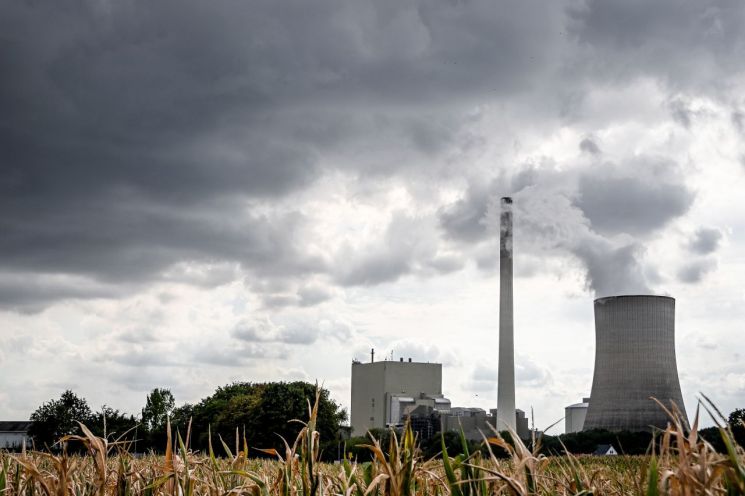 Uniper, Germany's largest energy company, operates the Heiden bituminous coal-fired power plant in Petershagen. Photo by Yonhap News
According to Germany's experience, where coal phase-out began earlier than in Korea, the federal government is expected to spend a total of 69 to 93 billion euros (approximately 112 to 151 trillion won) over more than 20 years. According to a report by the German Federal Government's Coal Commission, established in 2018 to facilitate coal phase-out, 5 to 10 billion euros are needed for compensation payments to coal power operators, and 5 to 7 billion euros are required for salaries for workers retiring as coal plants close. In particular, since shutting down coal power plants leads to a sharp rise in electricity prices, a budget of 16 to 32 billion euros must be allocated for price stabilization between 2023 and 2038.
In fact, after finalizing its coal phase-out plan, the German government has spent astronomical sums. In August 2019, a 40 billion euro spending bill was passed to fund the gradual closure of coal-fired power plants. Of this, 26 billion euros are used for federal programs, and 14 billion euros are allocated to revitalize the economies of North Rhine-Westphalia, Brandenburg, Saxony, and Saxony-Anhalt, regions where coal power plants are located. Operators participating in early closures are paid 165,000 euros per megawatt of facility capacity, with a total budget of 4.35 billion euros allocated for this purpose. Separately from the main budget, 2.6 billion euros are provided to power plants with severe pollution levels, and 1.75 billion euros are given as subsidies to power plants in eastern Germany.
Despite these efforts, there was fierce opposition from labor unions and local communities. Coal phase-out brings employment shocks and economic downturns to local areas. In 2018, when Germany began its coal phase-out, 32,800 people were employed in the coal power industry. Including related industries, the number exceeds 60,000, and with family members, it is estimated to be over 100,000. As a result, the German mining union IG BCE and the power plant union ver.di argued that coal phase-out before 2050 was impossible and that early closure of power plants was a direct attack on workers. North Rhine-Westphalia, Germany's largest coal-producing state, also opposed the coal phase-out process, claiming that compensation payments were insufficient.
Coal phase-out costs in Korea remain uncertain..."Plans must go beyond declarations and become legally binding"
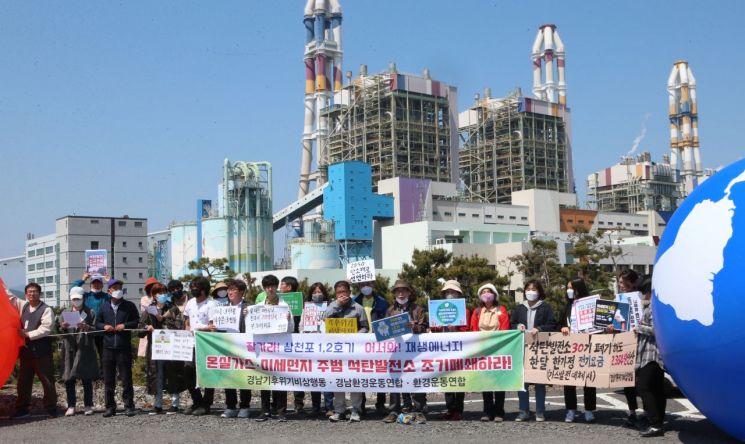 In 2020, environmental organizations in Gyeongnam, including Gyeongnam Climate Crisis Emergency Action and Gyeongnam Environmental Movement Federation, held a press conference on the 29th in front of the Goseong Samcheonpo Thermal Power Plant, urging the early shutdown of coal-fired power plants and shouting slogans. The photo is unrelated to the article content. Photo by Yonhap News.
The cost of coal phase-out in Korea remains uncertain. Unlike Germany, where the electricity market is privatized, most power plants in Korea are owned by Korea Electric Power Corporation, which is a positive factor. This means the compensation payments to private operators will not be as large. There are also no compensation payments needed for coal mines as in Germany, and the domestic coal power generation capacity is expected to decrease by about 19% by 2030 according to the Basic Plan for Electricity Supply and Demand, which is also advantageous in terms of cost. According to Climate Solution, the estimated cost of coal phase-out by 2030, considering these conditions, is about 6.6 trillion won.
However, the cost calculation has never included the budget required for workers and local communities. According to the Korea Labor Institute, based on the 10th Basic Plan for Electricity Supply and Demand, if coal-fired power plants are closed, 16,000 jobs will be lost by 2030 compared to 2019. Early retirement payments, compensation, and reemployment support costs must be provided for these workers. The local economy will also suffer significant damage. The Korea Research Institute for Human Settlements has stated that closing units 1 to 4 of the Dangjin coal power plant would reduce the region's gross regional domestic product (GRDP) by 2.3349 trillion won. If the budget for revitalizing the economies of coal phase-out regions is included, the total cost will increase astronomically.
Environmental groups also agreed that specific plans and funding sources must be presented. Kwon Kyunglak, an activist at Plan 1.5, said, "The term 'coal phase-out' has never been included in the Basic Plan for Electricity Supply and Demand or in government policy," adding, "Now is the time when efforts to reflect it in legally binding plans are more important than declarations." Lim Jaemin, secretary general of the Energy Transition Forum, said, "It is also important to determine what energy source will replace coal," adding, "Nuclear power or liquefied natural gas (LNG) will cause other environmental problems."
© The Asia Business Daily(www.asiae.co.kr). All rights reserved.














