A team of Korean researchers has succeeded in extending the fluorescence wavelength of 'Flavin' into the near-infrared range.
Flavin is a coenzyme involved in energy production and biochemical reactions within living organisms, and it is also a fluorescent molecule that emits light of specific colors. However, natural flavins mostly emit light only at short wavelengths in the blue to green region, making it difficult to extend their range into the infrared spectrum until now.
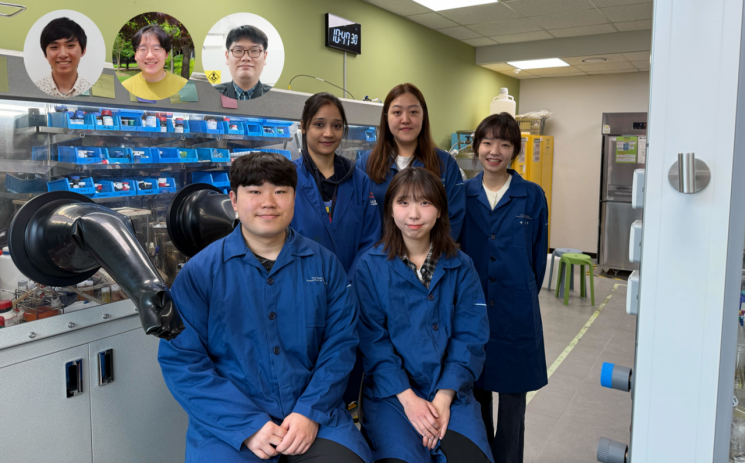 Members of the research team led by Professor Yoonjung Baek, who succeeded in designing the wavelength of 'Flavin' light, are posing for a commemorative photo. Provided by KAIST
KAIST announced on April 23 that the research team led by Professor Yoonjung Baek from the Department of Chemistry has developed, for the first time in the world, a 'pentacyclic flavin molecule' with a five-ring structure capable of emitting light in the near-infrared range.
First, the research team expanded the core structure of flavin from the traditional three-ring structure to five rings and introduced heteroatoms such as oxygen and sulfur. By doing so, they proposed a new synthetic strategy that allows for precise control of the molecule's electronic structure.
In particular, the newly developed molecule can emit deep red light close to the infrared region as well as light in the near-infrared spectrum. This expands the range of colors that conventional flavin pigments can produce.
As a result, the structure containing sulfur emitted light in the near-infrared region at 772 nm (nanometers), which is the longest wavelength ever reported among flavin derivatives. Most notably, this molecule exhibits quasi-reversible oxidation characteristics, which are rarely observed in conventional flavins, making it a multifunctional molecular platform with electrochemical functionality.
The research team emphasized that by finely tuning the molecular structure, they are now able to design how the molecule absorbs and emits light as desired. They also demonstrated that it is possible to simultaneously control the molecule's ability to transmit or convert electrical signals.
This research is significant in that it overcomes the limitations of conventional flavins by altering the wavelength of light, thereby suggesting the potential to expand the scope of applicable technologies and applications. For example, light with long wavelengths such as near-infrared (NIR) can be used to accurately diagnose and treat deep areas within the body, and it is possible to design pollutants or toxic substances to respond to specific wavelengths of light.
In addition, the research team proposed a new platform that enables precise control of emission wavelength and electronic properties, such as converting absorbed long-wavelength light into eco-friendly energy.
Professor Yoonjung Baek said, "The ability to change the light wavelength of flavin means that we can freely design and utilize light to suit any situation we desire. This will serve as a game-changing foundational technology in numerous fields where light-based technologies are applied, including medicine, environment, and energy."
This research was supported by the 'Excellent Young Researcher' program under the Individual Basic Research Project funded by the Ministry of Science and ICT, as well as the 'Materials and Components Development Project' funded by the Ministry of Trade, Industry and Energy. The research results were also introduced in 'Nature Communications' on April 15.
© The Asia Business Daily(www.asiae.co.kr). All rights reserved.











