The First "Transition Growth" Policy of the Last Presidential Election
Not Included in This Election's Policy Statement
Strategic Judgment Considered in Policy Withdrawal
The key change in the climate and environmental policy of former Democratic Party leader and current presidential candidate Lee Jaemyung, compared to his pledges during the 20th presidential election, concerns the sale of internal combustion engine vehicles. Analysts suggest that the omission of a ban on internal combustion engine vehicle sales from the 21st presidential election policy statement is closely related to a shift in policy focus from fairness to growth.
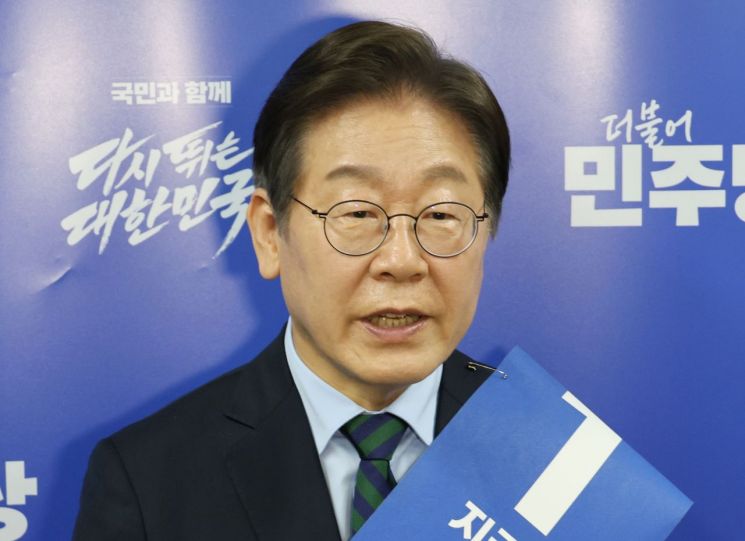 Former Democratic Party presidential candidate Lee Jaemyung is conducting a Q&A session with reporters at the "Chungcheong Region Joint Speech Meeting" on the 19th. Photo by Yonhap News
A senior official from Lee Jaemyung's presidential campaign explained in a phone call with Asia Economy on the 23rd that the reason for excluding the pledge to ban the sale of internal combustion engine vehicles is "the issue that hybrid vehicles are included as internal combustion engine vehicles," adding, "We need more internal discussion on this matter."
This pledge was the first policy in the "Transition Growth" series during the 20th presidential election. At that time, Lee held a press conference under the theme "Turning the Climate Crisis into an Opportunity for Growth," declaring, "We will accelerate the era of eco-friendly future vehicles such as electric and hydrogen cars, aiming for zero energy imports in the transportation sector."
Specifically, he proposed to halt domestic sales of internal combustion engine vehicles by 2040, expand and systematize subsidies for the purchase and conversion to zero-emission vehicles, convert the current low-emission vehicle supply target system into a mandatory zero-emission vehicle sales system, and provide increased financial support, retraining, and employment assistance for parts companies transitioning from internal combustion engine vehicles to new technologies or industries, thereby ensuring job stability.
However, in the climate and environmental policy statement for the 21st presidential election, while the policy to phase out coal power plants by 2040 was maintained, the transition to zero-emission vehicles was scaled back to "drastically reducing fine dust by expanding the supply of electric vehicles." This policy shift is analyzed as a strategic decision made with consideration for the domestic automobile industry.
If a ban on the sale of internal combustion engine vehicles is implemented, domestic automakers would inevitably be affected. Last year, the total number of newly registered vehicles was 1,646,000. By fuel type, there were 686,000 gasoline vehicles, 129,000 diesel vehicles, 161,000 LPG vehicles, 512,000 hybrid vehicles, 147,000 electric vehicles, 4,000 hydrogen vehicles, and 7,000 others (such as trailers). Eco-friendly vehicles such as electric and hydrogen cars accounted for only 151,000 units, representing just 9.1% of all new registrations.
Although Lee Jaemyung will remain a preliminary presidential candidate until the official announcement on the 29th, he is already presenting pledges that are effectively equivalent to those for the main election. Some have criticized the changes from his previous pledges as "unexplained withdrawals."
On the 18th, campaign chairperson Yoon Hojoong commented on the announcement of pledges during the primary, saying, "Unlike in typical presidential elections, as you know, there are only 45 days left until the election," and added, "The campaign period is so short that it is difficult to separate pledges for the primary and the main election. That is why we are announcing main election pledges from the primary stage."
© The Asia Business Daily(www.asiae.co.kr). All rights reserved.












