Court: "May Add About 10 More Sessions"
Second Hearing: Military Officers and Yoon's Team Clash
Kim Hyungki: "I Do Not Pledge Loyalty to Individuals"
Yoon Given Floor: "Martial Law Is Like a Sword; Using a Sword Should Not Be Equated with Murder"
The criminal trial of former President Yoon Sukyeol on charges of rebellion will be held at least 28 more times by the end of the year. At the second hearing held on April 21, the Criminal Division 25 of the Seoul Central District Court (presided over by Chief Judge Ji Guyon) announced this year's trial schedule. The court originally notified both parties that it planned to schedule 46 additional hearings, but after Yoon's legal team requested the exclusion of 18 dates, it was decided that there will be 28 hearings until the end of the year. This amounts to about three to four hearings per month. The court also stated that it may add another 10 or so dates, indicating that the trial is expected to continue into the next year.
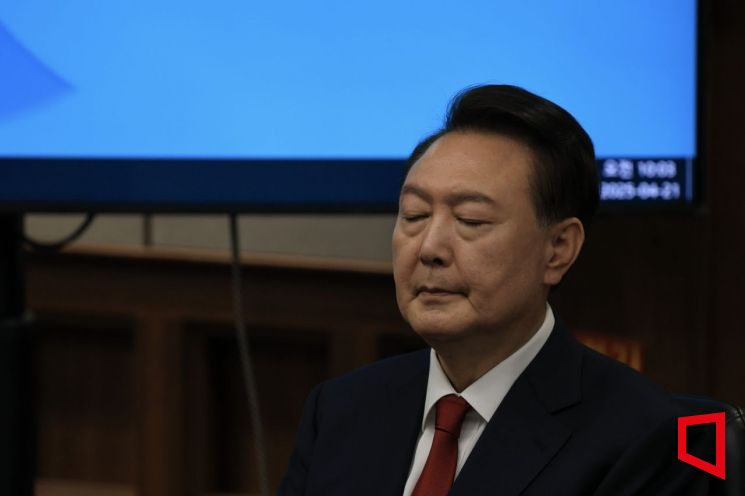 Former President Yoon Sukyeol is attending the second formal trial on charges of leading a rebellion at the Seoul Central District Court in Seocho-dong on April 21, 2025. Photo by Joint Press Corps
During the April 21 hearing, military officers called as witnesses engaged in heated exchanges with Yoon's defense team. Cho Sunghyun, commander of the 1st Security Battalion of the Capital Defense Command, testified, "Lee Jinwoo, the commander of the Capital Defense Command, ordered us to 'enter the National Assembly premises and control access to the building.'"
When Yoon's legal team asked Commander Cho, "It has been said that there was an additional order to remove everyone from the premises. In this context, does 'everyone' refer to lawmakers or to civilians?" he responded, "There were no individuals other than lawmakers." Kim Hyungki, commander of the 1st Special Forces Battalion, also stated, "Lee Sanghyun, commander of the 1st Airborne Brigade, relayed to me that Kwak Jonggeun, the Special Forces Commander, had been told by the President to 'remove lawmakers from the building, even if it means breaking down doors and smashing windows.'"
At the end of his testimony, Commander Kim requested to address the court, saying, "There is something I must say." He continued, "I have served in the military for 23 years, and one thing that has never changed, in the past or now, is the duty to protect the nation and its people. I do not pledge loyalty to individuals. I have been loyal to the organization, and that organization is tasked with protecting the nation and its people." By referencing a statement Yoon made during a National Assembly audit when he was a prosecutor investigating the National Intelligence Service comment scandal, Kim was expressing his own position.
Throughout the trial, former President Yoon showed no change in expression, but as Commander Kim made his remarks, Yoon fixed his gaze on him. Commander Kim then added, "To ensure that our military is never again used as a political tool, I ask those sitting behind me (the reporters) to keep a watchful eye on our armed forces."
At the end of the trial, former President Yoon was given an opportunity to speak. He stated, "Martial law is like a sword. Just because a sword is used, it should not be automatically equated with murder in a simplistic manner." He further argued, "It must be determined whether martial law actually destroyed the democratic constitutional order, and whether it has been proven to be a long-term dictatorial coup for personal power." This reiterated his argument from the first hearing held on April 14, where he stated, "Martial law is, in itself, a value-neutral legal instrument."
Yoon also said, "If the court focuses solely on the legal theory and logic of rebellion, there would be no need to examine witnesses," for which he was cautioned by the court. The court responded, "The court has a clear understanding of the substantive legal principles of rebellion. If the defendant and his counsel have doubts about this, they are mistaken."
© The Asia Business Daily(www.asiae.co.kr). All rights reserved.












