Hundreds of Pigeons Flock to Malsi Intersection in Geumcheon District,
a Hotspot for Repeated Complaints
"Young man, if you stand there, you'll get hit by pigeon droppings..."
 Hundreds of pigeons are gathered in flocks on utility poles and power lines near Malsi Intersection in Geumcheon District, Seoul. Photo by Byun Seonjin
At around 4 p.m. on April 24, while waiting for the traffic light at a crosswalk near Malsi Intersection and the livestock market in Geumcheon District, Seoul, a man in his seventies sitting on a nearby bench spoke to this reporter. Looking up, there were hundreds of pigeons gathered on the power lines and utility poles overhead.
Kim Hyunjae (29), a resident of Doksan-dong, said, "Since I moved here earlier this year, I've been hit by pigeon droppings more than once without even realizing it," adding, "These days, I deliberately walk on the opposite sidewalk." An official from the Geumcheon District Office said, "For several years, we've repeatedly asked a middle-aged woman who regularly feeds the pigeons not to do so," but added, "There is nothing the local government can do to stop the act of feeding itself." The Geumcheon District Office estimates that around 150 to 200 pigeons inhabit the power lines and utility poles near Malsi Intersection.
Local governments are struggling to deal with the increasing flocks of pigeons in urban areas. One of the main reasons for the rise in pigeon numbers is that people feed them. However, since there is no effective way to prevent this, citizens continue to suffer damages and file complaints.
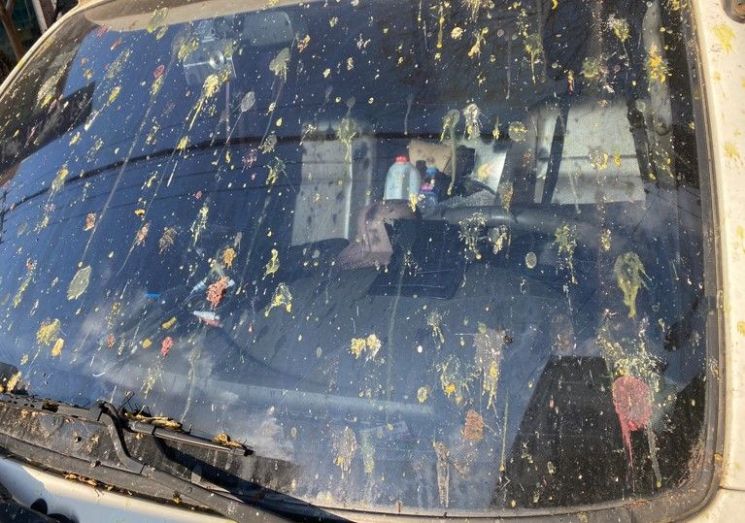 A vehicle parked in a resident-priority parking lot located in Gaepo-dong, Gangnam-gu, Seoul, damaged by pigeon droppings. Photo provided by a reader
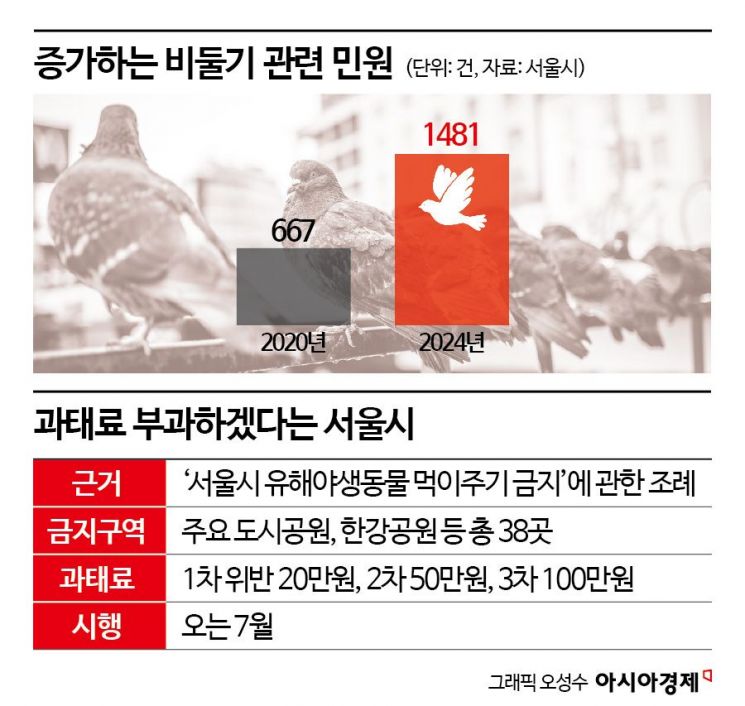
According to the Seoul Metropolitan Government, the number of pigeon-related complaints more than doubled in four years, from 667 cases in 2020 to 1,481 cases last year. The main complaints involve pigeon droppings and feathers, as well as damage to the exteriors of buildings and cars.
This year, there has been a notable increase in complaints from the Gaepo-dong area of Gangnam District about severe damage caused by pigeon droppings. One complainant's car windshield was covered in pigeon droppings of various colors, including white, yellow, green, and red. On a community forum in Seocho District, a post read, "Dozens of pigeons are always feasting on the sidewalk near Seocho Elementary School." Park, a 47-year-old resident of Seocho-dong, said, "When passing by here, you can see traces of bird feed like grains," and added, "It seems someone comes every day to feed the pigeons."
To resolve these complaints, it is necessary to reduce the pigeon population. One method is to capture and remove them. However, even if pigeons are captured, their numbers can quickly recover as long as food continues to be supplied, making such efforts ineffective. There is also the risk of backlash from animal rights groups. An official from one district office in Seoul said, "Rather than capturing them, we have tried spraying repellents to prevent birds from gathering, but since the work must be done at high places, it is dangerous and has not been very effective."
Pigeon droppings left behind by flocks can also threaten urban safety. Pigeon droppings contain uric acid, an acidic substance that can corrode urban structures made of metal or stone. A representative incident occurred in 2023 in Dongnae District, Busan, when a 10-kilogram steel plate fell from a pedestrian overpass onto the sidewalk below after pigeon droppings accumulated on its exterior. In addition, pigeon droppings contain pathogens such as Salmonella and Cryptococcus, which can be transmitted to humans.
There are also many people who suffer from "ornithophobia," a fear of birds. Lee, a resident of Gaepo-dong, said, "Every time my wife and I go for a walk around our apartment or Yangjaecheon, she is startled and terrified by the pigeons," adding, "We only walk in areas where there are no pigeons at all."
Starting in July, Seoul City plans to designate a total of 38 locations, including Seoul Forest and Hangang Park, as zones where feeding harmful wild animals is prohibited, and violators will face fines of up to 1 million won. Geumcheon District is also considering designating habitual complaint areas such as Malsi Intersection as no-feeding zones. This policy follows an amendment to the Wildlife Protection and Management Act in January last year, which allows local government heads to prohibit feeding harmful wild animals by ordinance.
However, since enforcement is realistically difficult, some point out that ultimately, what matters most is a change in public awareness. Heo Changdeok, professor of sociology at Yeungnam University, said, "Local governments should consistently conduct awareness campaigns, such as installing signs in areas where pigeons gather, asking people not to feed them, in order to change people's perceptions."
© The Asia Business Daily(www.asiae.co.kr). All rights reserved.














