Bank of Korea Releases "2024 Payment and Settlement Report"
"No Privacy Infringement Issues with Bank of Korea's Choice of General-Purpose Digital Currency"
The Bank of Korea stated that if stablecoins are used as a means of payment replacing legal tender, they could negatively impact central bank policy implementation, including monetary policy and payment and settlement systems. Therefore, the bank emphasized the need for a separate regulatory framework. The Bank of Korea plans to actively participate in future legislative discussions on stablecoins and to present these views from the central bank’s perspective.
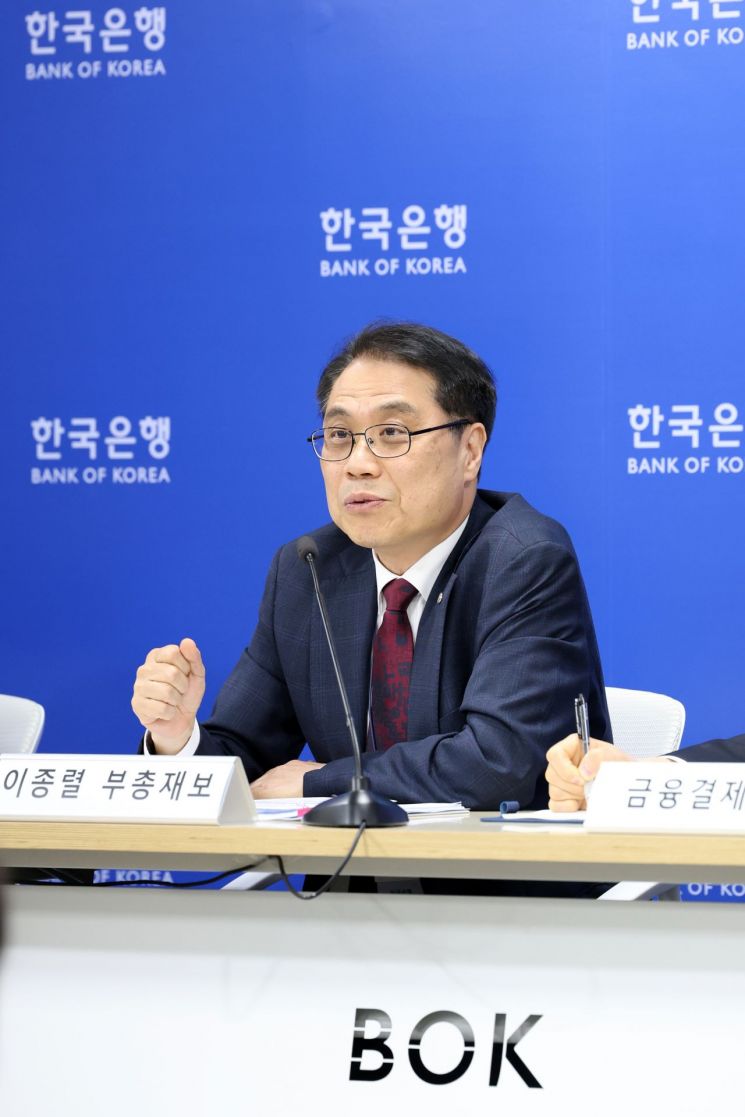 Lee Jongryul, Deputy Governor of the Bank of Korea, is speaking at the 2024 Payment and Settlement Report briefing held at the Bank of Korea in Jung-gu, Seoul on the 21st. Photo by Bank of Korea
On the 21st, the Bank of Korea made this announcement during a briefing on the "2024 Payment and Settlement Report." The bank explained that, unlike general virtual assets, stablecoins inherently possess the characteristics of a payment instrument, making separate regulation necessary. Lee Byungmok, Director General of the Financial Settlement Department at the Bank of Korea, said, "When stablecoins are issued, the reserve assets are either deposits or government bonds. If a shock occurs and their value becomes unstable, stablecoin holders may request redemption in kind from the issuer, which could heighten market instability." He explained that, in the process of withdrawing deposits or selling government bonds, a fire sale could occur, further intensifying market instability.
He added, "The U.S. government also recognizes that while stablecoins can provide a demand base for the government bond market, they can also cause turmoil if problems arise." Accordingly, the Bank of Korea plans to actively communicate its concerns regarding the negative implications for monetary policy if stablecoins are used as a means of payment, by participating in the Virtual Asset Committee launched by the Financial Services Commission in November last year.
The Bank of Korea also actively addressed some misunderstandings regarding "Project Hangang," a real-world digital currency pilot that began this month. Lee Jongryul, Deputy Governor of the Bank of Korea, stated, "Concerns about privacy infringement could arise if the central bank directly issues a 'general-purpose digital currency' to individuals, but the Bank of Korea uses an 'institutional digital currency' solely for interbank settlements. The public transacts using deposit tokens issued by banks, so such privacy issues cannot occur." Deputy Governor Lee further explained, "In addition, risks such as a 'digital bank run' (large-scale deposit withdrawals) and a decrease in bank deposits also exist, which is why the Bank of Korea did not choose a general-purpose approach."
Regarding concerns that physical cash might disappear, Deputy Governor Lee firmly stated, "That will never happen." He emphasized, "It is extremely important to maintain trust in the currency system. The reason people can trust and use digital currency or digital payment methods is the belief that they can always exchange that money for physical cash." He added, "We are currently considering ways to improve the circulation and use of physical cash." To this end, a Currency Circulation Team was established within the Bank of Korea’s Currency Issue Department earlier this year.
Meanwhile, as of the morning of the 21st, over 50,000 people had participated in the digital currency pilot that began this month. Yoon Sungkwan, Head of the Bank of Korea’s Digital Currency Research Team, said, "As of this morning, a total of 51,766 electronic wallets had been opened," and "from the 1st to the 20th, there were a total of 29,259 transactions." The number of cases where deposits were converted to deposit tokens was around 15,000, and the number of cases converted back to deposits was 2,100. The total number of payment transactions so far is 12,053.
Director Yoon stated, "Current issues being pointed out include inconvenience due to usage restrictions and the need to enter passwords multiple times," adding, "These are inevitable given the testing environment, but improvements will be made when it is officially introduced." He also said, "In the upcoming second round of testing, features such as person-to-person transfers and expanded vouchers will be implemented."
Project Hangang is a joint initiative by the Financial Services Commission and the Financial Supervisory Service, along with the Bank of Korea, to pilot a future digital currency infrastructure encompassing various digital currencies such as institutional digital currency and deposit tokens, and to test it in a real-world environment. The first round of testing for the general public will continue until June.
© The Asia Business Daily(www.asiae.co.kr). All rights reserved.












