65 Teams to Conduct Disinfection Three Times a Week in Public Restrooms and Sewers During Summer
KDCA Issues Japanese Encephalitis Advisory Following Detection of Vector Mosquitoes
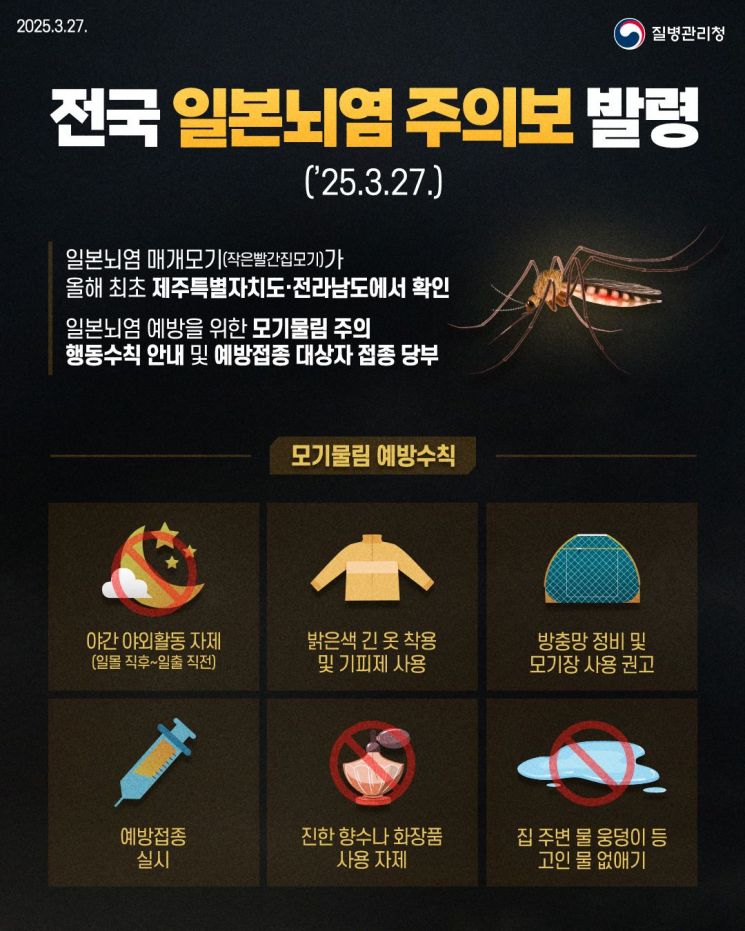
Gwangju City has declared a "war on mosquitoes" for the summer season. In cooperation with its five districts, the city has organized a disinfection team consisting of 65 units and approximately 150 personnel. The team will conduct disinfection and pest control operations at least three times a week, focusing on vulnerable areas such as public restrooms and sewers. In particular, following the recent announcement by the Korea Disease Control and Prevention Agency (KDCA) confirming the presence of mosquitoes that transmit Japanese encephalitis and issuing a nationwide Japanese Encephalitis Advisory, the city will strengthen its activities to prevent mosquito-borne infectious diseases.
On April 21, Gwangju City launched its summer disinfection and pest control campaign, starting with practical training for public health center staff responsible for pest control, aimed at strengthening their capacity to manage disease vectors.
The training, organized by the KDCA, was held to proactively respond to the emergence of mosquito-borne diseases during the summer. It focused on practical content, including understanding mosquito ecology, the use of pest control chemicals, environmentally friendly pest control methods, and sharing field case studies.
Previously, during the thawing period in February and March, the city completed preemptive larval control measures in vulnerable areas. Since April, as temperatures have risen, the city has shifted its focus to adult mosquito control and has been operating a summer pest control system.
To this end, the city has organized a total of 65 units and approximately 150 personnel into disinfection teams across its five districts. These teams will use more than 1,700 pieces of equipment to conduct disinfection and pest control activities at least three times a week, focusing on vulnerable sites such as public restrooms, sewers, and areas with frequent outbreaks of sanitary pests.
The city especially plans to strengthen disinfection activities to prevent mosquito-borne infectious diseases. This measure follows the KDCA's recent confirmation of the presence of Culex tritaeniorhynchus mosquitoes, which transmit Japanese encephalitis, and the issuance of a Japanese Encephalitis Advisory nationwide on March 27.
Japanese encephalitis is transmitted through the bite of an infected mosquito. While mild symptoms such as fever or headache may occur, in rare cases the disease can progress to encephalitis, resulting in high fever, confusion, or convulsions. Among these severe cases, 20 to 30 percent can be fatal.
Kang Yunseon, Director of Public Health and Medical Services, stated, "With the average temperature rising and mosquito activity increasing earlier, we are taking proactive measures for pest control." Kang also urged, "We ask residents to follow everyday preventive measures, such as refraining from outdoor activities at night, wearing long clothing when going out at night, and using mosquito repellent."
© The Asia Business Daily(www.asiae.co.kr). All rights reserved.












