Highest Level Since Legoland Crisis...
Concerns Grow Over Low-Credit Borrowers Leaving Formal Financial Sector
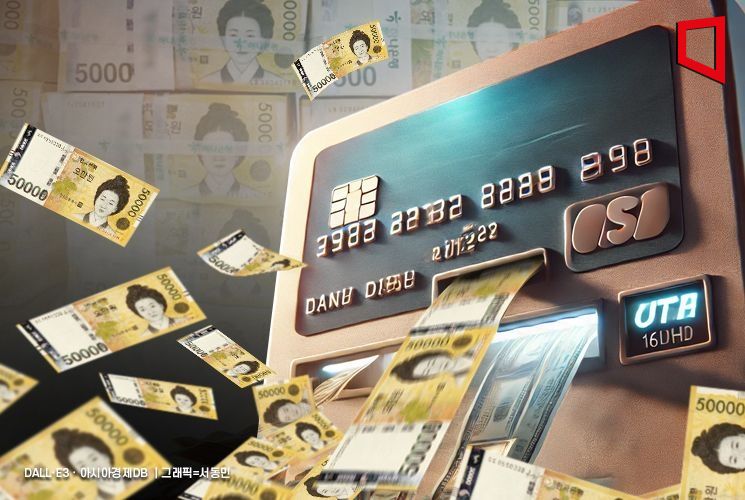
The interest rate on card loans, often used by low-income individuals for emergency funds, has reached its highest level since the "Legoland crisis" at the end of 2022. The main reason is that credit card companies are maintaining rates to manage their outstanding balances, as financial authorities have implemented strict household loan regulations.
According to the Credit Finance Association on April 20, the average interest rate on card loans at nine major credit card companies (Lotte, BC, Samsung, Shinhan, Woori, Hana, Hyundai, KB Kookmin, and NH Nonghyup Card) stood at 14.83% per annum in March, up about 0.19 percentage points from the previous month (14.64%). This is the highest figure since December 2022 (14.84%), when rates surged due to the Legoland crisis.
The Legoland crisis occurred when Gangwon Jungdo Development Corporation, responsible for developing Legoland in Gangwon Province, reported it could not repay part of its loans. In an attempt to reduce its own burden, Gangwon Province, which had provided a payment guarantee, pushed the corporation into corporate rehabilitation. This led to a sharp drop in Korea's bond credit ratings and a subsequent spike in interest rates.
Currently, card loan interest rates remain at similar levels despite two consecutive base rate cuts in October and November last year. Notably, the average card loan rate for high-credit borrowers with scores above 900 was 11.89% in both March last year and March this year. However, for low-credit borrowers with scores below 700, the average rate rose from 17.34% to 17.66% over the same period, an increase of 0.32 percentage points, further increasing the interest burden on vulnerable borrowers.
Since more than half of card loan users are multiple debtors with loans from three or more financial institutions, there are concerns that higher lending thresholds may push low-credit borrowers toward loans outside the formal financial sector.
According to the Financial Supervisory Service, the "credit card delinquency rate"?which refers to the delinquency rate of more than one month on credit card payments, installment payments, revolving credit, card loans, and unsecured loans?was 1.65% last year. This is up 0.02 percentage points from the end of the previous year (1.63%) and marks the highest level in 10 years since 2014 (1.69%).
© The Asia Business Daily(www.asiae.co.kr). All rights reserved.












