Observation Period for Battery Thermal Runaway Increased 24-Fold
Chinese Government Leads Inspection and Specifies Methods
Experts Call for Proactive Countermeasures
China is strengthening its electric vehicle battery safety standards to what it calls the "strictest level ever." The new national standard explicitly requires that, even after thermal runaway, there must be no fire or explosion within two hours and after 300 charging cycles?regulations that do not yet exist in Korea. In the wake of incidents such as last year's electric vehicle fire in Cheongna, Incheon, and growing concerns about the safety of Chinese-made batteries, the Chinese government has opted for a direct response, especially as U.S. tariff pressures have made it difficult to expand its battery market abroad. There are now concerns that the Korean battery industry, which has already lagged behind in technologies such as LFP (lithium iron phosphate) batteries, may also fall behind in responding to these new safety standards.
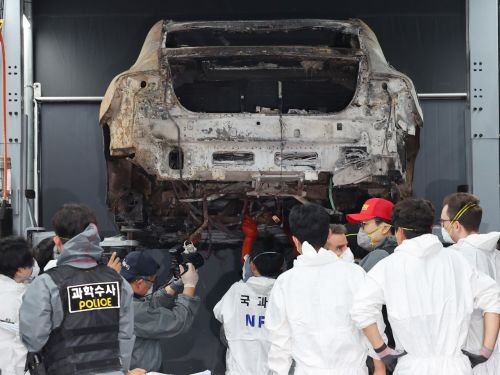 Last August, at an industrial workshop in Seo-gu, Incheon, police, fire department, the National Forensic Service, Mercedes-Benz, and other related personnel conducted a second joint inspection on August 1 last year of the electric vehicle that caught fire in the underground parking lot of an apartment complex in Cheongna. Photo by Yonhap News
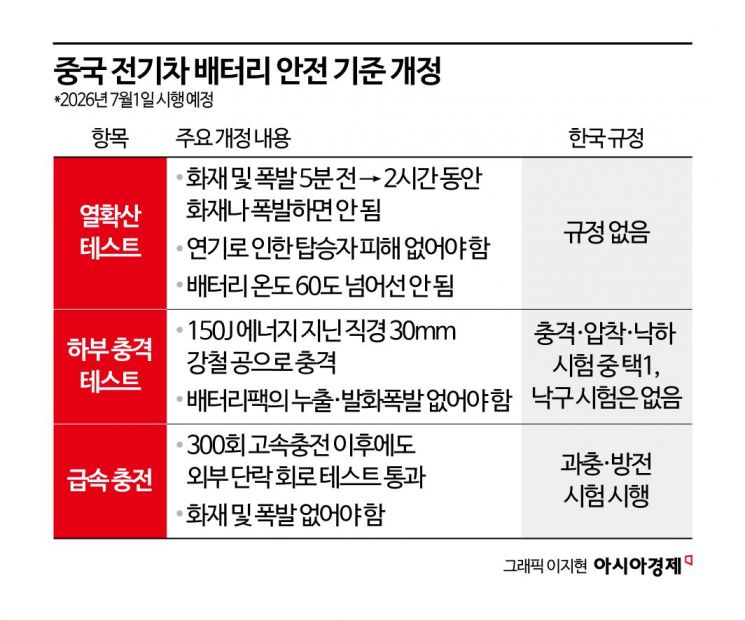
According to industry sources on April 21, China's Ministry of Industry and Information Technology recently announced a new national standard regarding safety requirements for electric vehicle batteries, which will take effect from July 1 next year. The enhanced safety standards focus on three main areas: fast charging, thermal propagation, and impact resistance from below. Compared to the standard announced in 2020, the new version has more detailed verification methods and reflects recent concerns, such as fire incidents. The Chinese government plans to directly test and certify battery safety before batteries are installed in electric vehicles and sold.
The most notable aspect of this revision is the observation period for thermal runaway. The new regulation states that, in the event of thermal runaway in a battery cell, there must be no fire or explosion within two hours, and the temperature must remain below 60 degrees Celsius. This observation period has been extended 24 times from the previous five minutes. The emission of toxic smoke harmful to passengers is also prohibited. Additionally, the new standard requires that the battery pack must not catch fire or explode even after being struck by a 30mm diameter steel ball with 150 joules of energy and after 300 cycles of fast charging.
The Korean government has also begun to implement a battery certification and history management system, starting in February, as awareness of domestic electric vehicle thermal runaway incidents has increased. There are currently a total of 12 test items, but unlike China, Korea has not yet established regulations for thermal runaway monitoring time or fast charging tests. A researcher at a related domestic institution explained, "The United Nations is currently discussing the establishment of international standards for thermal runaway. Once a decision is made, Korea will adopt it as the 13th test item."
Experts believe that if China strengthens its battery safety standards, the competitiveness of Korean companies?their biggest rivals?could be weakened. Moon Hakhoon, a professor at the Department of Future Electric Vehicles at Osan University, said, "Because safety issues require mandatory measures, our government should take the initiative in revising the certification system."
Kim Eesoo, a professor at the Department of Safety Engineering at Korea National University of Transportation, commented on China's revised standards, saying, "This is a preemptive response to the high number of fires involving new energy vehicles. While Korea is implementing pilot measures such as a battery identification system and banning charged electric vehicles from entering underground parking lots, these are still passive compared to China's inspection regulations." He added, "For these measures to be truly effective, it is necessary to review detailed items such as non-destructive testing, in addition to general electrical inspections like charge and discharge tests."
However, some argue that rather than blindly following China's regulations, Korea should adopt a flexible approach that takes into account industrial conditions and market pace. An industry official said, "A policy direction that prioritizes safety is positive, but if the government strengthens standards too quickly and strictly, it could actually slow market growth and negatively impact job creation. It is important to approach the timing and manner of tightening standards flexibly, considering the overall situation of the industry and economy."
© The Asia Business Daily(www.asiae.co.kr). All rights reserved.













