Seoul City: "After Expansion, Price Increases in Gangnam 3 Districts and Yongsan District Have Significantly Slowed"
59 Suspicious Transactions Detected ... 'Excessive Borrowing' Most Common
On April 20, the Seoul Metropolitan Government announced that the rate of price increases in the Gangnam 3 Districts and Yongsan District had significantly decreased following the expansion of land transaction permit zones. The city also explained that the price growth in Mapo, Seongdong, and Gangdong Districts, which had been expected to experience a "balloon effect," had also slowed.
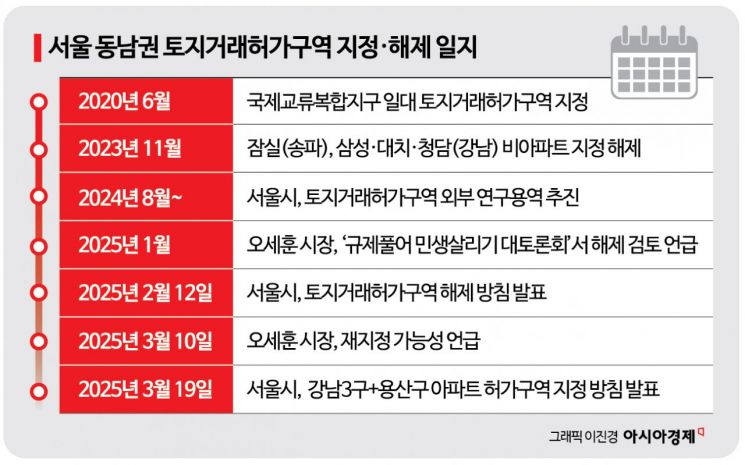
The Seoul Metropolitan Government stated that since the announcement on March 19 of the expanded designation of land transaction permit zones (effective from March 24), it has been making all-out efforts across the board to establish stable transaction order.
The city reported that it is closely monitoring market trends by tracking prices and transaction volumes, and that there are signs of stabilization in transaction prices since the announcement of the expanded designation.
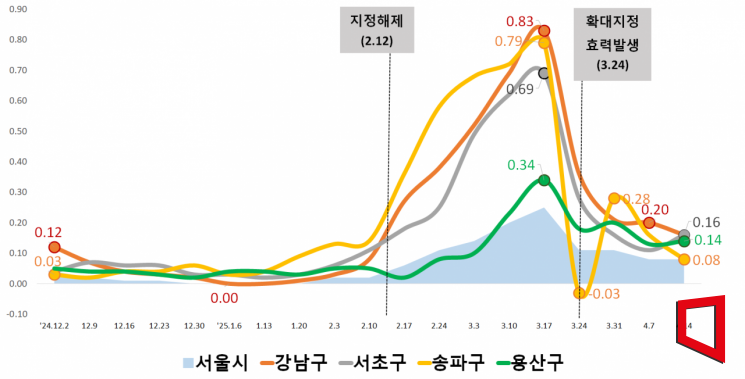 Weekly Apartment Price Change Trends in Gangnam 3 Districts and Yongsan District Managed by Korea Real Estate Board. Provided by Seoul City
Seoul City: "After Expansion, Price Increases in Gangnam 3 Districts and Yongsan District Have Significantly Slowed"
Comparing the price increase rates for Gangnam, Seocho, Songpa, and Yongsan Districts in the second week of April to the previous peak (the third week of March): Gangnam District fell from 0.83% to 0.16%, Seocho District from 0.69% to 0.16%, Songpa District from 0.79% to 0.08%, and Yongsan District from 0.34% to 0.14%.
In neighboring areas near the designated permit zones, the rate of increase also slowed: Mapo District from 0.29% to 0.13%, Seongdong District from 0.37% to 0.23%, and Gangdong District from 0.28% to 0.09%. According to the Seoul Metropolitan Government, there is no evidence of a balloon effect resulting from the designation of land transaction permit zones at this time.
 Weekly Apartment Price Change Trends in Mapo, Seongdong, and Gangdong Districts by Korea Real Estate Board. Provided by Seoul City
Transaction volumes also decreased after the designation took effect. According to data released by the Ministry of Land, Infrastructure and Transport (as of April 18), the total number of apartment transactions in Seoul increased by 2,379 cases (39%) from 6,098 in February to 8,477 in March.
Comparing transaction volumes in the Gangnam 3 Districts and Yongsan District before and after the effective date (March 24), there were 1,797 transactions from March 1 to 23, but only 31 transactions from March 24 to April 18, showing a sharp decline.
Although the number of transactions in adjacent areas such as Mapo, Seongdong, and Gangdong Districts also decreased, the decline was not as pronounced as in the designated zones. In Mapo, Seongdong, and Gangdong Districts, transactions dropped from 1,389 before the effective date to 397 from March 24 to April 18. During the same period, Mapo District saw transactions fall from 414 to 137, Seongdong District from 497 to 120, and Gangdong District from 478 to 140.

59 Suspicious Transactions Detected ... 'Excessive Borrowing' Most Common
The city is also focusing on blocking the "balloon effect," in which speculative demand shifts to areas adjacent to the land transaction permit zones. Since March, a joint inspection team has been formed with the Ministry of Land, Infrastructure and Transport, the Seoul Metropolitan Government’s Special Judicial Police, and local district offices to inspect all reported transactions.
The inspections have uncovered signs of collusion aimed at manipulating prices. In one case, the Seoul Special Judicial Police have launched an investigation into suspected price collusion after false information about a "record-high transaction" was spread through an apartment community application, apparently to artificially boost prices.
From last month through April 18, on-site inspections were conducted at a total of 214 real estate agencies, revealing 59 suspicious transactions. The most common issue was excessive borrowing, accounting for 25 cases, followed by 11 cases of illicit gifting, 1 case of false reporting, and 22 cases classified as other. The city is conducting detailed investigations into the sources of funds for these transactions. If any illegal activities threatening transaction order are confirmed, the city has pledged a zero-tolerance policy and will respond strictly.
Of the 12 cases where final payments had been completed, a detailed investigation found one case where the details of intra-family loans could not be verified, raising suspicions of gift tax evasion; this case has been reported to the National Tax Service. The city is also investigating a transaction in which a 2.9 billion won property was purchased using 2.8 billion won in funds either gifted or borrowed from the buyer's father (excluding a 120 million won rental deposit), resulting in an excessively high loan-to-equity ratio.
Starting this week, the city will conduct joint on-site inspections with the Ministry of Land, Infrastructure and Transport and local district offices to check for post-transaction violations, such as breaches of the mandatory residence requirement for permitted apartments. The inspections will involve visiting the properties and verifying residency through mail, apartment management office records, and vehicle registration status. Those found in violation may face enforcement fines of up to 10% of the actual transaction price.
The Ministry of Land, Infrastructure and Transport and the Seoul Metropolitan Government will soon announce finalized operational guidelines for the land transaction permit zones. These guidelines will standardize procedures across districts regarding whether redevelopment and reconstruction rights are subject to permits, how homeowners must handle existing properties, and the timing of occupancy after acquisition.
Kim Seongbo, Seoul’s Second Deputy Mayor for Administration, stated, "We have mobilized every available measure to prevent market confusion and speculative demand inflow that could arise after the expansion of land transaction permit zones, and we are already seeing results." He added, "We will continue to implement effective follow-up measures without gaps, and at the same time, actively support the creation of an environment where genuine homebuyers can stably purchase homes by expanding housing supply and strengthening market monitoring."
© The Asia Business Daily(www.asiae.co.kr). All rights reserved.













