National Part-Time Public Officials Union: 60.4% of Central Government Personnel Departments Favor Abolition of the System as of March 2025
Part-Time Recruitment Civil Servants Performing the Same Duties as Full-Time Staff
On April 15, the National Part-Time Public Officials Labor Union (Chairperson: Jung Sung-hye) announced the results of a survey conducted on March 18 among the personnel departments of central government agencies regarding the continued recruitment or abolition of the "part-time recruitment civil servant" system, which was introduced in 2014. Of the 48 agencies that responded, 29 agencies (60.4%) expressed a desire to abolish the system, while 7 agencies (14.2%) stated they would follow the improvement measures proposed by the Ministry of Personnel Management.
The part-time recruitment civil servant system, which began appointing officials in central government agencies in 2014, aimed to promote "work-life balance and the creation of quality jobs" and "raise the employment rate to over 70%." However, these goals proved elusive due to low satisfaction on the ground, leading to frequent resignations and withdrawals. Ultimately, the Ministry of Personnel Management effectively acknowledged the failure of the system by discontinuing the unified recruitment of part-time civil servants in central government agencies in 2020, just six years after its introduction.
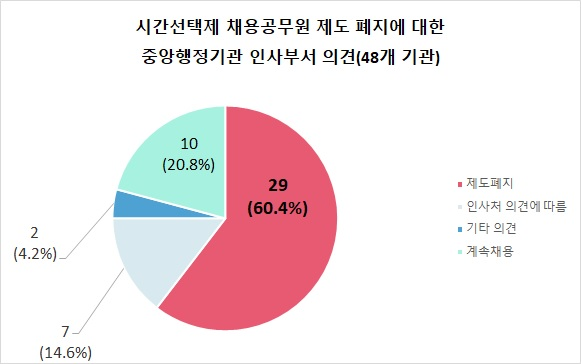
The Ministry of Personnel Management fails to improve the system as central government personnel departments call for abolition and reform
According to Article 93, Paragraph 4 of the Public Officials Appointment Regulations, "The Minister of Personnel Management shall conduct a fact-finding survey on personnel grievances and obstacles to part-time work among part-time public officials, and may recommend improvements to the relevant departments based on the survey results." However, since the introduction of the system in 2013, no such survey on obstacles to part-time work has ever been conducted.
As a result, the Part-Time Public Officials Union has been conducting annual surveys of central government personnel departments on the status of part-time recruitment civil servants and operational difficulties in place of the Ministry of Personnel Management. In 2025, the union added a question regarding whether to "continue recruitment" or "abolish the system." The survey found that personnel departments cited the following reasons for supporting abolition:
▲ The system should be abolished because part-time civil servants currently perform the same duties as full-time civil servants.
▲ Because part-time civil servants work shorter hours than full-time staff, it is difficult to assign them to departments or allocate work. Furthermore, with the recent introduction of various systems such as telecommuting and flexible work arrangements to promote work-life balance, continued recruitment of part-time civil servants is deemed unnecessary.
▲ Due to the inherently short working hours of part-time civil servants, continuity of work is relatively diminished.
▲ When calculating headcount, the occurrence of fractional numbers can actually result in a reduction of personnel for the agency, making personnel management more difficult (e.g., 0.875*2 people = a reduction of 0.25 of a person).
▲ Difficulties arise in assigning positions, calculating salary and service periods, evaluating work performance, determining promotion quotas, and designating acting officials.
The personnel department of the Korea Coast Guard, which advocated for abolition, stated that the part-time recruitment civil servant system (with a maximum of 35 working hours per week) was introduced to promote work-life balance and job creation for public officials. However, even full-time civil servants (working 40 hours per week) can use flexible work arrangements or switch to part-time work for reasons such as childcare or education. Moreover, most part-time recruitment civil servants perform the same workload as full-time staff, which creates the possibility of unfair treatment. For these reasons, the department strongly expressed the need to abolish the system.
In summary, the management of performance evaluations, headcount, salaries, and allowances for a small number of part-time recruitment civil servants requires separate administration, resulting in wasted time and manpower. Additionally, the short working hours create work gaps, inconveniencing colleagues and even leading to a decline in the quality of public services.
77.7% of local government personnel departments also call for abolition
A similar survey conducted by the Part-Time Public Officials Union in February among local government personnel departments found that 171 agencies (77.7%) wanted the system abolished, while 8 agencies (3.63%) responded that they would implement reforms in line with guidelines from the Ministry of the Interior and Safety.
Kim Jin-sik, Secretary General of the Part-Time Public Officials Union, stated, "Currently, I work 35 hours a week and, after transferring departments, have taken on the same duties as full-time civil servants. However, my salary, allowances, and the years required for promotion are all calculated in proportion to the 35-hour workweek, resulting in lifelong discrimination until retirement. The term 'part-time recruitment civil servant' is not accurate; 'part-time discrimination civil servant' would be more appropriate. Eleven years after the initial recruitment in 2014, it is now time for the Ministry of Personnel Management and the Ministry of the Interior and Safety to proceed with abolishing the system, as both central government and local government personnel departments desire."
© The Asia Business Daily(www.asiae.co.kr). All rights reserved.












