Katsunobu Kato to Visit the US Later This Month
Likely to Meet with Treasury Secretary Scott Besant
Weaker Dollar Is One of the Trump Administration's Goals
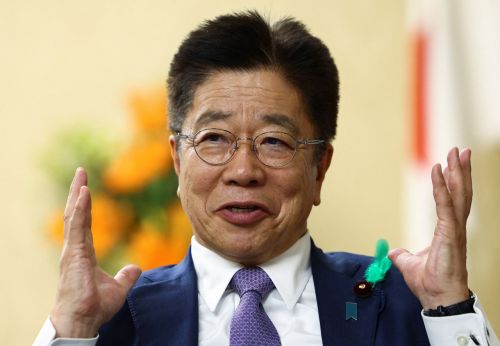
The Nihon Keizai Shimbun (Nikkei) reported on April 18 that the issue of exchange rates is expected to be discussed in late April during the US-Japan tariff negotiations, which are seen as a barometer for the Korea-US tariff talks.
Nikkei stated that arrangements are being made for Japanese Finance Minister Katsunobu Kato to meet with US Treasury Secretary Scott Besant during Kato's visit to the United States later this month to attend the International Monetary Fund (IMF) and World Bank meetings.
Regarding this, Kyodo News reported that Finance Minister Kato, when asked about plans for a US-Japan finance ministers' meeting at a press conference that day, only said, "We are seeking opportunities." It was previously reported that the issue of exchange rates was not mentioned during the US-Japan tariff negotiations held in Washington, D.C. on April 16 (local time).
Ryosei Akazawa, Japan's Minister for Economic Revitalization and the chief negotiator for Japan, responded to reporters' questions about the agenda after the first round of tariff negotiations by saying, "The exchange rate (issue) was not raised. The exchange rate will be discussed by the finance ministers of both countries."
President Donald Trump has repeatedly expressed dissatisfaction in the past, claiming that Japan is intentionally weakening the yen, and Treasury Secretary Besant has also indicated his intention to raise the issue of exchange rates in negotiations, along with non-tariff barriers. On March 3, President Trump stated, "Whether it's the Japanese yen or the Chinese yuan, if they lower the value of their currencies, it creates a very unfair disadvantage for us."
The Trump administration has made it one of its main objectives to maintain the dollar's status as the key currency while also easing the current strength of the dollar. A strong dollar is an inevitable factor contributing to the trade deficit. Nikkei pointed out, "Besant's goal is to find a narrow path to maintain the dollar's key currency status while also correcting the strong dollar."
Secretary Besant has stated, "The two are not contradictory," and added, "As was the case in the 1980s and 1990s, international currency coordination is necessary." For example, he has in mind macroeconomic policy coordination involving central banks, similar to the 1985 Plaza Accord. At that time, the United States reached an agreement with Japan, the United Kingdom, France, and West Germany to weaken the dollar in order to address the 'twin deficits' in trade and fiscal accounts.
Steven Miran, a former hedge fund manager and Treasury economist who now serves as chairman of the White House Council of Economic Advisers, is considering even more radical ideas. He is contemplating more aggressive plans, such as countries selling US Treasury bonds to induce a weaker dollar. However, such international cooperation cannot be achieved without the participation of China and the European Union (EU). In this process, it is possible that the 'tariff card' will be used as leverage to bring about international cooperation.
© The Asia Business Daily(www.asiae.co.kr). All rights reserved.












