Trump: "Productive Talks with Mexico and Japan... Today Is Italy"
Powell Directly Addresses Tariff Policy... Future Monetary Policy in Focus
Trump Again Calls for Rate Cuts and Powell's Dismissal
Weekly Jobless Claims Hit Lowest Level in Two Months
The three major indices of the U.S. New York stock market are showing mixed trends on the last trading day of this week, the 17th (local time). The market is focusing on the tariff negotiations the U.S. is conducting with various countries, along with the earnings announcements from companies entering the earnings season in full swing this week. UnitedHealth's downward revision of its annual earnings outlook has caused insurance stocks to plunge sharply.
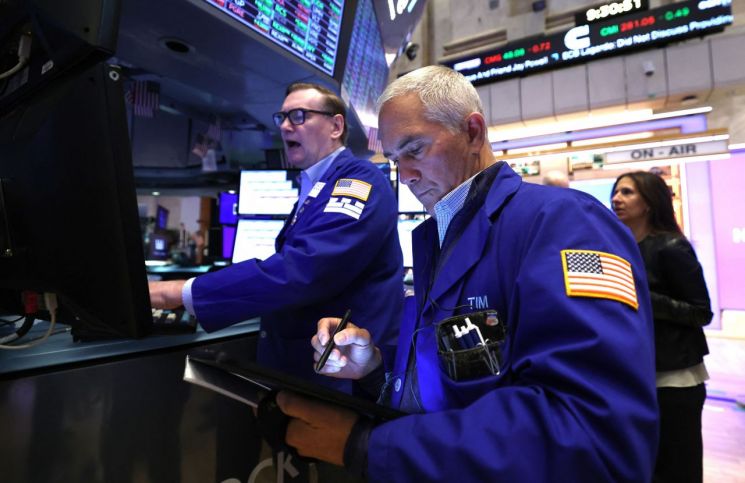
As of 11:11 a.m. in the New York stock market, the Dow Jones Industrial Average (Dow) focused on blue-chip stocks is trading at 39,181.75, down 487.64 points (1.23%) from the previous trading day. The S&P 500 index, centered on large-cap stocks, is up 17.92 points (0.34%) at 5,293.62, while the Nasdaq index, focused on technology stocks, is down 10.79 points (0.07%) at 16,296.37.
By individual stocks, UnitedHealth is down sharply by 23.3% following a disappointing first-quarter earnings report and a downward revision of its annual earnings outlook. Eli Lilly is up 13.59% after the success of clinical trials for an obesity treatment. Taiwanese semiconductor company TSMC is up 0.97% on strong first-quarter earnings.
NVIDIA is down 3.55%. The U.S. Department of Commerce has required new permits for the export of NVIDIA's H20 chips to China, causing the stock price to fall. NVIDIA has been selling the H20, which is based on the H100 semiconductor subject to export controls to China but with artificially reduced performance, to China. The company expects a loss of $5.5 billion in the first quarter of the fiscal year (February to April) if it cannot export the H20 to China due to this measure.
Investors' attention is turning to the progress of tariff negotiations between the U.S. and other countries. U.S. President Donald Trump stated that he is having very productive communications with countries such as Mexico and Japan. In a post on his social media platform Truth Social, which he created, he said, "I had a very productive call with the President of Mexico yesterday," and "I also met with Japan's top trade representatives, and it was a very productive meeting." He added, "All countries, including China, want to meet," and "Today is Italy."
Future U.S. Federal Reserve (Fed) monetary policy is also in focus. Fed Chair Jerome Powell dampened investors' hopes for the so-called 'Powell put,' where the monetary authority intervenes to stabilize the market, increasing investor anxiety. At an event of the Chicago Economic Club the previous day, Powell pointed out that the level and scope of tariff increases are beyond the Fed's expectations. He said, "The impact on the economy, including inflation and growth slowdown, will also be significant," and "We may face a difficult scenario where the dual mandate of price stability and maximum employment conflicts." He ruled out the possibility of rate cuts or liquidity supply citing uncertainty.
In response, President Trump posted on social media the next morning, pressuring the Fed to cut interest rates and mentioning the dismissal of Chair Powell. He claimed, "Jerome Powell of the Fed, who is always late and wrong, gave another typical, complete 'mess' report yesterday," and "He must cut rates now. Powell's dismissal must happen."
Chris Zaccarelli, Chief Investment Officer (CIO) of NorthLight Asset Management, analyzed, "Although Chair Powell said there is currently no dissent on the dual mandate, he clearly rattled investors' nerves," and "Investors are now worried that the possibility of recession and stagflation has increased."
The market is pricing in a high likelihood of a rate cut in June. According to the Chicago Mercantile Exchange (CME) FedWatch, as of today, the interest rate futures market reflects a 59.4% chance that the Fed will cut rates by 0.25 percentage points in June, slightly down from the 61.1% forecast the previous day.
On the same day, the European Central Bank (ECB) lowered its key policy deposit rate by 0.25 percentage points from 2.5% to 2.25%. This is analyzed as a preemptive measure to prepare for a possible economic slowdown caused by tariff shocks originating from Trump.
The U.S. labor market remains robust. According to the U.S. Department of Labor, new claims for unemployment benefits last week (April 6?12) decreased by 9,000 from the revised previous week to 215,000 claims. This is below the market forecast of 225,000 and marks the lowest level in two months. The market is focusing on employment indicators to gauge the impact of President Trump's tariff policies and federal government restructuring on the economy.
U.S. Treasury yields are steady. The 10-year U.S. Treasury yield, a global bond yield benchmark, rose 1 basis point (1 bp = 0.01 percentage points) to 4.29% from the previous trading day, while the 2-year Treasury yield, sensitive to monetary policy, fell 1 bp to 3.76%.
© The Asia Business Daily(www.asiae.co.kr). All rights reserved.












