Discovered During Slope Collapse Recovery Investigation
First Identification of the Upper Structure
A section of the fortress wall of the old Kimhae Fortress has been discovered at the Daeseong-dong Tumuli, a Gaya tumuli site in Kimhae, Gyeongsangnam-do, which is listed as a UNESCO World Heritage site.
According to Kimhae City on the 16th, the upper structure of the old Kimhae Fortress wall was identified during an investigation to address the collapse of a slope at the Daeseong-dong Tumuli.
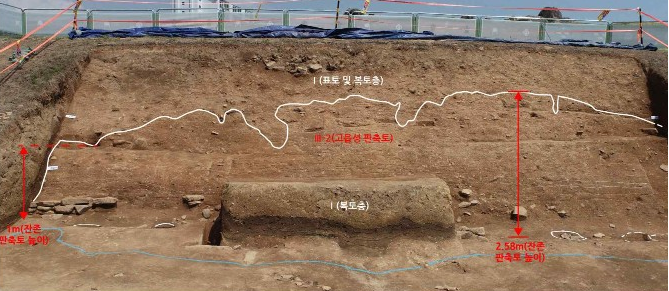 Soil layer of the wall of Goeupseong Fortress in Gimhae, discovered at Daeseongdong Tumuli, a World Heritage site. Provided by Gimhae City Hall
The old Kimhae Fortress was a foundation stone-piled and rammed earth fortress constructed after the Unified Silla period. It served as the military and administrative center of the Kimhae area until the construction of the Kimhae Eupseong Fortress during the Joseon Dynasty.
The fortress was recorded along with Kimhae Eupseong on a map of Kimhae from 1820, and its traces were clearly visible in aerial photographs from the 1950s.
During this soil layer investigation, the main body of the old Kimhae Fortress wall, known as the 'Cheseongbu,' was discovered, and stone chamber tombs created before the fortress was built were found distributed in the lower layers.
Although the foundation of the old fortress had previously been found during road construction near the Kimhae Library and the Citizen's Bell, this is the first time the upper structure of the fortress wall has been identified.
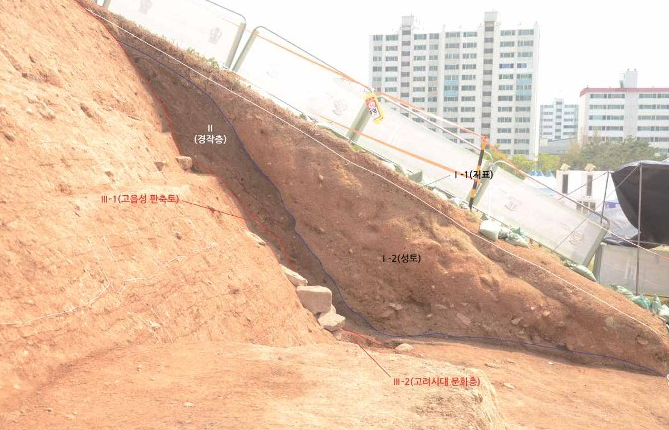 Soil layer of the Gimhae Goeupseong fortress wall discovered at Daeseongdong Tumuli, a World Heritage site. Provided by Gimhae City Hall
The portion of the fortress wall body (Cheseongbu) confirmed this time remains up to 2.6 meters in height.
It was constructed by alternately stacking soils of different properties, such as grayish-brown rock-containing soil and reddish-brown clay soil, in layers 30 to 60 cm thick to form a solid structure.
At the site, 'Yeongjeongju,' the wooden posts used as framework at regular intervals during the rammed earth construction of the fortress wall, were also found.
This recovery investigation was conducted with budget support from the National Heritage Administration to restore the western slope of the tumuli, which collapsed due to heavy rains last September.
The investigation found that no remains related to the Daeseong-dong Tumuli or the old fortress were damaged, and the collapsed section turned out to be part of a backfill layer added during the early 2000s tumuli maintenance project to reinforce the terrain.
Previously, Kimhae City held an academic advisory meeting on the 11th regarding the recovery investigation of artifacts from the collapsed slope at the Daeseong-dong Tumuli, and also held an on-site public briefing in conjunction with the Gaya Culture Festival to share the results with citizens.
The city plans to complete the restoration work as quickly as possible, reflecting the results of the academic advisory committee and the recovery investigation, after obtaining design approval from the National Heritage Administration.
© The Asia Business Daily(www.asiae.co.kr). All rights reserved.

![Clutching a Stolen Dior Bag, Saying "I Hate Being Poor but Real"... The Grotesque Con of a "Human Knockoff" [Slate]](https://cwcontent.asiae.co.kr/asiaresize/183/2026021902243444107_1771435474.jpg)















