The Constitutional Court unanimously suspended the effect of President and Acting President Han Deok-su's nomination of a constitutional court justice candidate. The reason is that it cannot be definitively concluded that the Prime Minister, who acts on behalf of the President's authority, has the power to nominate and appoint justices.
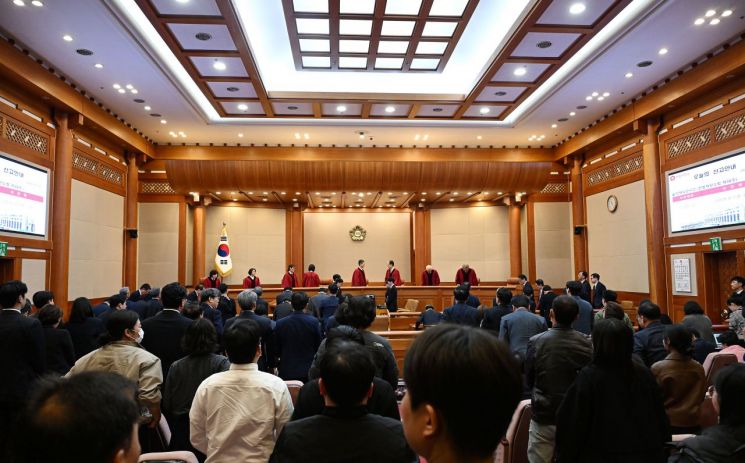
The Constitutional Court found that all requirements for granting a provisional injunction were met. The suspension of effect by provisional injunction is granted when ①the main trial is not clearly inappropriate or without grounds, ②there is a need to prevent irreparable harm that may occur if the 'exercise or non-exercise of public authority' in the constitutional complaint trial is maintained as is, ③there is an urgent necessity to suspend the effect, and ④the disadvantages of dismissing the main case after granting the injunction are weighed against those of granting the main case, and the latter is greater.
Constitutional Court: Possibility of Violation of 'Right to a Fair Trial' for Parties in Constitutional Court Cases
First, the Constitutional Court held that since it cannot be definitively concluded that Acting President Han has the authority to nominate justices for the 'President's quota,' the right to a fair trial of the parties involved in the constitutional court cases, including lawyer Kim, may be violated. The Court stated in its decision, "It cannot be definitively concluded that the Prime Minister acting on behalf of the President has the authority to nominate and appoint justices," and "If (Acting President Han) does not have the appointment authority, the applicant will receive constitutional adjudication from a person who is not a 'justice' appointed according to the qualifications and procedures prescribed by the Constitution and law." This means that the right to a trial according to constitutionally and legally prescribed content and procedures is infringed.
The Court added, "According to the Personnel Hearing Act, regardless of whether the National Assembly conducts a personnel hearing, the candidate in this case can be appointed as a justice," and "Since the appointment procedure has officially begun, there is a possibility that the candidate in this case will be appointed as a justice before the final decision on the constitutional complaint trial." Because future fundamental rights violations are clearly predictable at this point in time, this exception was recognized.
"The Disadvantage Caused by the Appointment of Justices Is Greater Than the Opposition"
Furthermore, the Court judged that it is necessary to grant the injunction considering the 'harm' situation if the candidates are appointed as justices. It found that if dismissed, the applicant faces a "risk of serious irreparable harm."
The Court explained, "If appointed, it is unclear whether the applicant can timely challenge the candidate's status as a justice or prevent the candidate from participating in the constitutional court's deliberations," and "there is also a possibility that a retrial will not be allowed if the candidate participates and the final decision is rendered."
Moreover, the Court judged that the disadvantage of dismissing the injunction after granting it is smaller than the disadvantage of granting the main case. In other words, the disadvantage caused by not blocking the appointment of justices nominated by Acting President Han is greater than the opposite case.
The Court stated, "Although the appointment of two justices will be delayed if the injunction is granted, seven justices can still deliberate and decide the case after the retirement of the two justices," and "If the outcome of the case can be affected by the opinions of the remaining two justices, the Court can wait for their appointment to deliberate and decide."
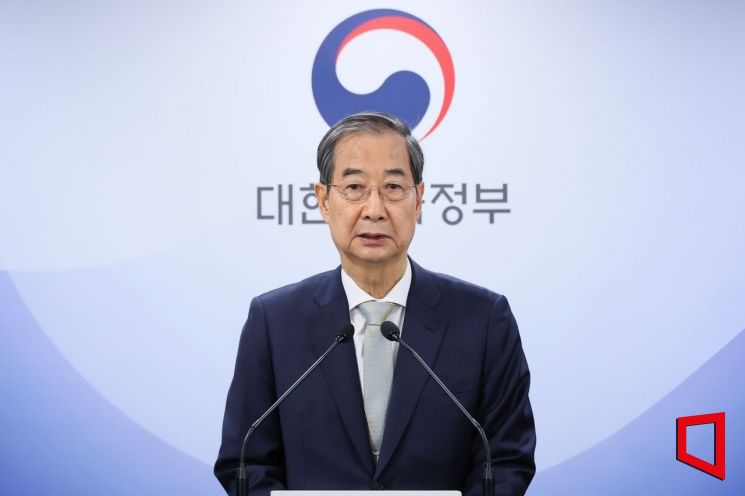 Acting President and Prime Minister Han Duck-soo is delivering a national address on the 4th at the Government Seoul Office following the Constitutional Court's ruling to dismiss President Yoon Seok-yeol. [Photo by the Prime Minister's Office]
On the other hand, the Court pointed out that if the injunction is dismissed and the justices nominated by Acting President Han take office, the 'trust' in the Constitutional Court could be seriously damaged. The Court said, "If granted, questions will be raised about the validity of decisions of the Constitutional Court in which the candidate participated as a justice, causing severe confusion in the Court's adjudicative functions," and "If retrials are not allowed, the normative power of constitutional adjudication will be significantly weakened, and trust in constitutional adjudication will be greatly damaged."
It added, "Even if retrials are allowed, multiple constitutional court cases involving the candidate will be retried until the constitutional complaint trial is granted, seriously undermining legal stability."
Accordingly, the suspension period of the effect of Acting President Han's nomination of Lee Wan-gyu, Director of the Legal Affairs Office, and Ham Sang-hoon, Chief Judge of the Seoul High Court, as constitutional court justice candidates is until the final ruling on the constitutional complaint filed by applicant Kim Jeong-hwan, a lawyer at Dodam Law Firm.
© The Asia Business Daily(www.asiae.co.kr). All rights reserved.












