Sewerage Fee System to Be Reformed Too
Seoul City will conduct a full survey and secure additional funding to effectively maintain aging sewer pipes, which are a major cause of ground subsidence (sinkholes).
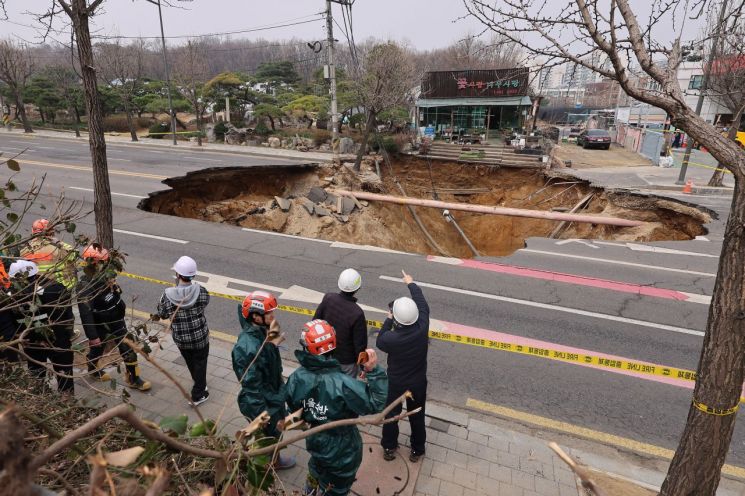
On the 16th, Seoul City stated in briefing materials, "We have been conducting an investigation on sewer pipes that have reached 30 years of service since last September, and a full survey of sewer pipes over 30 years old will also be conducted soon." It added, "We plan to complete the investigation by next year in areas with many causes of ground subsidence," and "We will continue to maintain sewer pipes based on the condition evaluation results."
According to Seoul City, as of December 2023, out of the total 10,866 km of sewer pipes in Seoul, 3,300 km (30.4%) are 'super-aged' sewer pipes that have been buried for over 50 years. Sewer pipes over 30 years old amount to 6,028 km (55.5%). Generally, sewer pipes with a service life of over 30 years are classified as aging sewer pipes.
Seoul City conducts condition evaluations of aging sewer pipes primarily using closed-circuit (CC) TV according to the Ministry of Environment’s established "Standard Manual for Sewer Pipe Investigation and Condition Rating Criteria," and maintains sewer pipes rated 4th and 5th grade. The urgency of maintenance is classified as 'low' for grades 1 and 2, 'normal' for grade 3, 'high' for grade 4, and 'very high' for grade 5.
Using this method, Seoul City spends about 200 billion KRW annually to maintain approximately 100 km of aging sewer pipes. However, to catch up with the aging, the maintenance target needs to be expanded to 150 km annually, requiring additional budget.
Seoul City stated, "With only about 200 billion KRW from the public enterprise sewerage special account annually, there are limits to stable sewer maintenance, so about 100 billion KRW in additional funding, including national subsidies, is needed." It added, "Among local governments nationwide, Seoul City is the only one without national subsidy support," and "We plan to promote sewerage fee rationalization and continue consultations with the Ministry of Environment to secure additional funding."
As of the 2023 settlement, Seoul City’s sewerage fee rationalization rate was 56%, the lowest among special and metropolitan cities, resulting in a deficit of 46 billion KRW. This is because the average cost of sewerage in Seoul is 1,246 KRW per ton, while the average fee is only 693 KRW per ton.
Seoul City plans to accelerate improvements to aging sewer facilities by rationalizing sewerage fees to secure finances. In this regard, a forum on sewerage fee system reform was held last February.
© The Asia Business Daily(www.asiae.co.kr). All rights reserved.












