MOU Signed for Development of UAV Aero Engines and Aircraft Systems
Only Five Countries Have Completed Independent Aero Engine Development
Doosan Enerbility is expanding its partnerships to localize the core 'aero engine' technology essential for aircraft manufacturing. Following last year’s contract with Korea Aerospace Industries (KAI) and the contract signed in January with the Agency for Defense Development related to aero engines, Doosan Enerbility recently decided to collaborate with Korean Air as well.
On the 16th, Doosan Enerbility announced that it signed a Memorandum of Understanding (MOU) with Korean Air at its headquarters in Changwon, Gyeongnam, for the development of aero engines and unmanned aerial vehicles (UAVs). The signing ceremony was attended by Go Min-seok, head of gas turbine development at Doosan Enerbility, and Kim Kyung-nam, director of the Korean Air Aircraft Technology Research Institute, along with other representatives from both companies. Doosan Enerbility will be responsible for aero engine development, while Korean Air will develop the aircraft systems. The two companies plan to cooperate on developing engines for medium-to-large UAVs with thrust ranging from 5,000 to 15,000 pounds-force (lbf) and engines for small UAVs with thrust ranging from 100 to 1,000 lbf.
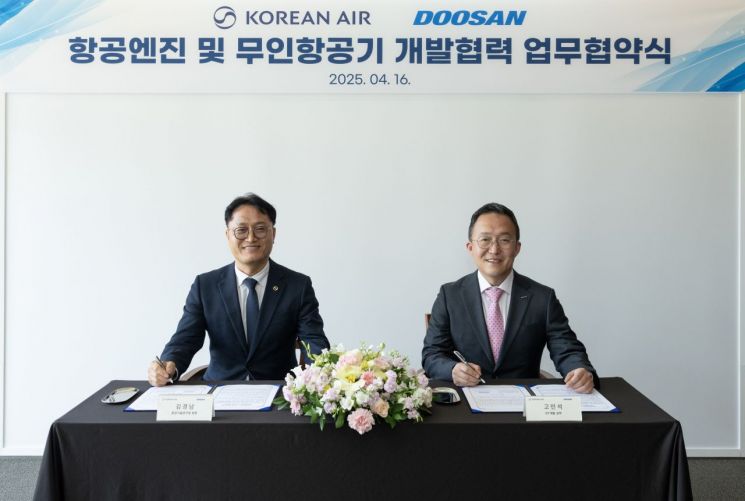 Kim Kyung-nam, Head of Korea Air Aerospace Technology Research Institute (left), and Go Min-seok, GT Development Manager, are signing the memorandum of understanding (MOU) for the aircraft engine and unmanned aerial vehicle development project at the Doosan Enerbility headquarters in Changwon, Gyeongnam, on the 16th. Doosan Enerbility
With this, Doosan Enerbility has established partnerships with both domestic aircraft system companies, KAI and Korean Air. Aircraft systems refer to the entire flight system encompassing the components of an aircraft and their interactions. Recently, Doosan Enerbility has been expanding its public-private cooperation for aero engine development. In December last year, it signed a business agreement with KAI for aero engine development, and in January, it contracted with the Agency for Defense Development for aero engine testing projects.
Aero engines are key devices that determine aircraft performance, but due to their highly complex and sophisticated technology, Korea has yet to achieve localization. The Korean government aims to secure technology for 10,000 lbf-class engines for UAVs and 15,000 lbf-class aero engines by the early 2030s to achieve localization. Currently, only five countries? the United States, the United Kingdom, Russia, France, and China?produce their own aero engines.
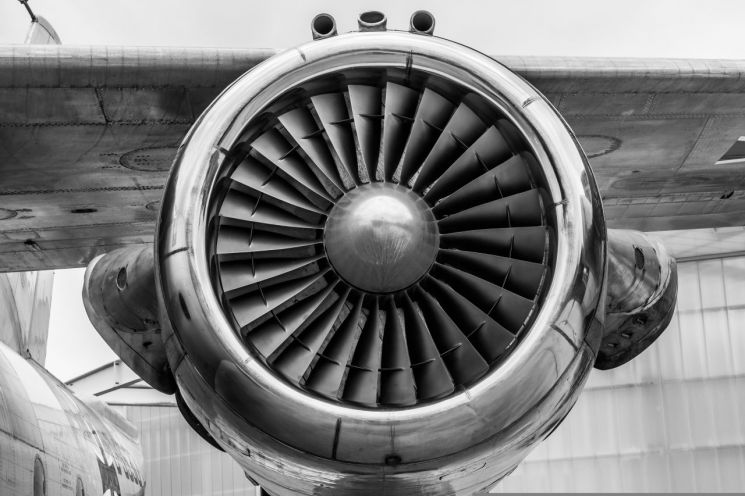
Doosan Enerbility has already secured core technology for 'power generation gas turbines,' which are structurally similar to aero engines. Since high-temperature component technology is key to aero engine development, the company plans to achieve full localization based on this foundation. Son Seung-woo, head of the Power Service Business Group at Doosan Enerbility, said, "We are focusing on cooperation and development to localize the aero engine lineup ranging from small to medium-large sizes," adding, "We will leverage the technology and know-how accumulated in the power generation gas turbine business to develop aero engine technology and expand our business."
© The Asia Business Daily(www.asiae.co.kr). All rights reserved.













