"Concerns Over Supercomputer Use"
Nvidia Faces $5.5 Billion Loss
The Donald Trump administration in the United States has restricted the export of Nvidia's H20 AI chip to China. This move appears to further intensify pressure on China, the main target of the ongoing trade war.
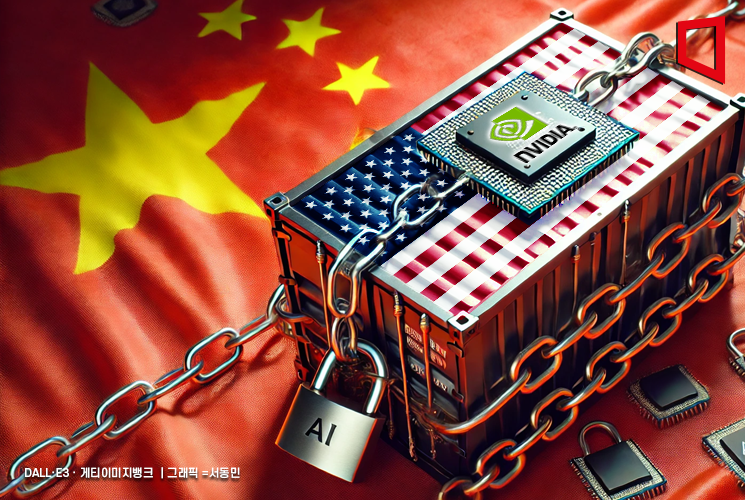
On the 15th (local time), Nvidia announced that it was notified by the U.S. government on the 9th that government approval is required for exporting the H20 chip to China. Additionally, on the 14th, it received a notice that this regulation would be applied indefinitely.
The U.S. government initially restricted exports of AI chips to China, including those from Nvidia, in October 2022, and has since expanded the scope and countries targeted. Nvidia explained that the U.S. government cited concerns that the H20 chip could be used or dedicated to Chinese supercomputers as the basis for the new regulation. Although the H20 chip performs lower than the latest model, Blackwell, it has excellent high-speed memory and connectivity with other chips, making it potentially useful for building supercomputers. This chip is among the highest-spec chips that the U.S. has legally provided to China so far. Notably, the H20 chip gained attention as one of the chips used by the Chinese AI startup DeepSeek for AI model training.
Due to this export restriction, Nvidia expects to recognize related costs such as inventory, purchase commitments, and provisions in the first quarter of its fiscal year (February to April), resulting in a loss of $5.5 billion (approximately 7.8 trillion KRW). This multi-trillion won cost is interpreted as stemming from the inability to supply the massive orders from Chinese companies. Earlier, IT specialized media The Information reported that Chinese tech giants Alibaba, Tencent, and ByteDance ordered more than $16 billion worth of H20 chips in the first quarter of this year.
Following this, Nvidia's stock, which had closed up 1.3% during regular trading hours on the New York Stock Exchange that day, fell more than 6% in after-hours trading.
Previously, on the 9th, U.S. public broadcaster NPR reported that the Trump administration had withdrawn plans to restrict exports of the H20 chip to China. The outlet cited sources saying that the policy changed after Jensen Huang, Nvidia's CEO, attended a dinner at Mar-a-Lago, President Trump's residence, and pledged new investments in AI data centers within the U.S.
Subsequently, on the 14th, Nvidia announced plans to build AI infrastructure worth up to $500 billion (approximately 700 trillion KRW) over the next four years with partners to produce supercomputers domestically in the U.S.
© The Asia Business Daily(www.asiae.co.kr). All rights reserved.












