Market Cap Reaches 1,574 Trillion Won...
Sales Could Total 1,144 Trillion Won
HFCAA, Executive Orders, and VIE Structures Cited as Possible Measures
The trade war between the United States and China has escalated to an extreme level, spreading its impact to the stock market as well. Amid increasing U.S. pressure on China, some factions within the U.S. political sphere are even considering measures to delist Chinese companies from the U.S. stock market. Wall Street anticipates that if such measures are implemented, it could lead to sales amounting to approximately 1,144 trillion won.

On the 15th (local time), Bloomberg News and the political media outlet Politico reported that the U.S. political circles are discussing the delisting of about 300 Chinese companies listed on U.S. stock exchanges.
Earlier, on the 9th, U.S. Treasury Secretary Steven Mnuchin said in an interview with Fox Business regarding the delisting of Chinese companies, "I think everything is on the negotiating table." Kevin O’Leary, a billionaire investor and close associate of former President Donald Trump, claimed on the 11th on Fox Business that this measure would help bring China to the negotiating table.
Voices calling for the delisting of Chinese companies are also emerging within the Republican Party. Senator Rick Scott (Florida) recently mentioned this issue in a letter to Paul Atkins, nominee for chairman of the Securities and Exchange Commission (SEC). He stated, "The U.S. capital market is envied by companies worldwide and offers incomparable fundraising opportunities to companies globally. However, such privileges come with responsibilities, primarily transparency and compliance with financial disclosure regulations." He added, "It is concerning that Chinese companies enjoy access to U.S. capital while not adhering to U.S. regulations."
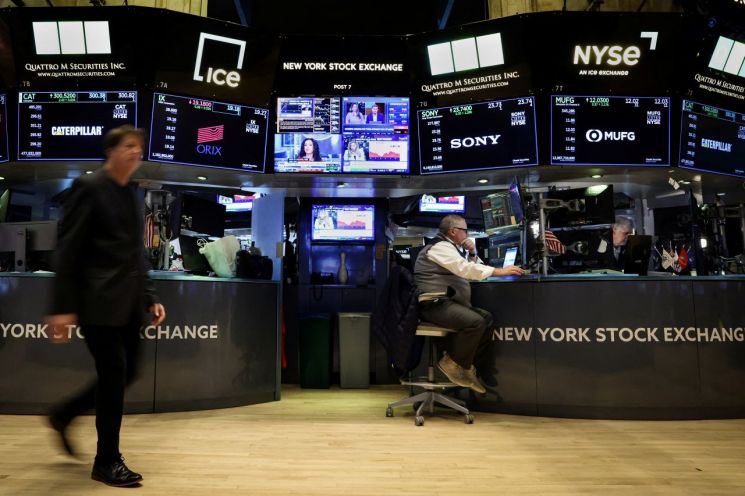
The delisting of Chinese companies from the U.S. stock market was also raised during the first term of the Trump administration. Politico reported that it is unclear how seriously the Trump administration considered this. However, the renewed interest in this idea reflects that the U.S. is reviewing all possible measures amid the intensifying trade war.
Jeremy Mark, senior researcher at the Atlantic Council, said, "The U.S. is considering all means to pressure China, and Chinese companies listed on the U.S. stock market are very prominent and important."
According to the U.S.-China Economic and Security Review Commission (USCC), as of March 7, there are 286 Chinese companies listed on U.S. exchanges, with a market capitalization of $1.1 trillion (approximately 1,573.66 trillion won).
There are several ways the U.S. could delist Chinese companies from exchanges. First, under the Holding Foreign Companies Accountable Act (HFCAA), companies that fail to comply with U.S. accounting standards and do not properly respond to audits for two consecutive years can be delisted. In February, President Trump issued an executive order directing the assessment of whether appropriate financial audit standards are being met by these companies. However, this method takes several years.
There is a faster method. Jared Seiberg, director at TD Cowen, stated that the quickest and easiest way is for President Trump to issue an executive order on national security grounds to delist Chinese companies from the U.S. stock market. He also mentioned that banning the Variable Interest Entity (VIE) structure, which Chinese companies use when listing in the U.S., could be considered. Chinese companies have used this structure to circumvent foreign ownership restrictions in their home country while raising capital in the U.S.
The SEC could order the delisting of companies based in China or Hong Kong or cancel their registration for trading in the U.S. It could also invoke emergency powers to order trading suspensions, Bloomberg reported.
Jefferies analysts said, "The U.S. holds two powerful cards: delisting American Depositary Receipts (ADRs) and banning investments in the U.S." They added, "The U.S. reciprocal tariffs are not merely trade issues but measures to ensure U.S. victory in the U.S.-China competition."
Regardless of the method used, if it leads to large-scale delisting, the impact on the market is expected to be enormous. Goldman Sachs analysts stated that restricting U.S. investors' investments in Chinese stocks could trigger sales worth about $800 billion (approximately 1,144.48 trillion won). JP Morgan estimated that if delisting occurs, these companies would be excluded from global indices, causing passive fund outflows of about $11 billion (approximately 15.7179 trillion won).
Companies such as PDD Holdings, the parent company of Temu, Bishop Holdings, and TAL Education Group could be severely affected. Most Chinese companies are dual-listed on both the Hong Kong and U.S. stock exchanges, but these companies are not listed on the Hong Kong exchange, leaving no way to avoid the impact.
Chinese Foreign Ministry spokesperson Liu Fengyu told Politico, "Undermining trust in Chinese companies' investments in the U.S. does not help the U.S. business environment at all," adding, "Excluding Chinese companies and the Chinese market will ultimately damage the U.S.'s economic interests and international credibility."
However, the Nasdaq Golden Dragon China Index, which tracks Chinese companies listed in the U.S., has not yet reflected these risks as of this day. It has fallen about 0.5% this year, outperforming the S&P index, which declined 8% over the same period.
© The Asia Business Daily(www.asiae.co.kr). All rights reserved.












