Goldman Sachs Lowers Target for Key Chinese Stock Indices Again
Cites "Unprecedented U.S.-China Trade Tensions" and Decoupling Risks
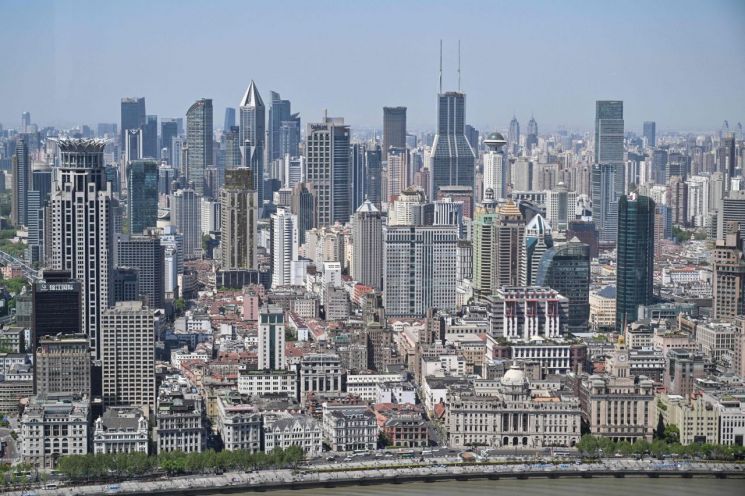
U.S. major investment bank Goldman Sachs has lowered its target for key Chinese stock indices for the second time this month, reported Bloomberg News on the 14th (local time).
Goldman Sachs' Kingger Lau, Chief Strategist for Chinese equities, lowered the 12-month target for the MSCI China Index from 81 to 75, and the 12-month target for the CSI 300 Index, composed of the top 300 stocks by market capitalization on the Shanghai and Shenzhen stock exchanges, from 4500 to 4300. This is the second downward revision this month. The new targets represent increases of 12% and 15%, respectively, from current levels.
In a memo on the same day, Chief Strategist Lau explained the reason for the downward revision, stating, "U.S.-China trade tensions have surged to unprecedented levels, fueling concerns about a global recession and decoupling risks between the world's two largest economies."
Earlier, he had raised the MSCI China Index target from 75 to 85 in February, citing the emergence of China's artificial intelligence (AI) company DeepSeek as a catalyst for further rally in the Chinese stock market. After U.S. tariffs on China were implemented, he lowered the target to 81 on the 6th of this month.
While the U.S. government showed inconsistent stances regarding tariffs on semiconductors and other products, the Chinese stock market showed gains on the day. As of 2:50 p.m. Korea time, the Shanghai Composite Index was up 0.66%, the CSI 300 Index rose 0.23%, the Hong Kong Hang Seng Index increased by 2.04%, and the Hong Kong H-Share Index (HSCEI), composed of mainland Chinese companies listed in Hong Kong, was up 1.76%.
The U.S. Customs and Border Protection (CBP) announced on the 11th the "Notice of Exclusion from Reciprocal Tariffs on Certain Goods," exempting smartphones, laptop computers, hard disk drives, computer processors, memory chips, semiconductor manufacturing equipment, and other items from country-specific reciprocal tariffs. However, two days later on the 13th, U.S. President Donald Trump stated that semiconductors and other electronic products were not exempt from tariffs and announced that the specific tariff rates for semiconductors would be announced next week.
© The Asia Business Daily(www.asiae.co.kr). All rights reserved.












