Chinese Government's Export Permit Required for Overseas Shipments
Key Materials for Magnets Essential to Electric Motors
Global Pressure... South Korea, Japan, and Germany Also Affected
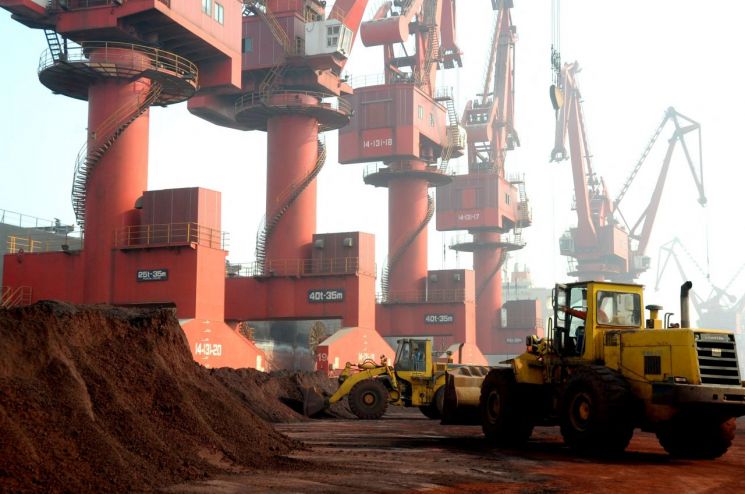 Workers are transporting soil containing rare earth elements for export at Lianyungang Port in Jiangsu Province, China. The New York Times (NYT) reported on the 13th (local time) that the U.S. defense industry and others have been directly impacted as China has imposed export controls on rare earth elements. Photo by Reuters Yonhap News
As China imposes export controls on rare earth elements in response to U.S. President Donald Trump's tariff barrage, there are concerns that various industrial sectors, including the U.S. defense industry, could be directly impacted.
According to the U.S. daily The New York Times (NYT) on the 13th (local time), the controlled exports include heavy rare earth elements such as gadolinium, terbium, dysprosium, lutetium, scandium, yttrium, and rare earth magnets. To export these items outside China, special export permits from the Chinese government are required.
These items are core materials for magnets that are essential in various electric motors. These electric motors are key components of electric vehicles, drones, robots, missiles, and spacecraft, and are also used in internal combustion engine vehicles.
Additionally, heavy rare earth elements are used in chemicals for manufacturing jet engines, laser equipment, automobile headlights, and spark plugs, and are also key materials for capacitors, components of artificial intelligence (AI) servers and smartphone chips.
Most of these essential heavy rare earth elements and rare earth magnets used across diverse industrial fields are produced in China. As of 2023, China produces 99% of the world's supply of heavy rare earth elements. In the case of rare earth magnets, China produces 90%, with the remainder manufactured in Japan and Germany; however, Japan and Germany also source the raw materials needed for magnet production from China.
This move is analyzed as a calculated effort by China to leverage its monopolistic position as a rare earth supplier in the global market to deliver a substantial blow to the U.S. industrial sector.
In fact, the U.S. industry is already on high alert. Daniel Fikard, chairman of the U.S. Trade Representative (USTR) and Department of Commerce's 'Critical Minerals Advisory Committee,' emphasized that China's export controls will have a serious impact on the U.S. and that the rare earth issue must be resolved swiftly.
James Litinsky, chairman and CEO of the U.S. rare earth company MP Materials, expressed particular concern about the supply of rare earths to defense contractors, stating, "Drones and robotics are considered the 'future' of warfare, and right now we are witnessing the closure of future supply chains for critical materials."
Meanwhile, this export control measure targets not only the U.S. but the entire world. Therefore, countries such as South Korea, Japan, and Germany are also within its scope.
© The Asia Business Daily(www.asiae.co.kr). All rights reserved.











