Electronic Devices and Semiconductors Excluded from Reciprocal Tariffs
White House: "Will Announce Results of Semiconductor Investigation"
The U.S. government has excluded smartphones, computers, and other items from reciprocal tariffs.
The Customs and Border Protection (CBP) announced on the night of the 12th (local time) a "Notice of Exclusion from Reciprocal Tariffs on Certain Goods." The excluded items include smartphones, laptop computers, hard disk drives, computer processors, memory chips, and semiconductor manufacturing equipment. U.S. media outlets such as Bloomberg and The Wall Street Journal (WSJ) forecast that this measure will benefit companies like Samsung Electronics, Apple, Dell, Nvidia, and TSMC.
The U.S. currently imposes reciprocal tariffs of 125% on China and 10% on other countries. President Donald Trump has also imposed a so-called "10%+10%" tariff on China, separate from the reciprocal tariffs. The New York Times (NYT) and others analyzed that this 20% tariff, imposed for drug enforcement and other reasons, will remain in place.
Earlier, on the 4th, President Trump announced reciprocal tariffs and excluded items such as steel and automobiles, which already had item-specific tariffs, as well as semiconductors and pharmaceuticals, which are planned to have item-specific tariffs in the future, from the reciprocal tariff targets.
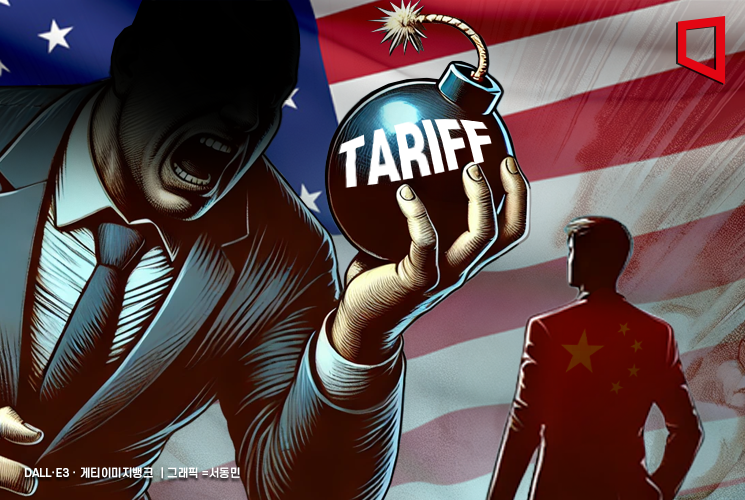
Accordingly, Bloomberg reported that the tariff exemption on smartphones and laptops may be temporary, and other types of tariffs could be applied soon. However, even in that case, the tariff rate is expected to be lower than the 125% reciprocal tariff imposed on China.
In this regard, the White House issued a statement on the same day under the name of spokesperson Caroline Levitt, stating that the U.S. cannot rely on China to produce core technologies such as semiconductors, smartphones, and laptops, Reuters reported. Levitt said, "President Trump has stated that automobiles, steel, pharmaceuticals, and semiconductors will be included in specific (other) tariffs to apply tariffs fairly and effectively," adding, "President Trump will soon announce the results of the Section 232 investigation on semiconductors."
Section 232 of the Trade Expansion Act grants the U.S. president the authority to take emergency measures if imported foreign products threaten U.S. national security. President Trump has used this law to impose 25% tariffs on steel and automobiles. He has repeatedly mentioned plans to impose item-specific tariffs on semiconductors as well.
© The Asia Business Daily(www.asiae.co.kr). All rights reserved.












