"Promoting a Shift to High Value-Added Work by Improving Manual Repetitive Tasks"
"Medical Prices Standardized Downward by Government Control... Little Room for Market Expansion"
"Most Smart Solutions Are Not Visibly Apparent... Difficult for Management to Make Decisions"
As AI-based electronic medical record automation systems and other digital transformations in medical institutions are gaining momentum, claims have been raised that still insufficient regulations are acting as obstacles.
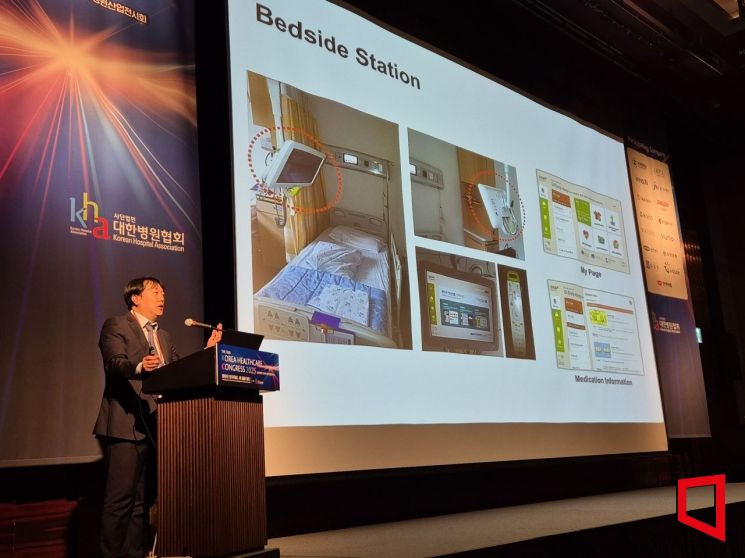 Professor Lee Ho-young of the Digital Healthcare Research Division at the Biomedical Research Institute, Bundang Seoul National University Hospital, is giving a presentation on "Smart Hospital" at the hospital management academic conference "KHC (Korea Healthcare Congress) 2025" held on the 11th at the Grand Intercontinental Seoul Parnas in Gangnam-gu, Seoul. Photo by Choi Tae-won
The Korea Hospital Association held the Asia's largest hospital management academic conference, 'KHC (Korea Healthcare Congress) 2025,' on the 11th at the Grand Intercontinental Seoul Parnas in Gangnam-gu, Seoul, under the theme 'Finding a New Path in the Chaos of Korean Healthcare.' In the session on 'Smart Hospitals' held that day, cases of hospital work efficiency through digitalization and factors hindering development were introduced.
The first speaker of the day, Kim Hye-sun, head of the Medical Information Team at Gangnam Severance Hospital, introduced the effectiveness of RPA (Robotic Process Automation). RPA refers to a system that automates rule-based simple repetitive tasks through software. Kim said, "Using RPA, rule-based simple repetitive tasks can be automated," adding, "Gangnam Severance Hospital has selected and is implementing 19 tasks across 7 departments related to admission and discharge medical records, nursing record checks, and more."
She continued, "Through the use of RPA, we were able to improve manual repetitive tasks and promote a transition to high value-added work," adding, "It enabled 24-hour task execution, improved accuracy, and created an environment where employees can perform creative and productive work."
While cases of smart hospitals were introduced, claims were also made that insufficient regulations are hindering development. Professor Lee Ho-young of the Digital Healthcare Research Division at the Biomedical Research Institute of Bundang Seoul National University Hospital emphasized, "Various regulatory and infrastructure deficiencies are holding back digital transformation," adding, "Now is the time for digital transformation toward a smart and healthy society."
He further pointed out, "The government wants to promote the healthcare industry, but for the industry to grow, there must be a market," adding, "However, the medical market is controlled by the government’s price regulation, and since prices are uniformly low, there is little room for market expansion."
He also criticized the lack of legal grounds for system improvements for smart hospitals. Professor Lee said, "Korea wants to create its own standards, but this ultimately leads to limitations that cannot be overcome," adding, "While Korean standards are important, international standardization of data is necessary."
He continued, "There are committees such as the Healthcare Data Standardization Promotion Committee, but they lack legal grounds," explaining, "Because there is no legal basis, they are constantly swayed, and the government or National Assembly may not consider the committee’s claims important without legal authority."
Concerns were also raised that focusing only on the appearance of smart hospitals is problematic. Kim Jong-yeop, director of the Biomedical Research Institute at Konyang University Hospital, said, "Sometimes hospitals focus on hardware introduction to appear smart," adding, "While this may have promotional effects, most smart solutions are software-based. Hardware aspects should be funded by promotional budgets, not smart budgets."
He added, "Most truly smart software-based solutions are not visually apparent, making it very difficult for management to make decisions," and suggested, "Therefore, such demands should come from frontline medical staff."
© The Asia Business Daily(www.asiae.co.kr). All rights reserved.












