Asia-Pacific 14 Countries Sustainability Disclosure Status Report Published
Four More, Including South Korea, to Finalize Within This Year
"Korean Companies Lack in Linking Performance to Compensation and Certification Through Internal Audits"
Although the pace of global sustainability (ESG) regulation advancement slowed after the inauguration of the second Trump administration, the direction of global sustainability regulations, including in the Asia-Pacific (APAC) region, has become clear. Among the 14 APAC countries, 12 have either already finalized sustainability disclosure regulations or plan to do so within this year.
On the 11th, Samil PwC announced the publication of the "Asia-Pacific 14 Countries Sustainability Status Report," which contains these findings. The report reviews the regulatory status in the APAC region surveyed by PwC and was prepared to present global sustainability disclosure trends and key areas for improvement for Korean companies based on data from the top 50 companies by market capitalization in the APAC region.
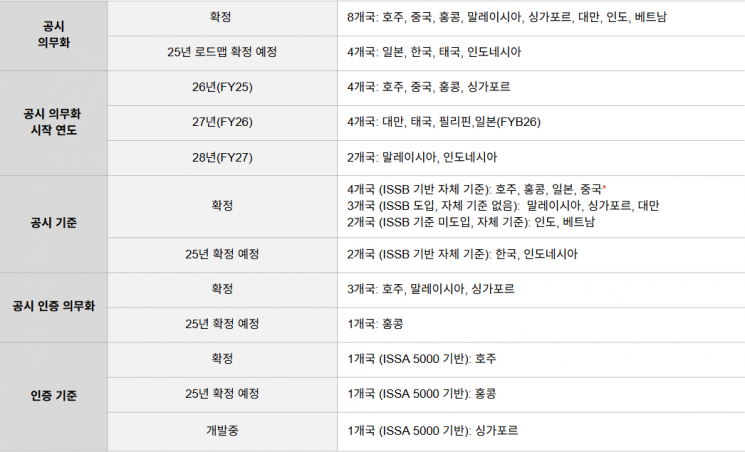
According to the report, except for India and Vietnam, which have adopted their own standards, six countries?Australia, China, Hong Kong, Malaysia, Singapore, and Taiwan?have confirmed mandatory disclosures based on the International Sustainability Standards Board (ISSB)'s International Financial Reporting Standards (IFRS) S1 and S2. Four other countries, including South Korea, Japan, Thailand, and Indonesia, are expected to finalize their disclosure roadmaps within this year. Notably, Japan finalized its sustainability disclosure standards in March and plans to disclose information in 2027 starting next year.
Accordingly, four countries are set to begin mandatory disclosures from next year. Australia, Malaysia, and Singapore have mandated disclosure certification, and three of these countries have either adopted or are currently developing the International Sustainability Standards Audit (ISSA) 5000 as the certification standard.
As sustainability disclosures by APAC companies continue to expand, key trends include disclosure of board roles, strengthened risk management, setting climate targets, and expanded emissions disclosures. The report evaluated, "Companies are actively disclosing board responsibilities and risk management procedures, and most tend to prioritize medium- to long-term sustainability strategies over short-term goals. An increasing number of companies are disclosing climate targets and related metrics, but disclosures reflecting climate risk analysis remain limited."
Differences were also observed in emissions disclosure methods. Among companies disclosing Scope 3 emissions, many provided only basic information. Only a few companies disclosed detailed data.
Korean companies generally publish high-quality sustainability reports within the APAC region. However, some areas for improvement were identified. Compared to APAC companies, the most notable differences were ▲linking sustainability performance to compensation ▲certification through internal audits ▲adoption of certification standards. Korean companies recorded a 48% rate of linking sustainability performance to executive compensation, placing them in the mid-range among APAC countries. The certification system through internal audits was also found to be insufficient. Accordingly, ▲developing flexible response strategies ▲expanding linkage to executive compensation ▲strengthening disclosure reliability were identified as three key tasks in the report.
Steven Kang, Sustainability Platform Leader at Samil PwC, stated, "Although the pace of global sustainability regulation advancement seems to have slowed with the inauguration of the second Trump administration, national policies and regulations are rather finding their own directions and settling in." He added, "To ensure Korean companies do not fall behind in global business, it is necessary to set a clear direction as soon as possible to reduce uncertainty and enhance competitiveness." More details can be found on the Samil PwC website.
© The Asia Business Daily(www.asiae.co.kr). All rights reserved.












