A multifunctional electrolyte that improves the short lifespan of lithium metal batteries has been developed domestically.
On the 11th, the National Research Foundation of Korea announced that a joint research team consisting of Professors Jinwoo Lee and Namsun Choi from the Korea Advanced Institute of Science and Technology (KAIST) and Professor Taekyung Lee from Gyeongsang National University developed a nanoparticle electrolyte that can extend the lifespan of lithium metal batteries while enhancing high-speed charging/discharging and high-voltage performance.
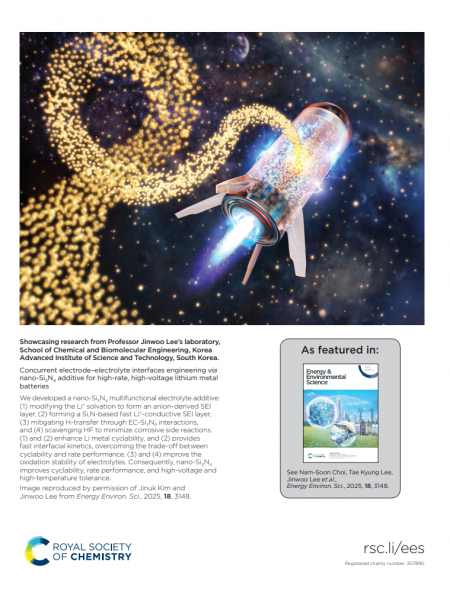 Back cover image in the academic journal Energy & Environmental Science. Provided by the National Research Foundation of Korea
Lithium metal batteries use lithium metal as the anode material. They are noted as next-generation batteries due to their top-tier energy density.
However, practical application has been challenging due to limitations such as a rapid decrease in lifespan under practical conditions and easy corrosion at high voltages. Practical conditions refer to the anode-to-cathode ratio that maximizes performance while minimizing the amount of lithium and electrolyte used in lithium metal batteries.
A representative electrolyte modification method to extend the lifespan of lithium metal batteries is the use of fluorine-based additives (adding a high content of fluorine components to the electrolyte to facilitate lithium ion movement). However, even in this case, high cost, environmental pollution, and degradation of other key performances posed limitations.
To overcome these limitations, the joint research team proposed an electrolyte design strategy that can improve performance without disrupting the balance among the core performances of lithium metal batteries.
This method involves adding non-fluorine-based silicon nitride nanoparticles to the electrolyte to precisely control the solvation structure of lithium ions and form a stable solid electrolyte interphase layer rich in inorganic materials. Solvation refers to the stabilization of lithium ions in a liquid, which affects battery performance. The solid electrolyte interphase is a thin protective film formed when lithium reacts with the electrolyte.
Lithium metal batteries using the nanoparticle electrolyte developed based on the strategy proposed by the joint research team were experimentally confirmed to maintain long-term cycle performance not only under practical conditions but also in high-temperature (50°C), high-speed charging/discharging (1C), and high-voltage (4.5V) environments.
In particular, in a 360 Wh/kg-class pouch cell test, 74% of the capacity was maintained even after 100 cycles, demonstrating the practical commercialization potential of the nanoparticle additive. Pouch cells, which are pouch-type batteries, have higher energy density and flexibility compared to cylindrical and prismatic types, attracting attention in the battery market.
Professor Jinwoo Lee, the lead researcher, emphasized, "This study is significant in that it realized multifunctionality with a single non-fluorine-based additive and was the first to apply nanoparticle electrolytes to pouch-type batteries."
Meanwhile, this research was conducted with support from the Nano and Materials Technology Development Project promoted by the Ministry of Science and ICT and the National Research Foundation of Korea. The research results were published on February 13 in the energy field journal Energy & Environmental Science and were also selected as an Inside Back Cover paper.
© The Asia Business Daily(www.asiae.co.kr). All rights reserved.












