Filming, Art, and Music Directors Reveal the Making of 'Poksak Soksassuda'
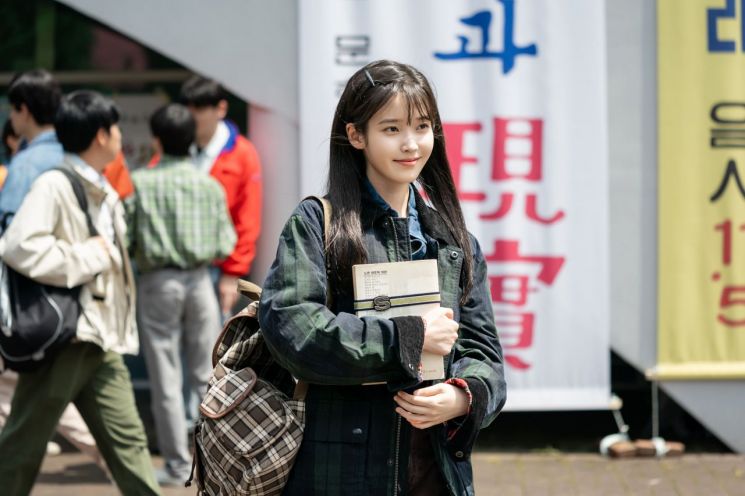
"It was the work of making jars using gold and silver as materials."
Director of Photography Choi Yoon-man, who captured the scenery of the Netflix drama 'Poksak Soksassuda,' summarized the drama this way. Spanning 65 years from the 1960s through the 80s and 90s to the present, another main character of the drama is the era itself.
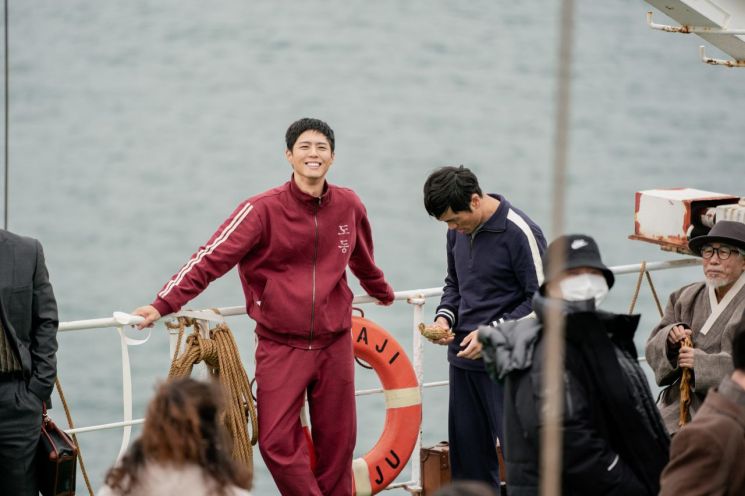
Through set filming and on-location shooting, the production completed the depiction of a seaside village in Jeju Island and the streets of Seoul across different times. The scene where Gwansik (Park Bo-gum) dives into the sea and swims to meet Aesoon (IU) on the breakwater was filmed at three different locations. The scenes of Gwansik on the boat were shot in Busan, Aesoon watching from Jangheung, and the set was used for other shots.
Art directors Ryu Seong-hee and Choi Ji-hye recalled that the biggest challenge was how to express 'time.' They resolved it through artistic elements such as color, patterns, and textures, saying, "Beyond recreating the era, it was important to realize the space of emotions and memories between characters. We focused on creating spaces that reflected the feelings of that time rather than strict realism."
Moreover, empathy from the younger generation was also important. The art team said, "After thorough historical verification, we recreated the styles, fonts, colors, and layouts of placards, flyers, and posters. Each was handcrafted and printed one by one."
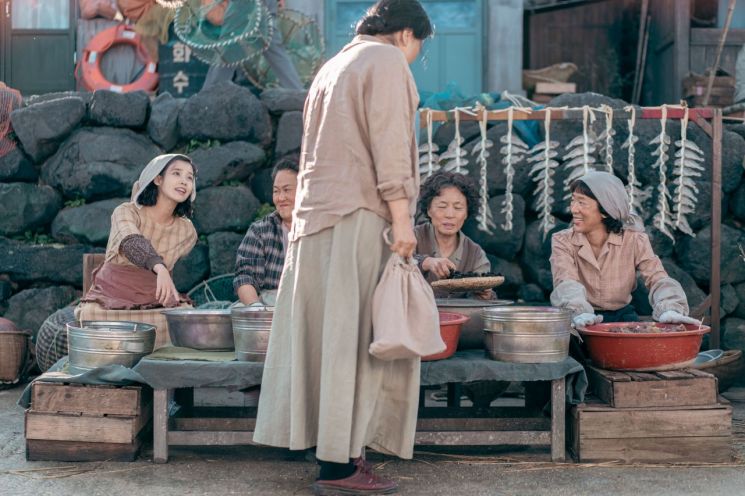
Securing a large set site capable of recreating a fishing village in Jeju and the streets of Jeju City was also a challenge. After searching nationwide, the production secured a suitable site in Andong. Instead of Jeju's native basalt, which cannot be brought to the mainland, basalt sourced from Vietnam and Cheorwon was used to recreate Jeju stone walls on the set.
The scene where Geumnam-i (IU) and Youngbeom (Lee Jun-young) part ways during military leave was filmed separately for characters and background and then composited. The stormy scene on the boat was completed through the combined efforts of the special effects and CG teams.
The marketplace where Aesoon sold cabbages transforms over time into a market selling fish and vegetables, and later into a space where middle-aged Aesoon sets up her stall. Also, the Hwiangsae Caf? where Aesoon had a matchmaking meeting with Sanggil (Choi Dae-hoon) changes over time into Soon-i's Aunt's restaurant. These locations, symbolizing both the characters' survival and the changes of the era, were designed with changes in mind during the set construction phase. Details such as signboards, stall materials, and road surfaces were expressed differently for each era.
The powerful emotions that surge like waves in life were greatly supported by music. Music director Park Sung-il said, "We chose to focus on emotions rather than a genre-based approach. Unfamiliar music could interfere with the viewers' emotional flow."
In episode 1, distinctive music was created using traditional Korean instruments in Western music. While using Korean instruments, traditional Korean rhythms were not borrowed. Aesoon's theme used a Korean flute instead of a Western flute, and the disco rhythms popular in the West during the 60s and 70s were combined with the geomungo (a traditional Korean string instrument).
Familiar songs to the public such as Kim Jung-mi's "Bom (Spring)," Jang Deok's "Yae Yae," Ham Joong-ah's "Smile Please," Lee Chi-hyun and Friends' "Only You," Nogojiri's "Teacup," and Jung Mi-jo's "Ear" were played. Music director Park explained, "The music of masters like Shin Joong-hyun, Yoo Jae-ha, Kim Kwang-seok, and Cho Yong-pil has powerful impact. Younger generations today may not know them well, but those in their 40s and older would definitely recognize these famous songs."
Overseas copyright regulations are strict and complicated. Regarding the use of The Beatles' "Yesterday," which has the most complex copyright issues, he said, "Obtaining final approval required enormous costs and time," adding, "This is the first time a Korean drama has used the original song by The Beatles."
It was also a technical challenge. After music editing, surround music mixing was redone using Dolby ATMOS. Dolby ATMOS is a more advanced surround mixing technique than the commonly used 5.1 surround mixing in cinemas. Music director Park explained, "When the seaside village ambience flows to the front, the music naturally moves to the back; when Gwansik, who lost his name in the typhoon, howls, or when the camera pans from the sky to the ground, the music also pours down from the ceiling?these were technical attempts."
© The Asia Business Daily(www.asiae.co.kr). All rights reserved.

![Clutching a Stolen Dior Bag, Saying "I Hate Being Poor but Real"... The Grotesque Con of a "Human Knockoff" [Slate]](https://cwcontent.asiae.co.kr/asiaresize/183/2026021902243444107_1771435474.jpg)
















