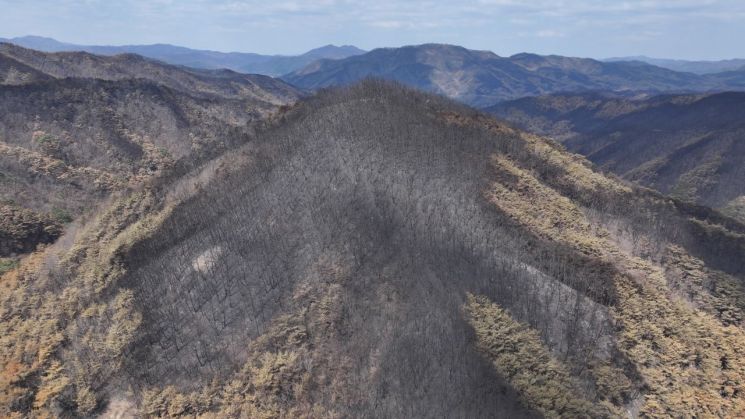
 On the 7th, an aerial view of Juwangsan National Park in Cheongsong-gun, Gyeongbuk. The forest scorched by the wildfire is charred gray. Photo by the Ministry of Environment Joint Press Corps
An analysis revealed that the wildfire incident last month emitted greenhouse gases equivalent to 3.66 million tons of carbon dioxide (CO2eq). This amount is comparable to the greenhouse gas emissions produced by approximately 35 million mid-sized cars traveling round-trip between Seoul and Busan.
On the 8th, the Korea Forest Service's National Institute of Forest Science announced that from the 21st to the 30th of last month, an estimated 3,659,200 tons of CO2eq greenhouse gases were emitted from the wildfire-affected area of 48,239 hectares in the Gyeongbuk, Gyeongnam, and Ulsan regions. The most emitted substance was carbon dioxide, totaling 3,244,000 tons. Methane emissions reached 272,100 tons, and nitrous oxide emissions were 142,400 tons.
The greenhouse gases emitted over the ten days are equivalent to the amount produced by 34.36 million mid-sized cars making a round trip of 800 km between Seoul and Busan. Additionally, this corresponds to about 9.2% of the net greenhouse gas absorption of 39.87 million tons by forests nationwide in 2022.
By region, Gyeongbuk had the highest greenhouse gas emissions. Approximately 3,425,500 tons, accounting for 93% of the total, were recorded in Uiseong, Andong, Cheongsong, Yeongdong, and Yangyang in Gyeongbuk. Gyeongnam followed with 140,830 tons, then Ulsan with 75,400 tons, Jeonbuk with 7,000 tons, and Chungbuk with 3,000 tons.
However, the National Institute of Forest Science explained that since this data is based on the current provisional wildfire-affected area, the greenhouse gas emissions may increase if the wildfire damage area expands after further investigation.
© The Asia Business Daily(www.asiae.co.kr). All rights reserved.











