Improving Prices of Major Dining Items... Incentives for Participation
Public-Private Consultative Body Launched Amid Ongoing Overcharging Controversies
Jeju Island is launching an image renewal campaign by operating a reporting center to eradicate overcharging.
On the 6th, Jeju Island announced that it will improve the prices of major dining items such as hairtail fish, pork belly, kimchi stew, jajangmyeon, and kalguksu, which are considered more expensive than the national average.
To this end, it will promote ▲ development of single-person menus ▲ presentation of appropriate prices per order unit ▲ display of representative menu prices outside restaurants ▲ provision of information on affordable local eateries. Incentives will be provided to participating businesses.
Additionally, to resolve overcharging controversies at festival sites, a reporting center will be operated, and it is recommended to add images of food on menus or place food sample models in front of booths.
To systematically implement these improvement measures, the province launched the “Creating Cost-effective Jeju Tourism” public-private consultative body on the 4th.
The consultative body includes departments in charge of seven major tourism sectors?accommodation, transportation, restaurants, tourist attractions, travel agencies, golf courses, and beaches?from the provincial and administrative city offices, as well as chairpersons of Jeju Tourism Association subcommittees and representatives of related organizations.
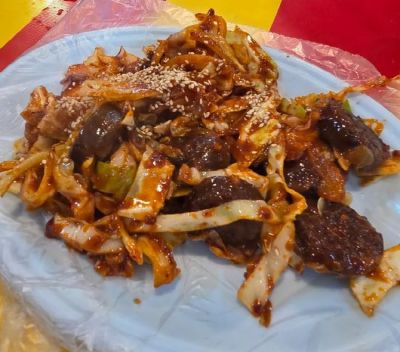 Stir-fried Sundae from a street stall recently controversial for overcharging in Jeju Island
 [Image source=Online community capture]
Jeju Island has recently been making every effort to attract tourists by operating travel weeks such as the “Jeju-e Pokssak Ppaessuda” campaign. However, overcharging controversies have resurfaced, leading to an increase in tourist departures.
Earlier, from the 28th to the 30th of last month, some street vendors at the King Cherry Blossom Festival held on Jeonnong-ro in Jeju City sold stir-fried sundae (Korean blood sausage) containing six pieces for 25,000 won, which was widely criticized after being shared on online communities.
According to the Jeju Special Self-Governing Province Tourism Association, the number of tourists visiting Jeju from January to February this year was approximately 1.81 million, a 12.3% decrease compared to 2.06 million tourists during the same period last year.
In fact, in the recently conducted “2024 Jeju Visitor Survey,” travelers showed high satisfaction scores in the 4-point range for food and tourist attractions, but the travel expenses (including prices at tourist sites) category received the lowest score of 2.93.
According to the consumer research agency Consumer Insight, the average daily travel expense in Jeju is 134,000 won. This is 1.5 times the national average of 88,000 won and more than twice the 63,000 won travel expense of Gwangju, which is considered the cheapest city.
In response, Jeju Governor Oh Young-hoon said at last month’s monthly policy sharing meeting, citing “grilled hairtail fish” as an example, “The structural improvement and innovation of Jeju tourism must be achieved.”
Governor Oh pointed out, “After analyzing why Jeju tourism is considered expensive, grilled hairtail fish was identified as a representative case,” adding, “The price system ranging from 70,000 to 100,000 won per person stems from a mindset focused on single-turn customer spending.”
© The Asia Business Daily(www.asiae.co.kr). All rights reserved.












