Recognized for Its Architectural Style as a Royal Temple of Seoul and Gyeonggi in the Late Joseon Period
The 'Paju Bogwangsa Daebang' building is scheduled to be registered as a Gyeonggi-do Registered Cultural Heritage. According to Paju City on the 3rd, the Paju Bogwangsa Daebang currently retains the appearance of a building originally rebuilt during the reign of King Gojong in 1869, with partial repairs carried out between 1913 and 1914.
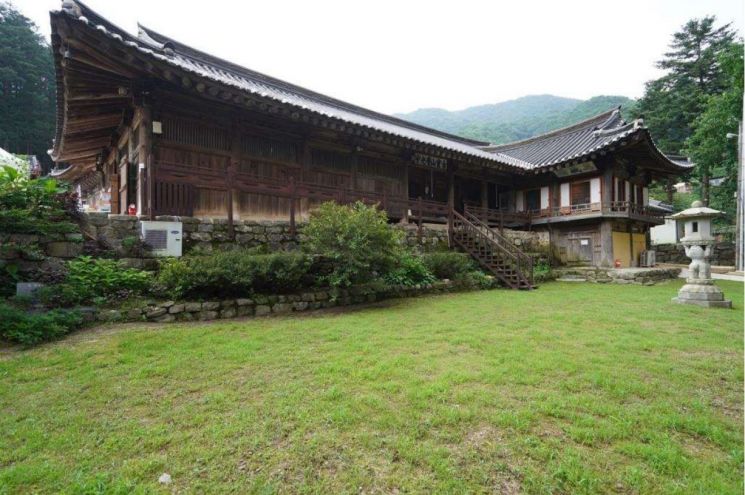 The 'Paju Bogwangsa Daebang' building is scheduled to be registered as a cultural heritage site in Gyeonggi Province. A view of 'Paju Bogwangsa Daebang.' Provided by Paju City.
The Daebang is built on a double high stone platform and forms a T-shaped floor plan by combining the kitchen (currently the Jongmuso office), Daebang, Sobang, Maru, and Nugaek. It was constructed with a scale of 9 kan on the front, 8 kan on the east side, and 4 kan on the west side.
The 'Paju Bogwangsa Daebang' was initially called ‘Nubang’ at the time of its construction, later named ‘Yeombuldang’ in the early 20th century, and currently, a signboard reading ‘Manseru (萬歲樓)’ hangs on the front of the Numaru. The Seungbang also has a signboard inscribed with ‘Goryeongsan Bogwangsa (高靈山普光寺),’ which is known to be the handwriting of King Yeongjo of the Joseon Dynasty. Meanwhile, a beautifully carved and painted ‘Mok-eo (wooden fish)’ hangs in the Maru, inspiring admiration from visitors to Bogwangsa.
According to experts, the ‘Daebang (大房)’ style is seen in temples built with royal patronage in the Seoul and Gyeonggi regions during the late Joseon period. It reflects the era of the modern period when Pure Land chanting Buddhism was widely practiced, featuring a unique complex space designed to facilitate chanting practice by incorporating chanting spaces, Nugaek, Seungbang, kitchen, and other auxiliary spaces, with the Daeungbojeon serving as both a practical and symbolic Buddhist altar.
Yoo Cho-ja, Director of the Culture and Arts Division, stated, “Currently, the kitchen space of Bogwangsa’s Daebang has been repurposed as the Jongmuso office for modern usability, and the space under the Nugaek is used as a boiler room, but overall, the building retains its original form from the 19th to early 20th century, giving it architectural value.” He also added, “By registering it as a cultural heritage, the usability of the building will not be compromised, and the value of the heritage can be preserved.”
The 'Paju Bogwangsa Daebang' is currently undergoing the ‘Gyeonggi-do Registered Cultural Heritage Registration Notice’ process, and it is expected to be designated as a Gyeonggi-do Registered Cultural Heritage after the announcement period ends on the 27th.
© The Asia Business Daily(www.asiae.co.kr). All rights reserved.

![Clutching a Stolen Dior Bag, Saying "I Hate Being Poor but Real"... The Grotesque Con of a "Human Knockoff" [Slate]](https://cwcontent.asiae.co.kr/asiaresize/183/2026021902243444107_1771435474.jpg)














