The design standards for forest roads will be strengthened. This is to ensure the stability of forest road facilities with robustness that does not collapse under extreme heavy rain conditions.
The Korea Forest Service announced on the 3rd that it will implement the "Amendment to the Enforcement Rules of the Act on the Creation and Management of Forest Resources" containing these details.
The amendment to the enforcement rules was made with the intention of sufficiently reflecting disaster prevention functions from the design stage of forest roads, considering the recent situation where natural disasters such as extreme heavy rain have become frequent due to climate change, thereby preserving the ecological value of forests and protecting the lives and property of the public.
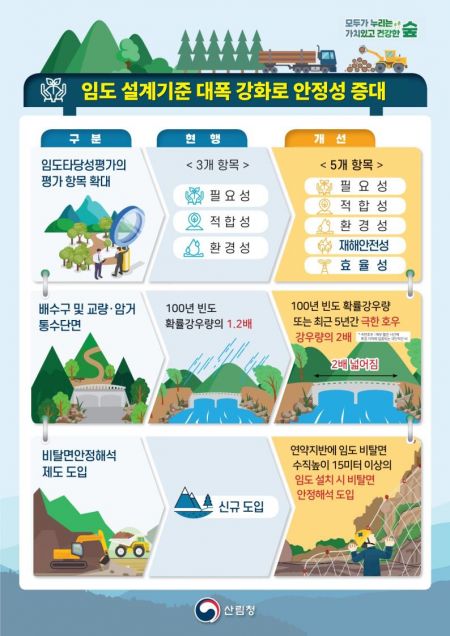
According to the amendment, the design standards applied when installing major structures within forest roads such as drainage outlets, bridges, and culverts (underground drainage structures) will become more stringent.
For example, previously, the installation of major structures within forest roads was designed to withstand about 1.2 times the rainfall amount corresponding to the 100-year frequency probability rainfall (extreme rainfall likely to occur once every 100 years).
However, going forward, the design must be able to withstand water up to "twice" the rainfall amount calculated by reflecting either the recent 100-year frequency probability rainfall or the extreme heavy rain conditions of the past five years.
Additionally, when installing forest roads in areas with soft ground and a vertical slope height of 15 meters or more, a "slope stability analysis" to evaluate whether the slope will not collapse and can maintain a stable state must be mandatorily conducted.
If the analysis results determine that stability is insufficient, the amendment requires the mandatory installation of structures such as retaining walls to secure the stability of forest road facilities in advance.
The evaluation items for forest road feasibility have also been expanded from three to five. In addition to the existing evaluation items of ▲necessity ▲appropriateness ▲environmental friendliness, disaster safety and efficiency have been added to comprehensively consider the stability and maintenance/management aspects of forest roads.
The Korea Forest Service plans to use the amendment to more thoroughly review the feasibility of forest road installation while ensuring that forest roads can be utilized as key facilities performing public functions such as forest management, wildfire suppression, ecotourism, and forest welfare.
Further detailed information about the amendment can be found at the National Law Information Center.
Park Eun-sik, Director of the Forest Industry Policy Bureau at the Korea Forest Service, said, "The Korea Forest Service will continue to improve and supplement related systems so that forest roads can function as key facilities that not only enable systematic forest management and disaster prevention but also enhance the convenience of public forest use."
© The Asia Business Daily(www.asiae.co.kr). All rights reserved.












