The first appellate trial for Song Young-gil, leader of the Sonamu Party (former leader of the Democratic Party), who was sentenced to prison in the first trial on charges including illegal political fund receipt, was held on the 2nd. The prosecution and Song’s side clashed over the legality of the so-called 'Lee Jeong-geun recording' as evidence.
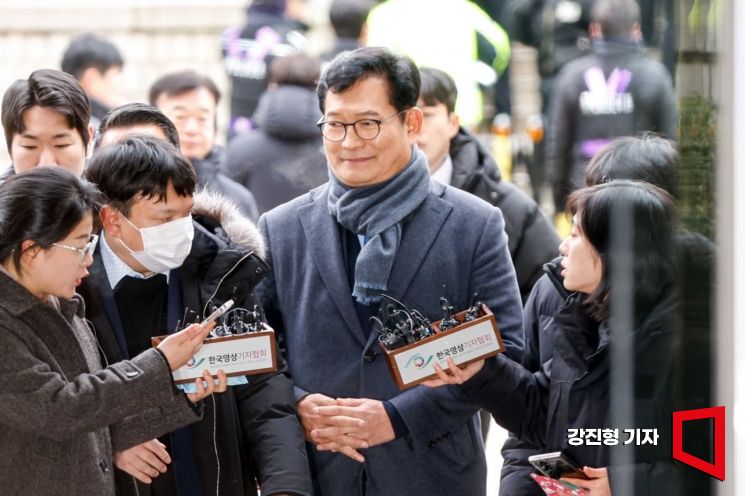
Additionally, Song, appearing in court wearing a prison uniform while in custody, requested bail from the court.
On this day, the Seoul High Court Criminal Division 1 (Presiding Judges Yoon Seong-sik, Min Seong-cheol, Kwon Hyuk-jun) held the first appellate trial for Song, who was indicted on charges of violating the Act on the Aggravated Punishment of Specific Crimes (bribery), the Political Parties Act, and the Political Funds Act.
During the trial, both sides disputed over the recording from the mobile phone of former Democratic Party Deputy Secretary-General Lee Jeong-geun. The prosecution argued that "both during the investigation phase and in court, Lee Jeong-geun voluntarily acknowledged submitting the recording and clearly indicated his consent regarding the scope of electronic information submitted," asserting that it was lawfully collected evidence.
On the other hand, Song personally stated, "The evidence, which should have been separated, discarded, and returned, was used for a separate investigation, making it a representative case of illegally collected evidence," and added, "The evidence recognized in the Meoksa-yeon (Peace and Livelihood Research Institute) case was also secured based on evidence from the money envelope case, so according to the 'poisonous tree bears poisonous fruit' theory, its evidentiary value should not be recognized."
In the first trial ruling made in January, the recording served as a basis for some of Song’s acquittals. The first trial court found Song guilty of receiving illegal political funds through Meoksa-yeon but acquitted him of charges related to involvement in distributing money envelopes during the Democratic Party’s party convention primary. This was because doubts remained about whether former Deputy Secretary-General Lee voluntarily submitted his mobile phone, leading to the evidence being inadmissible.
Regarding the arguments from both sides, the court asked the prosecution to clarify when they became aware that the recording files of former Deputy Secretary-General Lee contained files related to the money envelopes and why Lee has not yet been indicted.
During the trial, a bail hearing for Song was also conducted. Song appealed, saying, "The prosecution released President Yoon Seok-yeol, who incited rebellion against the entire nation, without filing an immediate appeal," and added, "I came here on my own. I consider the idea that I would flee to be an insult," pleading to be tried without detention.
In contrast, the prosecution countered that Song should remain in custody due to past instances of attempting to influence witness testimony and destroy evidence.
© The Asia Business Daily(www.asiae.co.kr). All rights reserved.












