Korea Racing Authority's LetsRun Park Busan-Gyeongnam (headed by Um Youngseok) announced that the horse Ponines, famous for its role in the restoration of Copris tripartitus and also known as the "dung beetle horse," has been transferred from the National Institute of Ecology's Endangered Species Restoration Center in Yeongyang, Gyeongbuk, to LetsRun Park Busan-Gyeongnam, following severe wildfire damage in the area.
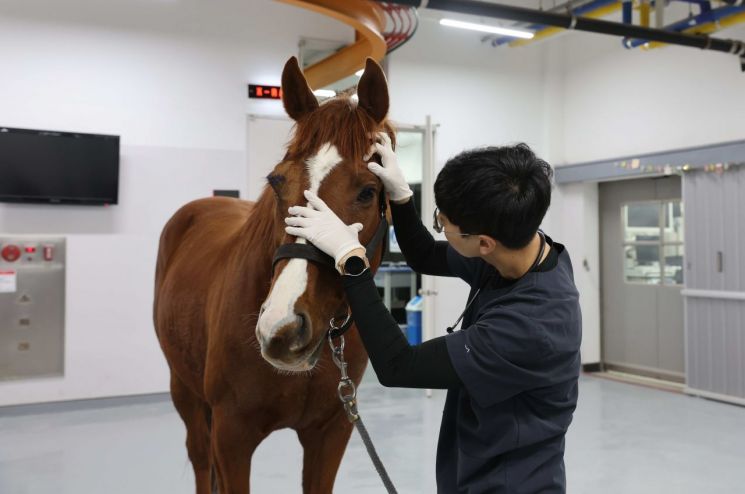 A veterinarian at LetsRun Park Busan Gyeongnam is examining P Nines. Photo by LetsRun Park Busan Gyeongnam
On March 26, when the wildfire crisis reached its peak, the flames spread to the vicinity of the National Institute of Ecology's Endangered Species Restoration Center in Yeongyang-gun, Gyeongbuk. Amid thick smoke in the mountains, center staff struggled to find safe havens for the animals and plants under their care. It was decided that birds would be sent to the main branch of the National Institute of Ecology in Seocheon, Chungnam, while fish and amphibians would be sent to the Freshwater Fish Research Center in Uljin, Gyeongbuk.
However, there was no suitable place to take in Ponines, the only horse living at the Endangered Species Restoration Center. The center requested help from LetsRun Park Busan-Gyeongnam, where Ponines, a retired racehorse, had previously stayed. Fortunately, they remembered Ponines, whom they had donated to the National Institute of Ecology five years earlier. The Korea Racing Authority decided to support Ponines to ensure the horse could be protected in a stable environment during the evacuation period.
That morning, an evacuation order was issued for residents in Yeongyang-eup, Yeongyang-gun, Gyeongbuk. Ponines was loaded onto a horse transport vehicle and began the journey to LetsRun Park Busan-Gyeongnam, arriving safely five hours later. Seo Yujin, head of the Busan Racehorse Resource Management Department, along with Korea Racing Authority veterinarians who had cared for Ponines five years ago, personally greeted the horse upon arrival. The staff comforted Ponines, who was startled during transport, and treated injuries sustained during the move.
Ponines had been an active racehorse at LetsRun Park Busan-Gyeongnam until early 2019, but retired after suffering a serious injury during training. Although Ponines overcame the injury after undergoing the first-ever high-difficulty orthopedic surgery in Korea, returning to racing was not possible. Around the time Ponines was looking for a new home after retirement, it became known that the National Institute of Ecology was struggling to secure horse manure needed for the restoration project of Copris tripartitus.
The endangered Copris tripartitus, also known as the "dung beetle," consumes horse manure as well as cow manure. However, the manure was a problem. Cow manure from domestically raised cattle contains antibiotics and dewormers, making it unsuitable for Copris tripartitus. Researchers at the Endangered Species Restoration Center even traveled to Jeju Island in search of pasture-raised horse manure. Upon hearing of these difficulties, the Korea Racing Authority, after consulting with the horse owner, donated Ponines to the National Institute of Ecology.
Ponines, a retired racehorse, became known as the "nutritionist for Copris tripartitus" at the National Institute of Ecology's Endangered Species Protection Center, being the only horse in Korea entrusted with the crucial task of supplying horse manure to feed the beetles. By eating and excreting well, Ponines helped sustain dozens of Copris tripartitus at the institute.
Ponines is currently regaining stability at the LetsRun Park Busan-Gyeongnam Equestrian Land. Thanks to its unique background and gentle temperament, Ponines has attracted much attention from LetsRun Park tour visitors within just a few days of arrival. LetsRun Park Busan-Gyeongnam plans to provide meticulous care for Ponines until the National Institute of Ecology's Endangered Species Restoration Center is stabilized, ensuring that Ponines does not feel fear in the new environment.
At the end of last year, the Korea Racing Authority adopted Unicorn, one of the horses involved in an abuse case at a ranch in Gongju. Unicorn, a 24-year-old senior horse, had difficulty finding a new home, and the Korea Racing Authority provided a new sanctuary at its Jangsu Ranch in Jeonbuk so that Unicorn could spend its remaining years in comfort.
Um Youngseok, head of the Korea Racing Authority's Busan-Gyeongnam Regional Headquarters, said, "The Korea Racing Authority will continue to support and pay attention to the welfare of retired racehorses through various programs such as retired racehorse equestrian competitions and lifecycle welfare projects."
© The Asia Business Daily(www.asiae.co.kr). All rights reserved.












