Aiming for Official Opening Next Year...
Pilot Program Launches This Year
Suncheon City in Jeollanam-do (Mayor Noh Gwan-gyu) is planning to establish the 'Suncheon Ecological College,' aiming to surpass Schumacher College.
On the 28th of last month, the city launched the 'Suncheon City Ecological Civilization Advisory Committee' and announced this plan through a workshop attended by over 70 domestic and international experts in ecology.
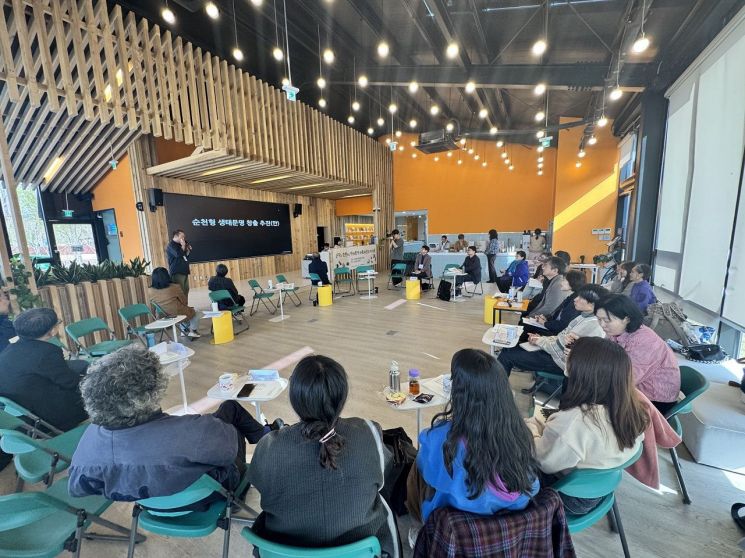 Ecological civilization experts held a two-day workshop of the Suncheon Ecological Civilization Advisory Committee at Suncheonman National Garden starting from the 28th of last month. Provided by Suncheon City
Schumacher College is an alternative higher education institution in the United Kingdom, based on the philosophy of economist Ernst Schumacher, author of 'Small is Beautiful.' The college covers topics such as environment, sustainability, ecological philosophy, and alternative economics. Graduates are recognized for their abilities by leading institutions and governments simply by virtue of their graduation.
Twenty years ago, when most local governments were focused solely on attracting factories and addressing livelihood issues, Suncheon City set out its vision as an ecological capital. Together with civil society, the city worked to preserve Suncheonman and protect the habitat of the hooded crane. Ecological policies such as removing utility poles for migratory birds faced much criticism at the time, but consistent policy implementation eventually gained citizens' approval.
Additionally, through two garden expos, the city proved that ecology can also drive economic growth. While the external requirements for an ecological capital have been somewhat met, the need for policies to transform citizens' lives ecologically has also emerged.
This is the transition to ecological civilization, a historic shift for humanity that goes beyond the limited concepts of responding to the climate crisis and environmental protection. The redefinition of speed and growth, and the reassessment of hierarchical universities and uniform life priorities, require new wisdom suited to an era of shifting values?hence the vision for an ecological college to learn and teach such wisdom.
The city plans to operate a pilot program this year, aiming for the official opening in 2026. The pilot program will run for six months from June this year, offering a curriculum that combines academics and community living to about 20 students. An admissions briefing is scheduled for late April, with screening and selection to follow in May.
The academic curriculum will encompass philosophy and society, science and art, and pilgrimage, while the community living component will be an implicit curriculum focused on methods and practices for considering all things connected to oneself. The city will cover tuition and research support to allow students to fully concentrate on college life.
Classes will be project-based, with the expectation that students will provide solutions to current issues and challenges facing the city. The main location will be the Nongju branch of Haeryong Elementary School, with the entire Suncheon area serving as the campus.
As the first case of alternative higher education through cooperation between the private sector and local government, the city is taking a different approach. The ordinance enacted in July last year to promote and support the practice of ecological civilization in Suncheon, and the formation of a dedicated team, are known to be the first among basic local governments in Korea.
To maximize the capabilities and imagination of the private sector, the city has established a principle of minimal administrative intervention and is also working to strengthen communication with local civil society and enhance the ecological competencies of public officials.
They have built a network by meeting with representatives from over 100 alternative education institutions and ecological civilization stakeholders across the country and listening to their experiences. In particular, the responsible public official has moved their office to the pilot program site, making it their main workplace, thus striving to break down the boundaries between the public and private sectors.
Attention is focused on whether the ecological college that Suncheon City has envisioned for 20 years will yield results commensurate with its long period of deliberation.
© The Asia Business Daily(www.asiae.co.kr). All rights reserved.












