Local Governments Say, "Difficult to Eradicate Due to Long-Standing Practices"
Sharp Increase in Wildfire Risks in April... "Public Urged to Stay Vigilant"
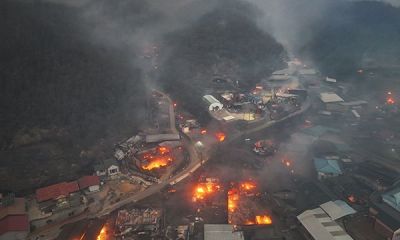
As wildfires continue across various regions nationwide, including northern Gyeongbuk and Sancheong in Gyeongnam, causing significant damage, it has been reported that illegal burning of spring farming byproducts and waste is still rampant in some areas.
On the 29th, Yonhap News quoted a forestry department official from a local government in the western Gyeongnam region adjacent to Sancheong, where a large wildfire occurred on the 21st, stating that several cases of illegal burning have occurred even after the Sancheong wildfire.
The official said, "Just 2 to 3 days ago, we received a report of someone gathering and burning straw in a field at night, and we responded together with 119, but we could not catch the person responsible for the illegal burning," adding, "Sometimes people gather and burn straw because if left in the field, it gets entangled in machinery during plowing and causes damage."
He continued, "We have also strengthened crackdowns on illegal burning of farming byproducts and waste and imposed fines, but since this has been a long-standing practice, it is not easy to eradicate."
Under the Forest Protection Act, fines for illegal burning are 300,000 KRW for the first offense (with a 20% discount if paid in advance), 400,000 KRW for the second, and 500,000 KRW for the third. Even accidental wildfire ignition can result in imprisonment of up to three years or a fine of up to 30 million KRW, and intentional wildfire ignition can lead to imprisonment of up to 15 years.
The official added, "Since the elderly know the working hours of public officials and wildfire watchers, many cases of burning occur after sunset."
Local governments anticipate an increase in wildfire risk factors such as hikers, spring visitors, ancestral grave visits, and tree-planting activities ahead of Cheongmyeong (April 5) and Hansik (April 6), as well as the start of full-scale farming preparations.
Accordingly, local governments are maintaining strengthened wildfire preparedness, establishing special wildfire prevention measures such as increasing emergency duty personnel for patrols and monitoring.
Over the past 10 years, there have been a total of 11 wildfires nationwide during the Cheongmyeong and Hansik periods. The leading cause is burning-related wildfires (27.3%), followed by arson by visitors (18.2%), electrical causes (18.2%), and arson by ancestral grave visitors (9.1%).
On the 27th, Hong Taeyong, mayor of Gimhae City, issued an appeal for wildfire prevention, urging, "Ahead of Cheongmyeong and Hansik, please refrain from all kinds of burning activities and smoking in forest-adjacent areas and maintain vigilance to prevent wildfires."
Other cities and counties in the province plan to operate wildfire drone monitoring teams to intensively monitor blind spots in wildfire surveillance day and night and implement measures such as rapid response teams for nighttime wildfire preparedness.
© The Asia Business Daily(www.asiae.co.kr). All rights reserved.











