Concerns Grow Over Myanmar Earthquake Relief
Aid Cuts Under Second Trump Administration Hamper Humanitarian Response
Concerns have been raised that the relief system in Myanmar, where a major earthquake occurred, may not function properly. This is because the second Trump administration in the United States pushed for the abolition of the United States Agency for International Development (USAID) and halted most foreign aid projects.
On the 29th, Yonhap News quoted the US CNN broadcast reporting an analysis by the think tank Center for Global Development (CGD) containing this information. According to the report, due to the suspension of USAID operating funds under the second Trump administration, US aid to Myanmar was cut by $52 million (76 billion won).
 On March 28, 2025, people are looking at a collapsed building in Naypyidaw, the capital of Myanmar. EPA/NYEIN CHAN NAING Photo by Yonhap News
USAID has provided humanitarian and development aid by funding non-governmental organizations, foreign governments and international organizations, and other US agencies. As of the 2023 fiscal year, its annual budget reached $40 billion (about 59 trillion won).
CGD researchers told CNN, "We calculated the estimated amount of aid cuts based on the list of suspended projects provided to the US Congress," adding, "This is a conservative estimate compared to the true scale of the cuts."
Sarah Charles, a former senior USAID official who oversaw disaster response teams and humanitarian aid during the Biden administration, also expressed concern. She told the Associated Press that under the second Trump administration, the aid system itself became a "mess," explaining that there are no people or resources available to act quickly to rescue survivors from collapsed buildings.
International organizations expressed worries that the damage caused by this major earthquake would worsen due to aid cuts by the second Trump administration. Joe Freeman, Myanmar researcher at Amnesty International, told CNN, "This earthquake happened at the worst possible time for Myanmar." Since the 2021 military coup, Myanmar has seen over 3 million internally displaced persons due to armed conflicts.
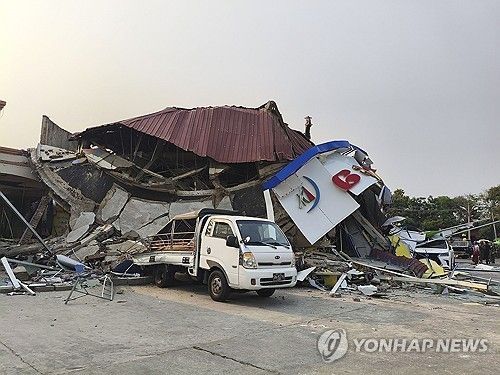 On March 28, 2025, a major earthquake in Myanmar caused buildings to collapse in the capital city, Naypyidaw. Photo provided by the "Myanmar Military Real News Information Team" and distributed by AP News. Photo by Yonhap News.
He pointed out that "more than one-third of Myanmar's population (about 54 million) will require humanitarian aid this year," and that the earthquake occurred just as the humanitarian aid gap caused by US aid cuts was beginning to emerge.
Arino Noor, head of Myanmar operations at the nonprofit organization CARE, issued a statement on the 28th, the day the earthquake struck, expressing concern. He explained, "Even before the earthquake, 19.9 million people in Myanmar were in crisis and needed humanitarian aid," adding, "There is a severe shortage of funds needed for response, and the already deteriorating situation has worsened due to this disaster."
Last year, the World Bank (WB) analyzed that about one-third of Myanmar's population suffers from poverty amid the coup and civil war. In reality, Myanmar, which had been growing mainly through its key export industry of garment manufacturing, has faced severe economic difficulties since the 2021 coup. The poverty rate of 32% has returned to the level of 2015.
The Myanmar military coup has had a significant impact on this situation. The Myanmar military claimed that the November 2020 general election, in which the National League for Democracy (NLD) led by State Counsellor Aung San Suu Kyi won a landslide victory, was fraudulent, and staged a coup on February 1 of the following year. The military government suppressed opposition forces with violence, and the People's Defense Forces (PDF) under the National Unity Government (NUG), an interim government of the democratic camp, along with ethnic armed groups, engaged in armed resistance.
In response to various concerns, US State Department spokesperson Tammy Bruce stated, "USAID maintains a team of disaster experts capable of responding to disasters," and despite the aid cuts, claimed that "our ability to fulfill this obligation is not affected."
However, on the same day, the State Department notified USAID staff and Congress that most of the remaining USAID employees would be laid off, and that ongoing USAID projects would be transferred under the jurisdiction of the State Department.
Earlier, President Trump, upon starting his second term, froze all US overseas aid for 90 days, and under the leadership of the Department of Government Efficiency (DOGE) led by Tesla CEO Elon Musk, most USAID operations were halted and staff were laid off as part of downsizing efforts.
© The Asia Business Daily(www.asiae.co.kr). All rights reserved.













