Only Small Amounts of Rain Outside the Southern Coast by 5 p.m.
2 mm in Seongju, 1 mm in Daegu
Cold Arrives as Northwesterly Winds Move In
Temporary Yellow Dust Affects Western Regions
Rain will continue in Yeongnam until late night on the 27th. However, the rainfall is still far from sufficient in the areas severely affected by the massive wildfires.
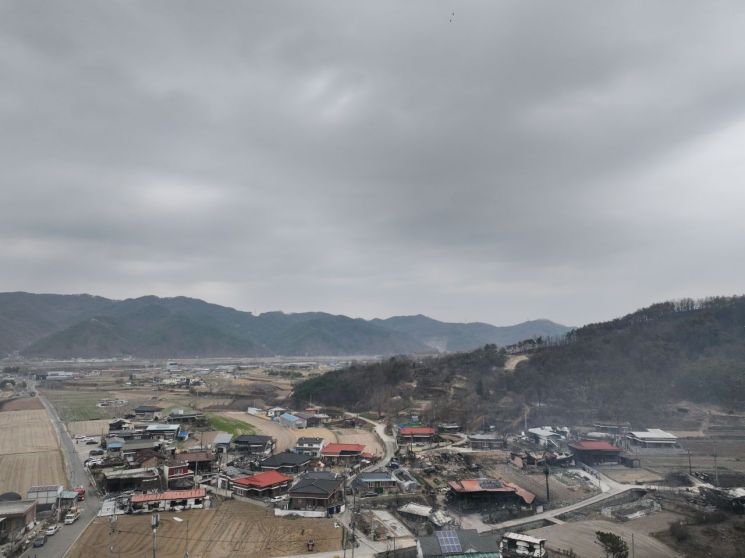
By 5 p.m. on that day, a total of 24.0 mm of rain fell in Geoje, Gyeongnam, and 11.5 mm in Haeundae, Busan, indicating considerable rainfall along the southern coast of Gyeongnam. However, most parts of Yeongnam, where rain is urgently needed due to the wildfires, have not yet recorded the expected amount of precipitation. In fact, in Gyeongbuk, only small amounts of rain fell by 5 p.m., such as 2.0 mm in Seongju, 1.2 mm in Daegu, and 1.0 mm in Chilgok.
Nevertheless, rain is expected to continue in Yeongnam until late night on the 27th. Rain will persist until dawn on the 28th along the southern coast of Gyeongnam, and until late night on the 27th in other parts of Yeongnam excluding this area. In other regions, rain will continue until the evening of the 27th in Chungcheong and Jeonbuk, until dawn on the 28th in Jeonnam, and until morning on the 28th in Jeju (with rain or snow in Jeju's mountainous areas).
The expected additional rainfall amounts are 5 to 30 mm in Jeju, 5 to 10 mm in Busan, southern coast of Gyeongnam, and southern coast of Jeonnam, around 5 mm in Gwangju, Jeonnam, Ulsan, and Gyeongnam, and less than 5 mm in Chungcheong, Jeonbuk, Daegu, Gyeongbuk, western inland Gyeongnam, Ulleungdo, and Dokdo.
With easterly winds blowing over the mountainous areas of Gangwon and the east coast, as well as the northeastern mountainous areas of Gyeongbuk and the northern east coast, rain (or rain and snow in Gangwon's mountainous areas and the east coast) will fall from dawn to afternoon on the 28th. However, the precipitation amounts will be small, around 5 mm and about 1 mm respectively.
From night, northwesterly winds will flow in, causing temperatures to drop sharply. The lowest temperatures on the morning of the 28th will range from 0 to 10 degrees Celsius, about 10 degrees lower than on the morning of the 27th. The highest daytime temperatures are expected to be between 9 and 15 degrees Celsius.
The expected lowest and highest temperatures in major cities are 3°C and 12°C in Seoul, 3°C and 10°C in Incheon, 5°C and 13°C in Daejeon, 5°C and 12°C in Gwangju, 8°C and 14°C in Daegu, 9°C and 13°C in Ulsan, and 10°C and 15°C in Busan.
Strong winds with instantaneous gusts exceeding 70 km/h (90 km/h in Jeju's mountainous areas) will blow nationwide for the time being, including along the western coast of Jeonnam until night on the 28th and in Jeju from night on the 27th. These strong winds increase the risk of large fires and lower the perceived temperature, intensifying the cold.
On the 28th, fine dust levels nationwide will be 'good' or 'moderate.' However, in the morning, PM10 concentrations may temporarily rise to unhealthy levels in Incheon, Chungnam, Gwangju, and Jeju. This is due to yellow dust originating from the Gobi Desert and the Inner Mongolian Plateau being carried by northwesterly winds. Most of it will pass through the upper atmosphere, but some will descend to the surface, raising fine dust concentrations.
© The Asia Business Daily(www.asiae.co.kr). All rights reserved.











