Japanese Government: "Extremely Regrettable to Be Included as a Target Country"
Prime Minister Ishiba Orders Thorough Investigation of Tariff Measures
EU Expresses "Deep Regret"; Canada Hints at Retaliatory Tariffs
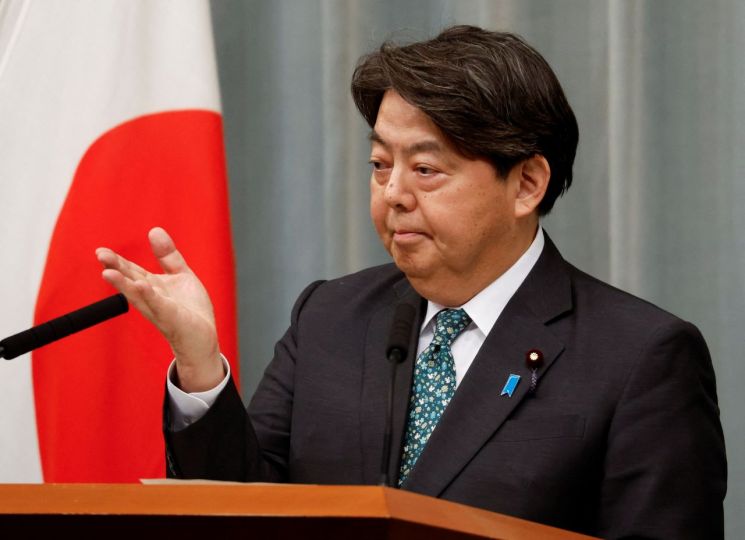 Hayashi Yoshimasa, the newly appointed Chief Cabinet Secretary of Japan, is speaking at a press conference held at the Prime Minister's Official Residence in Tokyo on December 14, 2023. He expressed regret over the U.S. plan to impose a 25% tariff on automobiles, stating, "It is extremely regrettable that Japan is included as a target country." / Photo by Reuters and Yonhap News Agency
Following the announcement on the 26th (local time) of U.S. President Donald Trump's policy to impose a 25% tariff on automobiles, the Japanese government expressed "deep regret." Given the upbeat atmosphere during the U.S.-Japan summit in February, Japan's disappointment toward the U.S. government is also considered significant.
Hayashi Yoshimasa, Chief Cabinet Secretary and spokesperson for the Japanese government, stated on the 27th regarding the Trump administration's plan to impose a 25% tariff on automobiles, "It is extremely regrettable that Japan is included as a target country in the announced measures."
He noted that Japan has been the world's largest investor in the U.S. since 2019, contributing to the American economy, and especially that Japanese automobile companies have invested approximately $61.6 billion (about 90 trillion won) in the U.S., creating around 2.3 million jobs. He added, "Broad trade restrictions by the U.S. government, including automobile tariffs, could have a significant impact on the economic relationship between the U.S. and Japan as well as the global economy."
He continued, "Japan has repeatedly requested the U.S. government at various levels that automobiles and automobile parts should not be included in the full scope of these measures," and "Following this announcement, we have again requested the U.S. government to exclude Japan from the applicable targets."
Chief Cabinet Secretary Hayashi explained, "Prime Minister Ishiba Shigeru has instructed a detailed investigation into the contents and impacts of this tariff measure and will demand that the U.S. exclude Japan from the applicable targets. He has also ordered a thorough investigation of the domestic industry and employment impacts to ensure necessary countermeasures are fully prepared."
Regarding the impact of the U.S. automobile tariff measures on domestic industries, he stated, "The automobile industry is a key sector, accounting for 20% of manufacturing shipments, 10% of total employment across all industries, and 30% of manufacturing investment in facilities and research and development." He added, "There are opinions that the extensive supply chain, including parts manufacturers, will be affected." He further said, "Based on the importance of the automobile industry and the supply chain, we will persistently carry out necessary responses, including close consultations with the U.S."
At the Upper House Budget Committee meeting held that day, Prime Minister Ishiba was asked about the necessity of retaliatory measures such as counter-tariffs against the U.S. He replied, "All options are naturally under consideration," but emphasized, "The key point is to think about what best serves our national interest, and we are strongly requesting that the 25% tariff not be applied to Japan."
Kiyomi Tsujimoto, a member of the Constitutional Democratic Party, the largest opposition party, urged Prime Minister Ishiba, saying, "Countries around the world are also considering countermeasures," and "Japan must respond properly, including countermeasures." Tsujimoto pointed out that the U.S. automobile tariff measures might violate the U.S.-Japan trade agreement concluded in 2019 during Trump's first term, and also criticized, "The U.S. is demanding imports of types of potatoes that are not imported due to plant quarantine."
Meanwhile, on the same day, leaders from Europe, Canada, and other countries expressed regret immediately after President Trump's announcement of automobile tariffs and hinted at retaliatory tariffs. Ursula von der Leyen, President of the European Union (EU) Commission, issued a statement in the afternoon saying, "We deeply regret the U.S. decision to impose tariffs on European automobile exports." She added, "We will evaluate this announcement along with other measures the U.S. is considering." However, she left open the possibility of negotiations by saying, "We will continue to seek solutions through negotiations."
Canada, which recently entered into a full-scale trade war with the U.S., responded more aggressively. Canadian Prime Minister Mark Carney declared, "We will protect our workers," showing a strong intention to respond. He described the U.S. automobile tariff announcement as a "very direct attack" on the Canadian economy. Ahead of an early general election next month, Prime Minister Carney plans to briefly leave the campaign trail on the 27th to hold an emergency meeting with the 'Special Cabinet Committee on Relations with the U.S.,' which handles Canada's diplomatic affairs with the U.S.
© The Asia Business Daily(www.asiae.co.kr). All rights reserved.












