Bank A Sets LTV at 80% for Gwangju, 65% for Hampyeong
More Than Half of Bitgreen Industrial Complex Lies in Hampyeong
Most Companies Choose Gwangju Sites to Secure Funding
"Raising LTV for Rural Areas Needed to Attract Investment"
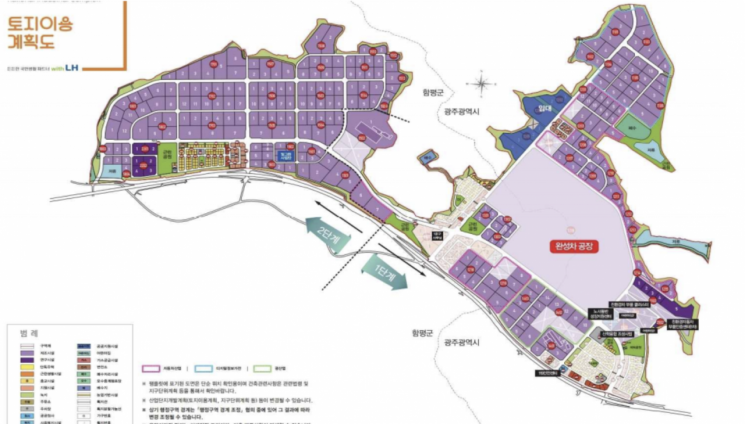
The Bitgreen Industrial Complex, which spans across Hampyeong-gun in Jeollanam-do and Gwangsan-gu in Gwangju, has more than half of its total area located in Hampyeong. However, it was found that financial institutions are applying a higher loan-to-value (LTV) ratio to companies in the Gwangju area, creating a disparity.
In particular, since the second phase, scheduled for completion in June, is entirely located in Hampyeong, there are increasing calls to raise the LTV for rural areas within the same industrial complex in order to help resident companies secure operating funds and to revitalize the local economy.
According to Hampyeong-gun and the LH Gwangju-Jeonnam Regional Headquarters on the 27th, the first phase of the Bitgreen Industrial Complex was completed in 2022, and the second phase is set to be completed this June. The site of the Bitgreen Industrial Complex is divided, with 54% in Hampyeong-gun and 45% in Gwangsan-gu, Gwangju, meaning a single industrial complex spans two administrative districts.
Currently, 145 companies have completed sales and occupancy contracts in the Bitgreen Industrial Complex, with 110 companies located in Gwangsan-gu, Gwangju, and 35 companies in Hampyeong-gun, Jeollanam-do.
Looking at the areas subject to paid supply: Phase 1 covers 1,912,365 square meters with a development cost of 248,173 KRW per square meter, and Phase 2 covers 1,060,360 square meters at 232,169 KRW per square meter. Phase 1 includes Samgeo-dong in Gwangsan-gu, Gwangju, and Wollya-myeon in Hampyeong-gun, while Phase 2 is entirely within Hampyeong-gun. Of the 145 lots in Phase 1, 125 have been sold, while in Phase 2, 74 out of 79 lots remain unsold.
Despite being the same industrial complex, it was found that banks are applying different LTV ratios to each region according to their internal regulations.
For example, Bank A applies an LTV ratio of up to 80% for factories located in Gwangju, while setting the maximum at 65% for those in Hampyeong-gun.
Bank B, on the other hand, generally sets the maximum LTV at 70% for Gwangju and 50% for Hampyeong, but if the factory is within the same industrial complex, Hampyeong-gun companies can also receive up to 70%.
In fact, one bank reportedly advised that, since the LTV ratio is more favorable in Gwangju, it would be better to sign a contract for a site in the Gwangju area if possible.
A bank official stated, "It is difficult to disclose the LTV ratios in detail, but there are slight differences depending on demand for each site and by industry. Even within the same industrial complex, our internal regulations require different LTV ratios for Gwangju and Hampyeong."
Due to these significant differences in LTV ratios between banks and even within the same complex, resident companies are facing difficulties in securing funds for equipment and operations.
In response, Hampyeong-gun recently submitted a request for policy improvement to Jeollanam-do, arguing that the application of different LTV ratios within the same complex makes it difficult for rural companies to secure funds and is unfair. The county plans to propose this to the Ministry of the Interior and Safety.
An official from Hampyeong-gun stated, "Even though the completion of the second phase of the Bitgreen Industrial Complex is just around the corner, companies planning to move in are struggling to secure operating funds due to the different LTV ratios. If the LTV ratio is raised for factories on the Hampyeong side as well, it will improve business conditions for companies and help revitalize the local economy."
© The Asia Business Daily(www.asiae.co.kr). All rights reserved.











