First Discussion on Sustainable Care Policies
Sharing the Significance of "Foreign Domestic Worker"
"Expected to Become a Future-Oriented Discussion Body"
Seoul City has newly formed the 2nd Population Policy Committee and held its first discussion to proactively respond to population changes. The city decided to start by examining sustainable care policies.
According to Seoul City on the 27th, the newly formed 2nd Population Policy Committee consists of 20 appointed members, an increase from the 15 members in the 1st committee. It includes experts in urban, welfare, and social policy fields, as well as diverse members such as youth, foreign residents, and the elderly. During its two-year term, the committee will review and advise on annual implementation plans established according to the basic population policy plan, discuss social issues caused by mid- to long-term population changes and future response tasks, and play a role in discovering policy agendas.
At the first meeting, a presentation and discussion were held on the theme of "Population Policy for Responding to Future Care Demand." Professor Kang Jeong-hyang of Sookmyung Women’s University, who participated as the research director of Seoul City’s "Foreign Domestic Worker Pilot Project," stated that the project provided psychological stability to dual-income couples and families with heavy childcare burdens, and that the domestic workers’ affinity positively influenced the emotional stability of children.
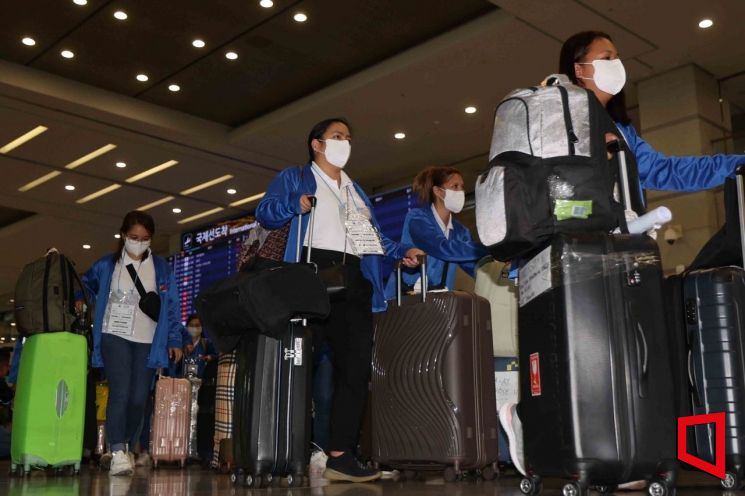 Filipino domestic workers participating in the pilot project for foreign domestic workers arrived through Incheon International Airport Terminal 1 on the morning of the 6th and are moving by bus. Photo by Airport Photo Journalists Group
Professor Kang said, "It became an opportunity to propose an alternative to childcare support services by legally attracting foreigners and further explore mid- to long-term workforce supply plans that combine domestic and foreign labor to solve care issues." She added, "In a situation where national efforts must be mobilized to solve the low birthrate problem, I hope this will be an opportunity to expand child care policies."
Professor Kim Yeon-hong of Sookmyung Women’s University Graduate School of Policy, who is a research director at the Immigration Policy Association, emphasized the necessity of introducing foreign workers in elderly care based on projections that by 2028, the number of care workers will be short by 116,734 compared to the needs of long-term care institutions. The demand for care in our society is continuously increasing, with the number of long-term care recipients expected to reach 1.72 million by 2030. However, as of 2028, there will be a shortage of 116,734 care workers compared to the needs of long-term care institutions, and due to the decline in the working-age population, the shortage is expected to worsen in the future.
Professor Kim referred to Japan’s care service case in its super-aged society and suggested, "A stepwise process should be established, starting from the introduction of non-professional workers in the care sector to strengthening training such as education and practice, leading to the cultivation and utilization of professional personnel."
Based on the two presentations, committee members engaged in in-depth discussions on mid- to long-term care workforce supply strategies encompassing both domestic and foreign labor. In particular, amid the reality of increasing care demand and workforce shortages, there was consensus on the necessity of introducing foreign workers, institutional improvements, and workforce training systems, highlighting the need for Seoul City’s proactive policy alternatives. Kim Tae-gyun, Seoul City’s First Deputy Mayor for Administration, said, "We will expand discussions centered on the committee to proactively respond to social issues caused by population changes and prepare future-oriented policies."
© The Asia Business Daily(www.asiae.co.kr). All rights reserved.












