Korea Ratings Seminar:
"Trump 2.0" Policies
to Deeply Impact Secondary Batteries,
Automobiles, Semiconductors, and Steel
Shipbuilding Seen as Only Beneficiary
Machinery and Defense Outlook Upgraded to Neutral
Donald Trump, the so-called 'tariff man' and President of the United States, has intensified tariff offensives, with secondary batteries being identified as the domestic industry most likely to suffer adverse effects. Not only automobiles, which face immediate concerns over import tariffs, but also semiconductors and steel are expected to inevitably experience negative impacts. However, machinery and defense sectors have seen a mixed outlook with some positive factors, leading to an improved evaluation from 'unfavorable' to 'neutral.'
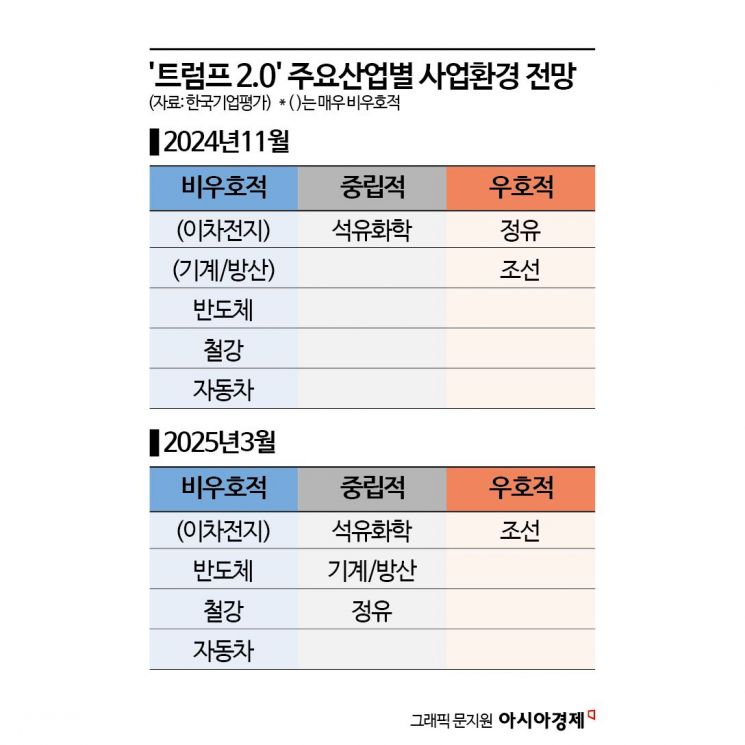
On the afternoon of the 27th, Korea Ratings held a seminar titled "Trump 2.0 ? Macro and Major Industry Impacts and Outlook" in Yeouido, Seoul, where it announced these findings. Korea Ratings noted that since the Trump administration took office, protectionist trade policies have intensified and green energy policies have retreated, resulting in changes. They categorized the business environment outlooks for major domestic industries with high tariff risks into three groups: unfavorable, neutral, and favorable.
In this update, four industries were classified as unfavorable, three as neutral, and one as favorable. Compared to November last year before the Trump administration began, machinery and defense improved from 'unfavorable → neutral,' while refining was downgraded from 'favorable → neutral.' The neutral outlook indicates a mix of positive and negative factors under the Trump administration's second term policies.
The domestic industry diagnosed as most unfavorable is undoubtedly secondary batteries. It was assessed that the retreat of green policies, starting from the key market of the United States, inevitably brings negative repercussions. Korea Ratings mentioned possible changes to the Inflation Reduction Act (IRA) provisions on electric vehicle purchase subsidies and the Advanced Manufacturing Production Tax Credit (AMPC), predicting this could lead to sluggish global secondary battery demand and deteriorating profitability for the secondary battery industry. Moreover, the domestic secondary battery sector's financial stability indicators have recently worsened, implying that short-term financial burdens are bound to increase.
Besides secondary batteries, the unfavorable outlook also includes automobiles, semiconductors, and steel. For automobiles, which have raised concerns due to the U.S. announcement of import tariffs, a negative operating environment is expected to develop due to comprehensive tariff impositions.
Korea Ratings stated, "More than 60% of Hyundai Motor Group's U.S. sales volume consists of exports. Even after the operation of the 300,000-unit scale Meta Plant (HMGMA, Hyundai Motor Group Meta Plant America), about 40% of the volume remains exposed to tariff risks," expressing concerns that performance deterioration is inevitable. They also noted, "The tariff impact will vary among global automakers," identifying key variables influencing this as global sales volume and dependence on the U.S. market, the proportion of U.S. imports, U.S. excess production capacity (Capa), regional composition of import volumes, and exchange rates.
Alongside this, semiconductors are expected to continue facing an unfavorable environment under Trump 2.0 due to increased uncertainties regarding China business strategies and U.S. investment plans, while steel is anticipated to suffer from deteriorating supply-demand conditions amid protectionist trade policies. Conversely, the only industry expected to experience positive effects is shipbuilding. Shipbuilding is assessed to have dominant opportunity factors due to improved demand for liquefied natural gas (LNG) carriers and potential partnerships with the United States.
Additionally, machinery and defense, initially forecasted as unfavorable, were reclassified as neutral considering the expanding demand base for power, machinery, and defense despite tariff risks. Refining, which retreated from a favorable to a neutral outlook, was recognized for reduced investment burdens due to the retreat of green policies and demand improvements from falling oil prices; however, the possibility of inventory-related losses due to low oil prices was newly factored in this update.
Meanwhile, at the seminar, Korea Ratings also projected that a significant interest rate differential between Korea and the U.S. is inevitable with the start of the Trump administration's second term. They forecast that even if the global strong dollar trend eases, the Korean won will continue to weaken, sustaining the upward trend in the dollar-won exchange rate. However, Korea Ratings added that this won depreciation is not entirely negative, as it could help improve the export competitiveness of Korean products.
© The Asia Business Daily(www.asiae.co.kr). All rights reserved.












