Hyundai Motor and Related Stocks Rally
Foreign Investors Turn Net Sellers After Seven Sessions
"Focus on U.S. Consumer Sentiment Index"
On the 25th, the domestic stock market closed lower across the board. Although it started strong on easing concerns over U.S.-imposed tariffs, selling pressure from foreigners and institutions weighed on the market.
On that day, the KOSPI closed at 2,615.81, down 16.26 points (0.62%). The KOSPI had a positive start, rising 20.97 points (0.80%) to 2,653.04 in early trading, but the upward trend was broken as foreigners switched to net selling for the first time in seven trading days. While individuals and foreigners sold 63.4 billion KRW and 74.6 billion KRW respectively, institutions were net buyers with 67.9 billion KRW.
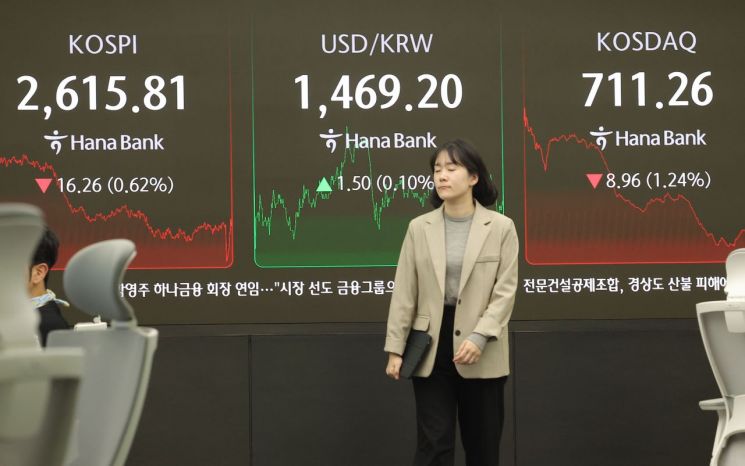
Among the top market cap stocks on the KOSPI that day, mixed trends were observed. Hyundai Motor, which personally demonstrated tariff response measures through a 31 trillion KRW scale investment plan in the U.S., surged 3.29%, leading related stocks such as Hyundai Engineering & Construction (4.50%), HD Hyundai Electric (3.58%), Kia (2.13%), and HD Hyundai Marine Solutions (2.70%) to rally together. Additionally, Yuhan Corporation (5.18%), Hanwha Vision (2.81%), and HYBE (3%) saw their stock prices rise. On the other hand, shipbuilding and defense stocks such as Hyundai Rotem (-8.82%), Hyundai Steel (-6.95%), POSCO International (-6.82%), Hanwha Systems (-7.19%), Hanwha Ocean (-6.29%), and Samsung Heavy Industries (-4.57%) faced corrections.
Ji-won Kim, a researcher at KB Securities, explained, "Although tariff concerns have eased, the extended directional search trend led to a simultaneous decline in both markets. The combined net selling by foreigners and institutions, along with the continued strength of the dollar, also acted as burdens." Earlier, in the foreign exchange market, the won-dollar exchange rate rose for six consecutive trading days, surpassing 1,470 KRW during the session, marking the highest level since January. Kim also added, "Semiconductor stocks, which started the day higher, turned weak due to concerns over a management vacuum following the passing of Samsung Electronics Vice Chairman Han Jong-hee."
On the same day, the KOSDAQ closed at 711.26, down 8.96 points (1.24%). The KOSDAQ also started strong, rising 5.12 points (0.71%), but soon turned downward and widened its losses, creating a 'strong start, weak finish' market pattern. While individuals and foreigners were net buyers of 88.7 billion KRW and 6.4 billion KRW respectively, institutions alone sold 92.3 billion KRW.
Among the top market cap stocks, Nature Cell finished at the daily limit. Investor sentiment was stimulated as its degenerative arthritis cell gene therapy 'Jointstem' was designated as a breakthrough therapy by the U.S. Food and Drug Administration (FDA). In addition, Mezzion (10.37%), Olix (5.84%), Pearl Abyss (4.72%), YG Entertainment (3.75%), HLB (2.98%), and Lunit (2.03%) rose. Conversely, Philoptics (-9.25%), Hana Materials (-6.72%), Simtek (-7.54%), GemVax (-6.55%), Hyzen R&M (-5.90%), SNS Tech (-6.18%), and Yuil Robotics (-5.88%) showed declines.
Researcher Kim said, "Amid rising concerns over stagflation (economic slowdown with rising prices) due to Trump's tariff and immigration policies, attention should be paid to the consumer sentiment index to be released tonight." On the 25th (local time), the U.S. Conference Board (CB) will release the March Consumer Confidence Index. The weekly initial jobless claims, which show the labor market status, and the finalized GDP growth rate for the fourth quarter of last year will be released on the 27th.
© The Asia Business Daily(www.asiae.co.kr). All rights reserved.












