Ministry of Gender Equality and Family and Korea Youth Policy Institute Announce First Nationwide Survey on Isolated and Reclusive Youth on the 25th
Main Reasons for Isolation and Reclusion: Difficulties in Interpersonal Relationships and Academics
7 out of 10 Express Willingness to Recover... Half Have Attempted to Escape Isolation
Policy Support Needed, Including Development of Healing Programs
Among domestic 'isolated and reclusive youth,' 7 out of 10 do not talk with family or friends, and some do not even leave their rooms. It was found that they have a will to recover and escape from their current situation. The rate of attempts to break isolation and reclusion also reached half, indicating the need for policy support such as the development of healing programs to help isolated and reclusive youth overcome difficulties in forming interpersonal relationships.
On the 25th, the Ministry of Gender Equality and Family and the Korea Youth Policy Institute announced the results of the '2024 Survey on the Actual Conditions of Isolated and Reclusive Youth,' conducted nationwide from January to October last year targeting youth aged 9 to 24. This is the first nationwide survey to understand the actual conditions of isolated and reclusive youth.
In the first survey, out of 19,160 respondents, 2,412 were classified as 'isolated youth' and 3,072 as 'reclusive youth,' accounting for 12.6% and 16.0%, respectively. Among them, the ultra-high-risk group who answered that they 'do not even leave their rooms' numbered 395 (2.1%).
The life satisfaction score of isolated and reclusive youth was 4.76 (on a 10-point scale), significantly lower compared to 7.35 for non-affected youth. Among them, the proportion who reported no conversation experience with 'family/relatives' or 'friends/acquaintances' in the past two weeks was 8.3% and 5.6%, respectively, while the non-affected group reported 1.9% and 0.8%.
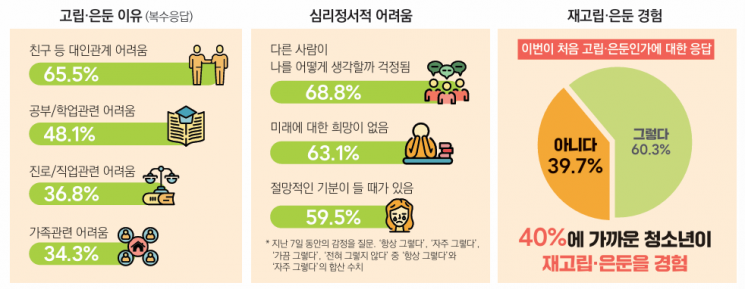
A second survey was conducted with 2,139 isolated and reclusive youth selected from the first survey. In the second survey, respondents cited 'difficulty in interpersonal relationships such as with friends' (65.5%) as the most common reason for isolation and reclusion (multiple responses allowed), followed by difficulties related to study and academics (48.1%) and career and job-related issues (36.8%).
The psychological difficulties they experienced included 'worrying about what others think of me' (68.8%), 'having no hope for the future' (63.1%), and 'sometimes feeling despair' (59.5%).
Nearly 40% reported that this was not their first experience of isolation and reclusion. When asked if this was their first time being reclusive, 39.7% answered that they had experienced repeated isolation and reclusion. The main reasons for repeated isolation and reclusion were 'feeling tired and exhausted' (30.7%) and 'because the problems that caused isolation and reclusion were not resolved' (20.9%).
Additionally, 7 out of 10 isolated and reclusive youth (71.7%) said they have felt a desire to escape their current lifestyle. The proportion who had attempted to break away from isolation and reclusion was also half (55.8%). To support this, the most common response was the need for 'a space where they can stay without feeling self-conscious' (79.5%). Other needed supports included 'financial support' (77.7%), 'support for hobbies, cultural, and sports activities done alone' (77.4%), 'career activity support' (75.1%), and 'support for recovery of daily life' (70.0%).
Dr. Choi Hong-il of the Korea Youth Policy Institute, who conducted the survey, said, "Policy support is needed for the development and response of household-level healing programs, enhancement of relational formation capabilities such as interpersonal relationship building, and expansion of free spaces."
Hwang Yoon-jung, Director of the Youth and Family Policy Office at the Ministry of Gender Equality and Family, said, "Through the results of today's survey, we understood that more detailed support is necessary for youth to recover psychological and social relationships early and grow healthily. We will make efforts to proactively identify youth in need of help and provide comprehensive support, while fostering a social atmosphere that embraces isolated and reclusive youth and expanding support projects for them nationwide."
© The Asia Business Daily(www.asiae.co.kr). All rights reserved.












