Hyundai to Invest $21 Billion in the U.S. Over Four Years
Building Steel Mill in Louisiana... "Localizing the Supply Chain"
Trump: "No Tariffs When Producing Steel and Cars in the U.S."
Hyundai Motor Company announced a new investment plan worth $21 billion (approximately 31 trillion KRW) over the next four years, including the establishment of a steel mill in Louisiana, USA. The company will also purchase $3 billion worth of American liquefied natural gas (LNG). President Trump stated, "This investment is clear evidence that tariffs are very effective," adding, "Hyundai produces steel and automobiles in the United States and, as a result, does not have to pay tariffs."
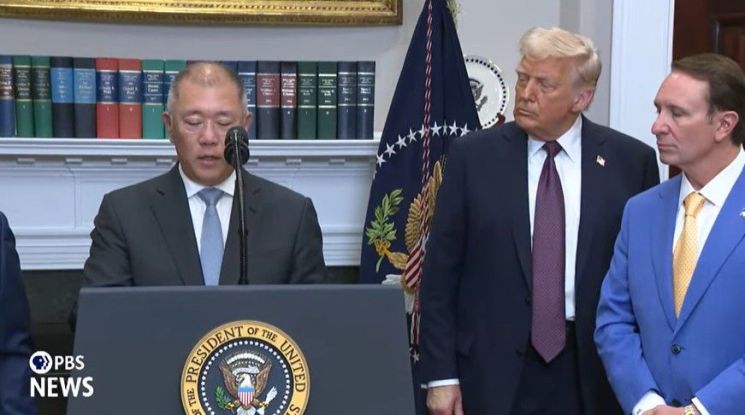
On the 24th (local time), President Trump announced Hyundai's investment plan at the White House. The event was attended by Hyundai Motor Chairman Chung Euisun, Vice Chairman Jang Jaehoon, President Sung Kim, U.S. House Speaker Mike Johnson, Louisiana Governor Jeff Landry, and others.
President Trump said, "The Louisiana steel mill will produce more than 2.7 million tons of steel annually and create over 1,400 jobs for American steelworkers," adding, "It will supply steel to Hyundai's automotive parts and finished vehicle plants in Alabama and Georgia, which will soon produce more than 1 million American-made vehicles annually." He also emphasized, "As you know, there are no tariffs when products are made in the U.S. Many companies and factories that previously did not even consider entering the U.S. market are now coming in."
Chairman Chung stated, "The core of this investment is to strengthen the domestic supply chain in steel, parts, and automobiles in the United States," adding, "By investing billions of dollars in the Louisiana steel mill, we will create 1,300 American jobs and lay the foundation for a more self-reliant and secure automotive supply chain within the U.S." He continued, "We will purchase $3 billion worth of American LNG to support the U.S. energy industry and enhance energy security," explaining, "All these efforts will accelerate the localization of the supply chain in the U.S. and contribute to expanding our business and increasing jobs domestically."
Chairman Chung also said, "Under President Trump's leadership, we will expand our business and create even more jobs in the U.S. Hyundai Motor Group is proud to be a stronger partner in the future of American industry."
On the same day, Hyundai unveiled a total $21 billion investment plan in the U.S., including the establishment of a steel mill in Louisiana with billions of dollars invested. The Louisiana steel mill will employ about 1,400 workers and produce next-generation steel required for electric vehicle manufacturing at Hyundai's local U.S. automobile plants. Hyundai currently operates automobile plants in Alabama and Georgia, and on the 26th, it will hold a completion ceremony for its third plant, the 'Hyundai Motor Group Meta Plant America (HMGMA),' in Georgia, where $8 billion has been invested, further expanding local production in the U.S.
This new investment announcement by Hyundai is the first by a Korean company during President Trump's second term and was made just over a week before Trump's April 2 announcement on reciprocal tariffs by country. President Trump has also warned of imposing item-specific tariffs of up to 25% on imported automobiles and has repeatedly urged companies to increase local production in the U.S. In response, Hyundai plans to expand its local production capacity through large-scale investments to directly overcome the tariff risks posed by President Trump. Taiwan's TSMC and Japan's SoftBank also announced large-scale investment plans in the U.S. at the White House after the start of Trump's second term.
In particular, the automotive sector is a major item in Korea's trade surplus with the U.S., drawing attention to the potential impact of Hyundai's investment plan on future tariff negotiations with the U.S. The U.S. is expected to focus reciprocal tariffs on the so-called 'Dirty 15' countries with large trade deficits. Korea's trade surplus with the U.S. was $55.7 billion last year, making it the eighth-largest trade deficit partner from the U.S. perspective. Of Korea's $127.8 billion in exports to the U.S. last year, automobile exports accounted for 27%, totaling $34.7 billion.
© The Asia Business Daily(www.asiae.co.kr). All rights reserved.












