"Competitive Third-Party Logistics Companies Must Emerge"
Government to Foster an Enabling Environment Through System Improvements and Incentives
There has been a call to institutionally activate third-party logistics (3PL) to foster global logistics companies. In response, the government plans to separate international logistics brokerage, classified under transportation services by Statistics Korea, from the existing transportation industry to gain a more detailed understanding of the market conditions, and to support the shipping and logistics sectors through measures such as extending corporate tax cuts.
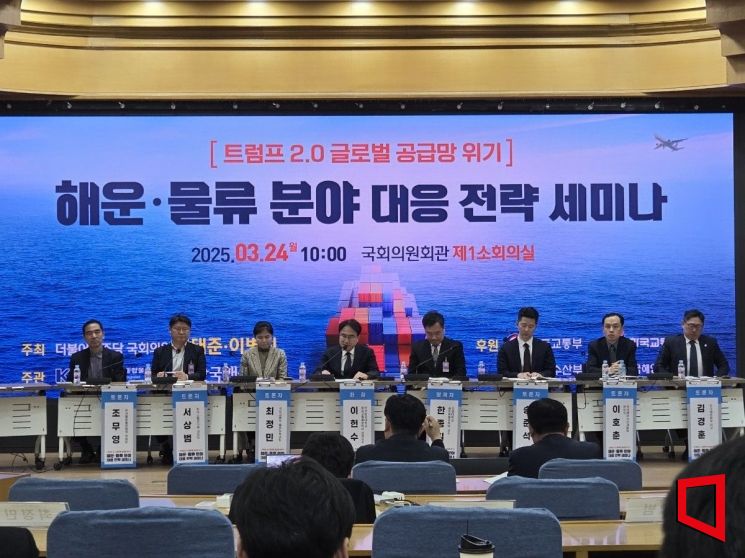 On the 24th, panelists are presenting at the 'Trump 2.0 Global Supply Chain Crisis, Shipping and Logistics Sector Response Strategy Seminar' held at the National Assembly Members' Office Building in Yeouido, Seoul. Photo by Noh Kyung-jo
On the 24th, Choi Jeong-min, Director of the Logistics Policy Division at the Ministry of Land, Infrastructure and Transport, stated at the "Trump 2.0 Global Supply Chain Crisis, Shipping and Logistics Sector Response Strategy Seminar" held at the National Assembly Members' Office Building in Yeouido, Seoul, "We will consider various support measures to help domestic third-party logistics companies secure competitiveness."
The domestic logistics market is primarily formed around second-party logistics (2PL), where the main clients are parent or affiliated companies. Representative 2PL companies include Hyundai Glovis and Samsung Electronics Logistics. Although third-party logistics, entrusted to specialized logistics companies such as CJ Logistics and LX Pantos, has grown in scale, it remains relatively low compared to the United States and Japan.
Han Jong-gil, a professor in the Department of Global Logistics at Sungkyul University and a presenter at the seminar, emphasized, "The Trump administration is attempting to decouple the global shipping market into U.S.-centered shipping and shipping related to China. To respond to this, third-party logistics companies with international competitiveness must emerge quickly."
Professor Han cited Japan as an example, saying, "In the 1960s, manufacturers like Sony and Toyota, which had second-party logistics companies, gradually made efforts to convert them into third-party logistics companies. We need similar efforts."
He also mentioned the need to consolidate the fragmented logistics companies. As of 2023, South Korea has 5,221 logistics companies, more than nine times the number in Japan (554 companies), but only two Korean companies (2PL) are among the global top 50 logistics companies, compared to six Japanese companies (3PL).
Professor Han suggested, "South Korea has an excessively large number of operators relative to the size of the logistics market. The international logistics brokerage industry should be shifted from a registration system to a licensing system, and jurisdiction should be transferred from local governments to the central government."
In the subsequent discussion, Cho Moo-young, Vice Chairman of the Korea Integrated Logistics Association, also stressed the importance of third-party logistics. Vice Chairman Cho said, "In a closed structure where first-party logistics (1PL) or second-party logistics account for more than two-thirds of the total, it is impossible to secure volumes competitive with global logistics companies like UPS and DHL. Third-party logistics must be activated through policy support."
He added, "An environment should be created where companies feel it is more advantageous to entrust logistics to specialized firms. This requires establishing a new industry category for third-party logistics, strengthening tax credits for logistics outsourcing costs, conducting statistical surveys on third-party logistics, and introducing government financial support."
The government stated that it cannot forcibly restructure the market. However, to clearly understand market conditions before institutional improvements, it plans to subdivide statistical surveys and conduct studies for administrative and financial support. Director Choi said, "There are many small logistics companies, and it is difficult to force mergers and acquisitions (M&A). The Ministry of Land, Infrastructure and Transport will reflect the activation and support measures for international logistics brokerage in the 'National Logistics Basic Plan' every ten years based on proper market analysis."
The Ministry of Oceans and Fisheries is strengthening cooperation between shipowners and cargo owners. Kim Seung-ryong, head of the Shipping Market Order Team at the Ministry of Oceans and Fisheries, said, "We are reducing dependence on North American routes and providing corporate tax reductions to excellent shipowner-cargo owner companies to encourage the development of new routes. This system is set to expire at the end of this year, and we plan to revise and supplement it."
To be selected as an excellent shipowner-cargo owner company, the proportion of expenses paid to domestic shipping companies must be at least 40% of total maritime transportation costs. Since few companies meet this criterion, measures such as differentiating the ratio are being considered. The corporate tax reduction limit, currently only 1% of total expenses, will also be increased. Kim said, "This is a matter under the Restriction of Special Taxation Act, and we will actively propose it to the Ministry of Economy and Finance. We will strive to overcome global logistics disruptions."
© The Asia Business Daily(www.asiae.co.kr). All rights reserved.












