Busan to Begin Pilot Service in April, Full Operation in July
Deputy Mayor Lee Junseung: "Establishing Data-Driven Policies"
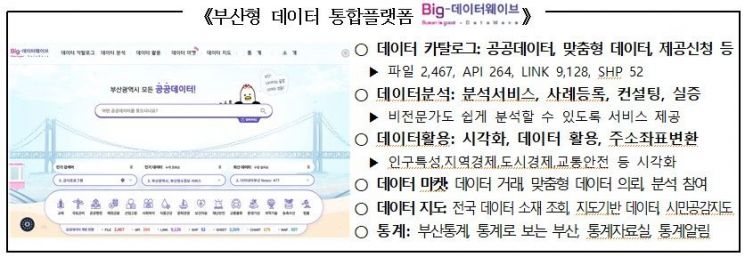
The Busan-type Data Integration Platform, which manages the entire lifecycle of public and private sector data in the Busan area, has been fully established.
The Busan Metropolitan City (Mayor Park Hyungjoon) held a completion report meeting for the "Busan-type Data Integration Platform Construction" on the morning of the 24th at the City Hall International Conference Room, aiming to lead data-driven administration and realize a digital economy city.
The city announced that the pilot service for this integrated platform will begin in April.
About 150 people attended the report meeting, including advisory committee members from specialized fields, representatives of public-private data councils from various industries such as finance, real estate, and tourism, Lee Junseung, Deputy Mayor for Administrative Affairs of Busan, and working-level officials from related organizations. The event was conducted in the order of ▲project completion report ▲utilization and development plans ▲expert opinions ▲Q&A session.
The Busan-type Data Integration Platform project was promoted to collect and integrate scattered public and private data, manage the entire data lifecycle, create data economic value through data analysis and utilization, and establish scientific policies.
Launched in August 2023, the first phase of the project completed the construction of the "Big-DataWave" portal by August 2024, providing services such as data opening, analysis/visualization, and data utilization.
The second phase, which includes the Data Market, Integrated Data Map, and demonstration project services (ShowMeTheBusan, Employment Mobility Change), will begin pilot operation in April and be fully operational from July.
Through this project, Busan City has promoted ▲the establishment of a data sharing and utilization portal (Big-DataWave) ▲data collection (about 145,000 cases) ▲construction of analysis and visualization services available to all citizens ▲provision of an integrated data map for easy access to nationwide data ▲operation of a Data Market to vitalize private data distribution ▲establishment of a dashboard for data demonstration cases.
A "Data Market" was established where private data supply and demand companies can participate, distribute, and trade their data to create value. Once data products available for transaction are registered by companies, full-scale operation is scheduled to begin in July.
The "Integrated Data Map" service provides information on the location of data held by local governments and the Ministry of the Interior and Safety nationwide at a glance, linking and providing about 130,000 pieces of national data meta-information.
As a demonstration case showing the necessity of data analysis and utilization, key policies and economic trends have been analyzed and visualized from the citizens' perspective. Big data-based citizen interest analysis on 2024 key keywords and news, monitoring of seafood distribution volume in Busan, and analysis of seafood price fluctuations are being provided as a comprehensive big data-based seafood distribution monitoring service.
This year, services will be provided for ShowMeTheBusan, which gives an overview of population, consumption, income, prices, industry, finance, and housing in Busan, as well as an employment mobility change analysis dashboard that tracks employment trends, including the employed, economically inactive population, and employment mobility.
Busan City plans to continuously promote education, linked projects, data ecosystem creation, and publicity to vitalize the Busan-type Data Integration Platform Big-DataWave.
In addition, the city will expand various analysis demonstration and visualization cases and promote training for public officials to foster data talent, thereby strengthening analysis and utilization capabilities. Collaboration will be pursued with the Big Data Innovation Center project of Busan Technopark, public and big data utilization startup competitions, and DataWeek events to enhance platform usability.
The public-private data council (9 in 2024, about 20 in 2025) will be expanded, and the data ecosystem will be fostered by registering data market products and participating in trading and distribution. The city also plans to actively cooperate in promoting public-private collaboration projects.
Busan City will hold a citizen participation event in April to promote the completion of the Busan-type Data Platform and improve services tailored to different user groups. Through feedback and citizen satisfaction events, the city aims to stabilize the system and enhance user convenience by collecting various opinions, with participation available through a survey on the city’s website.
Lee Junseung, Deputy Mayor for Administrative Affairs of Busan, said, "Through the establishment of the Busan-type Data Integration Platform, we will contribute to implementing scientific, data-driven municipal administration, expanding the local data industry ecosystem, and driving innovative growth in the digital economy." He added, "We will strengthen the competitiveness of the digital economy city by establishing data-driven municipal policies and revitalizing the local data industry."
© The Asia Business Daily(www.asiae.co.kr). All rights reserved.












